The Surplus Shuffle

It’s not a new dance. We did it last year and the year before that. The State of Florida, through its agency the Department of Education, calls the tune every July as it insists, through its governing body the State Board of Education, that public schools that have run afoul of its requirements for improvement must implement the predetermined plan proposed by the school district and approved by the State Board.

Even more, any school in turnaround status (in Duval, that is 21 schools, two of which must be turned over to an outside management company), must make staff changes based upon the Spring FSA results and the resulting VAM scores.

Thus, it is time for the 2018 Surplus Shuffle, when two weeks before teachers return for the new school year, they are informed that they will be moved to another school. Who shuffles in behind them? With less than a week to go before the teachers in the turnaround schools are mandated to begin work (because their turnaround status means that they must start work August 1 for additional training and preparation), the district has yet to learn who the surplused teachers will be.

What are the consequences of these actions and this timeline?

Grumpy Old Teacher has the following questions:

  1. What subject areas and years are under the surplus mandate? (Is it only FSA subjects, that is, only ELA/Reading grades 3 – 10, Math grades 3-8, and Algebra 1? These are the only subjects/areas where the State provides a VAM score.)
  2. If the surplus includes other subject areas, how will teacher data scores be determined? Does the district report district test results to the state to allow the state to run the data through its VAM model? Does the district have access to the state VAM model and do its own calculations?
  3. Given that Superintendent Greene and Duval County put in its plan for the two schools now under new management that they would replace the surplus teachers with only effective or highly effective teachers, as determined by the VAM/student growth scores only, how do they plan to induce such teachers to transfer at this time? Financial incentives? Administrative transfer, in which other teachers will be informed the district has changed their assignment?
  4. Because the district had not learned from the state as of Thursday, July 25 who the affected teachers are, yet the staff has to report for preplanning Wednesday, August 1 (less than a week), what is the plan for covering the affected positions until the transfers are in place?
  5. If the three extra days of preplanning are essential for the success of the turnaround schools, how will the schools bring new teachers up-to-speed given that it is almost impossible to have all personnel in place by Wednesday?
  6. Given the timeline between identifying surplus teachers and the date when new personnel should be in place, what efforts does the district make to anticipate the possible moves it has to make? Does it identify persons for transfer in the Spring, meet with them, and come to an agreement that they will move if needed?


We have seen this before. Florida school districts must comply under regulations set by the Department of Education and approved by the State Board of Education, who themselves are only implementing to the best of their abilities the policy mandates written into law by the Florida legislature.

That reasonable persons, looking at the process and its timeline, wonder exactly who thinks this is going to work is a question that readers should direct to their Florida senators, representatives, and governor.

7. What makes you think that this process will produce improved schools? Cite evidence, included peer-reviewed research by educational experts, that led you to the policy prescriptions you placed into law regarding ‘failing schools,’ including the controversial ‘Schools of Hope’ that you created in the 2017 education bill known as H.B. 7069.

By the way, peer-reviewed research does not mean you read a book by a self-designated reformer.
Devil in the Grove

(Gilbert King, HarperCollins Publishers, 2012. ISBN 978-0-06-179228-1)

An unvarnished look at actual Florida history, Devil in the Grove will not be an easy read as it tells the story of four black men accused of raping a white woman (only two of whom had even interacted with the young woman and her husband on that fateful night in July 1949) in Lake County, Florida, a county located to the immediate northwest of Orange County and in the center part of the state, a part resistant to the end to the orders of the U.S. Supreme Court to end segregation.

Spoiler alert: There are no spoiler alerts. This is a story that the author cannot control. He can’t direct the plot away from the sympathetic characters because they don’t deserve their fate. The events really happened and the book will grip you as it takes you through what happened in Lake County against the larger backdrop of the action of the NAACP and its Legal Defense Fund headed by Thurgood Marshall.

It is a story of abusive law enforcement and the way it terrorized people of color in the county, a story of power among the citrus growers and their need for cheap labor, a story of how segregation recreated a system of forced labor after the 13th amendment outlawed slavery, and a story of what happens to those who protest.

Lest you scratch your head in wonder, that you thought the real evil was in the Deep South (and there was real evil there) states of Mississippi, Alabama, Georgia, and South Carolina, that Florida being ‘south of the South,’ was nothing like them, you might be right in a twisted way: “From 1882 to 1930, Florida recorded more lynchings of black people (266) than any other state, and from 1900 to 1930, a per capita lynching rate twice that of Mississippi, Georgia, or Louisiana.” (pages 169 & 170.)

There was no rape. In describing the events against the larger national backdrop of the NAACP’s legal strategies, the reader gathers a good sense of the times, the struggles, the chaos, the fears, the terror, and the hope that were part of daily life in the South (“Lawyer Marshall is coming”), and the author then personifies those feelings and experiences in the story about Lake County, where the sheriff exercised tyrannical power to the point that people lied for him out of fear for their own lives and that in turn empowered him to be a law unto himself.

Read the book if you don’t understand #blacklivesmatter and why it is the height of stupidity to protest, “But #alllivesmatter.”

Read the book if you think those times are far in the past and we’re better now and we would never acquiesce in the worst violations of human rights.

Read the book and think about those red MAGA hats and what people really want. Fascism and National Socialism (yes, the Hitler and the German Nazis were socialists) will not take root here, but we have our own dark past yearning to break free because we haven’t ever really dealt with it.

No spoiler alert is needed because you know how the story turned out. While the NAACP was successful in overturning the original convictions, the U.S. Supreme Court ordered a new trial. The sheriff collected the two defendants at Raiford (Florida State Prison where death sentences are carried out) and, on the way back to Lake County, was successful in murdering one. The other defendant played dead and survived two bullets from the sheriff and a third shot through his neck by a deputy.

The survivor was reconvicted but received a life sentence that was later commuted. One year after the commutation, he received permission to go back to Lake County to attend the funeral of his uncle. He was found dead within a few hours of his return to Lake County.

If you want to know why I am talking about this book in my new education blog, it is this: this book should be required reading in every U.S. History high school classroom in Florida.

Postscript:

As for me, Devil in the Grove is a cautionary tale about politicians and the power they wield in this state. The politicians who a generation ago would be protecting and enabling the Lake County sheriff, recognizing no bounds on their power and their desire to enrich themselves by it and the exploitation of the vulnerable and poor, these are the ones who have targeted public education for destruction in this state.

They hold the power and will tolerate no dissent. As I am a dissenter, this book is a cautionary tale about the risks of fighting back against the privatization schemes such as those manifested in the so-called Schools of Hope.

Scrubbing

I am interrupting my review of the book, The Testing Charade (Daniel Koretz, 2017) to address something taking place in Florida with the release of school grades. And yet, I am going to use the book to talk about it: scrubbing, that is, the practice of removing students not likely to score well from a test’s population.

“The method of choice was to exclude from testing students who were likely to score poorly, a technique that is often called ‘scrubbing’ because it entails removing the worrisome students from enrollment rolls.” (The Testing Charade, Daniel Koretz, page 74.)

In the early days of testing, this was easy to do. Tell the questionable students to stay home until the testing window closed. Suspend the misbehaving students. By whatever means, keep them off school property until testing was done.

States counteracted this by setting minimum percentages of students who must test, usually 95%.

Schools reacted by disenrolling the worrisome students and then re-enrolling them once the test window closed. They utilized school choice (an ironic twist) to counsel low-performing students to leave for charter schools or other options such as homeschooling. Charters play the same game, of course, and counsel out low-performers to return to their traditional schools.

Scrubbing is real and it’s wrong. Other forms entail schools and districts devising means to maneuver students around tested courses. For example, until Florida discontinued the Algebra 2 End-of-Course exam, districts began scheduling students with poor Geometry performance into a course called ‘Advanced Topics’ so that they could bypass Algebra 2 on their way to amassing the required math credits for their diplomas.

The state was complicit in this because, unless the state created an approved course in its catalog, the dodge course would not have been available to districts.

Districts also reviewed their mid-year benchmark tests for Algebra 1. Students scoring lower than what projected to a passing grade on that EOC were rescheduled into Algebra 1A so they would not have to take the exam. (In this instance, though, the state had the schools by the throat; passing the Algebra 1 EOC is a diploma requirement and sooner or later, students have to pass it.)

The same goes on with graduation rates. Schools routinely refer students not on track to graduate to leave the school and enroll in other programs to complete their education and receive their diplomas.

Campbell’s Law rearing its hydra-like heads; cut one off and three more grow in its place.

“‘The more any quantitative social indicator is used for social decision making, the more subject it will be to corruption pressures and the more apt it will be to distort and corrupt the social processes it is intended to monitor.’ In other words, when you hold people accountable using a numerical measure–vehicle emissions, scores on a test, whatever–two things generally happen: they do things you don’t want them to do, and the measure itself becomes inflated …” (Koretz, page 38.)

Now to the controversy of the week. A conservative school board group, which may be composed of as few as five members, have questioned the Civics EOC results in three Florida districts: Duval, Polk, and Manatee Counties. Conservative School Board Group Questions Civics Results in 3 Counties

Soon thereafter, six lawmakers weighed in to demand an investigation. Here is the text of their letter:

Dear Commissioner Stewart:

It has come to our attention that allegations have been raised regarding Duval, Manatee and Polk County school districts potentially undermining the integrity of our state’s public school accountability system through employing questionable testing practices on the state end-of-course exam in civics. 

While we should all celebrate increases in student achievement, particularly in civics, we must ensure the results are earned with integrity. Otherwise, as we are sure you would agree, we are doing a complete disservice to our children.

As reported by multiple Jacksonville media outlets, the districts are accused of restricting certain students from participating in the state end-of-course civics exam in an effort to artificially inflate their final school grades. Not only are these allegations alarming, but we are fearful there may be other districts engaging in these same shameful practices. 

As parents of public school students and taxpayers, we share skepticism of the three counties’ testing practices with the public, and now we want to know more. In the interest of transparency of our public education system and the children it serves, we have the following questions for these districts and for your department:

1.                Were any students enrolled in a civics course during the 2017-18 school year prevented by any of these districts from taking the required Civics End-Of-Course exam? 

2.                When and how was it determined which students would sit for the exam and which ones would not? 

3.                Who at the district level made this determination?

4.                Some schools are employing these dishonest tactics specifically to game the school grading system, especially those schools seeking to avoid the implications of the Schools of Hope interventions. Others do it to unscrupulously collect school improvement funds every other year, while student achievement never actually improves. How will manipulation of the system and avoidance of accountability be addressed by your department?

5.                Are there ways FLDOE could penalize a school or district found guilty of these tactics by lowering its final grade and/or withholding any school grade improvement funding?

Upon receipt of your answers, we plan to work with you, your colleagues at the Florida Department of Education, the governor and our legislative colleagues to review and improve existing state testing policies to ensure these dishonest and unethical practices do not happen again. 

Florida’s public schools have improved more than any other state in the last 20 years due in large part to A-F school grading and the transparency it brings to parents, taxpayers and the public. However, we will not see sustained growth if certain adults running the system are more committed to their own interests than the interests of the students they serve. 

We look forward to your response and appreciate your leadership and immediate attention to this matter. (Source: The Tampa Bay Times, use the link above to confirm.)

Take a good look at item 4 and the unfounded accusations thrown out with no supporting evidence.

We must ask ourselves: did the three districts and possibly others engage in scrubbing?

The answer is NO. They did not game the system by removing students in ways such that the students would never be tested. They did determine that many students needed more preparation in their studies and arranged their schedules accordingly.

Every 7th grade student who did not take the Civics EOC this year will take it next year as an 8th grade student.

The Florida Department of Education has already acknowledged that this is allowable by the law. Students must take the Civics EOC at some time during their years in middle school. The exact grade level is not specified.

Ya know, in the education biz, we call this differentiation of instruction to meet every student’s needs. Too bad we have lawmakers in Florida ignorant of the concept, even if they once served as a school board member.

The Testing Charade, Part Two

“In other words, when you hold people accountable using a numerical measure–vehicle emissions, scores on a test, whatever–two things generally happen: they do things you don’t want them to do, and the measure itself becomes inflated, painting too optimistic a view of whatever it is that the system is supposed to measure.” (Koretz, page 38.)

Inflated scores is not a problem limited to education. Koretz takes pains to demonstrate how it permeates any endeavor where too much focus is placed upon a score. He describes how British hospital emergency rooms were scored on how quickly they saw newly arriving patients, but the response was anything but good. Some hospitals hit their target by queueing the ambulances in the parking lot and not allowing people to be brought in until they could see them!

In other cases, hospitals were scored on how long it took to admit ER patients to the building. They got around that by declaring a gurney in the hall a hospital bed and patients lined the hallways as no rooms were available.

We haven’t been immune to that in the U.S. When New York began publishing mortality rates for cardiac patients, many physicians refused to treat the most seriously endangered patients.

When the target becomes the measure, it distorts the behavior of the people involved and it produces undesired outcomes.

This is known as Campbell’s Law and it rears up anywhere numerical measures are used to judge the performance of people. Decision-making inevitably skews towards whatever will make the number better.

As in education. Koretz shows how the results of high-stakes tests do not match those of low-stakes tests. He demonstrates how the dramatic improvement in 8th grade math scores in New York is not confirmed by the little improvement in the same grade on the NAEP scores. New York is not alone. The phenomena of state tests showing increasing gains while low-stakes tests do not is widespread and has been going on for decades.

What makes the difference? In the case of New York, the one area NAEP showed increases was algebraic thinking. Not coincidentally, that is the area heavily emphasized on the New York state test. That is the area, therefore, that teachers focused on to the detriment of the rest of mathematical content.

Koretz documents the reluctance of states and school districts to allow researchers to study this. It seems they simply do not want to find evidence that the proclaimed success stories, the gains in learning, are an illusion.

Why do scores inflate? Whenever a new test is introduced, scores drop. But as time goes on, scores move upward as teachers become more familiar with what is being tested and how it is being tested. As a result, they are better able to predict what students will see and prepare them to be successful.

The predictability of the test items is a large factor in inflating scores. Teachers can ignore what is not being tested; teachers can give students strategies to recognize test questions and answer them correctly whether or not the students actually know what to do.

In other words, because the tests are predictable, teachers are able to teach to the test and ignore the rest.

Why would they do that? Even ignoring VAM measurements and the career-ending and maybe life-destroying consequences of not focusing on getting the highest scores possible, the unrelenting pressure on teachers, administrators, and schools pushes them to make test scores the purpose of education. Good scores? Golden. Bad scores? Gehenna for you! The pressure began before VAM became the vogue among policymakers.

Few can withstand it. Koretz discusses cheating in Chapter Six, a chapter he allowed a colleague to write and share. The mentioned scandals are well-known. What is interesting is that, in passing the chapter to someone else, he subtly undermines it as a chief concern. Yes, cheating is wrong and yes, cheating should be stopped. Cheating should be punished. But even if all the cheating ends, test results will still be corrupted and we will still have a false picture of school improvement.

Next: Test prep, good and bad, unrealistic targets, the sham of Vam and the Common Core.

The Testing Charade, Part One

“It’s no exaggeration to say that the costs of test-based accountability have been huge. Instruction has been corrupted on a broad scale. Large amounts of instructional time are now siphoned off into test-prep activities that at best waste time and at worst defraud students and their parents. Cheating has become widespread. The public has been deceived into thinking that achievement has dramatically improved and that achievement gaps have narrowed.” (Daniel Koretz, page 191.)

This a book that denounces test-based accountability systems for schools and explains why the system used in the United States does not work, gives a misleading picture of rising student outcomes, and is irrational and unworkable when used to evaluate educators and schools.

As I write this, school grades, based mostly on test scores, have been issued for the state of Florida. Typical of the crowing over improving results are statements like these:

“We continue to improve and move forward,” said Superintendent Dr. Patricia Willis [Duval County Public Schools]. “Duval is like a team that wins a few more games each year, and each year we get closer to the championship. This is a district improving student outcomes every year … But seeing the improvement overall in the district tells the public that Duval County Public Schools is on the right path overall.” (Source: duvalschools.org)

Superintendent Alberto Carvalho saw an immediate justification for the tax increase. He announced during the meeting that school grades were released by the state and Miami-Dade was an A-rated district, one of only two in the state. “The news could not have come at a better time,” Carvalho said. “When I say the performance justifies it, Miami Dade Public Schools has justified their return on investment.” (Source: Miami-Herald newspaper.)

Gov. Rick Scott touted the results in a press release. “Our years of historic investment in Florida’s K-12 education system are paying off,” Scott said. “The ability to get a great public education empowers our students to live their dreams in Florida. This is why since 2011 funding for Florida’s K-12 public schools has increased by $4.5 billion.” (Source: The Tampa Bay Times newspaper.)

To which Daniel Koretz says foolishness. Improving scores are not the result of better schools, instruction, or leadership from the state; they are the result of score inflation, cheating, and poor instructional practices that focus on test-preparation instead of actual learning.

Testing alone is incapable of determining all the learning that should be taking place. At best, a test is a sampling of all the content in a domain, that is to say, a subject area. A test does not cover it all and therefore can only pretend to present an idea of how well the entire domain was taught.

Testing as done now is more limited than that. Current testing only samples two areas each year, reading and math, yet the resulting scores are used to draw conclusions about student’s learning in all subjects, including physical education and the arts.

Testing has the further problem that some types of learning are not measured by the format constraints of a standardized test.

Yet upon these scores alone we determine the performance of our entire educational systems.

Foolishness. “The core logic of reform has been to treat a small number of test scores, either alone or with minor additions, as an adequate measure of school reform.” (Page 18.)

What reform has done, through its sole reliance on testing to measure results (Grumpy Old Teacher now talking) is to cause our school systems to focus on the needs of adults rather than students. We sit in meeting after meeting reviewing test scores, talking about how to increase them, worrying about our school enrollment and that sweet, sweet juice known as school recognition bonuses if our grade falls, agonizing over how our evaluation will turn out because a significant portion is based on test scores, and complaining about how terrible the system is for us. We focus on our needs and assume that our students’ needs are the same.

Next: Part Two, Campbell’s Law, what inflates test scores, and how you can know.

E + L = DEW

Many teachers would say, “And that rhymes with eww!” in reaction to the announcement that the executive branch of the federal government proposes to merge the Departments of Education and Labor into a single department to be known as the Department of Education and Workforce.

Today I don’t want to opine about the consolidation move, but to note that it is part of a greater effort to reorganize government. I am reading through the report, but for a start, quoting from the report, these are the proposals:

MISSION ALIGNMENT IMPERATIVES A. Organizational Realignments to Enhance Mission and Service Delivery
1. Merge the Departments of Education and Labor into a single Cabinet agency, the Department of Education and the Workforce, charged with meeting the needs of American students and workers from education and skill development to workplace protection to retirement security. As part of the merger, the Administration also proposes significant Government-wide workforce development program consolidations, streamlining separate programs in order to increase efficiencies and better serve American workers.
2. Move the non-commodity nutrition assistance programs currently in the U.S. Department of Agriculture’s (USDA) Food and Nutrition Service into the Department of Health and Human Services—which will be renamed the Department of Health and Public Welfare.
Also, establish a Council on Public Assistance, comprised of all agencies that administer public benefits, with statutory authority to set cross-program policies including uniform work requirements.
3. Move the Army Corps of Engineers (Corps) Civil Works out of the Department of Defense (DOD) to the Department of Transportation (DOT) and Department of the Interior (DOI) to consolidate and align the Corps’ civil works missions with these agencies.
4. Reorganize the USDA’s Food Safety and Inspection Service and the food safety functions of HHS’s Food and Drug Administration (FDA) into a single agency within USDA that would cover virtually all the foods Americans eat.
5. Move USDA’s rural housing loan guarantee and rental assistance programs to the Department of Housing and Urban Development (HUD), allowing both agencies to focus on their core missions and, over time, further align the Federal Government’s role in housing policy.
6. Merge the Department of Commerce’s (Commerce) National Marine Fisheries Service with DOI’s Fish and Wildlife Service. This merger would consolidate the administration of the Endangered Species Act and Marine Mammal Protection Act in one agency and combine the Services’ science and management capacity, resulting in more consistent Federal fisheries and wildlife policy and improved service to stakeholders and the public, particularly on infrastructure permitting.
7. Consolidate portions of DOI’s Central Hazardous Materials Program and USDA’s Hazardous Materials Management program into the Environmental Protection Agency’s (EPA) Superfund program. This consolidation would allow EPA to address environmental cleanup under the Comprehensive Environmental Response Compensation & Liability Act (CERCLA) on Federal land regardless of which of these agencies manages the land, while DOI and USDA would maintain their existing environmental compliance, bonding, and reclamation programs for non-CERCLA sites.

8. Optimize Department of State (State) and U.S. Agency for International Development (USAID) humanitarian assistance to eliminate duplication of efforts and fragmentation of decision-making. A specific reorganization proposal will be submitted by State and USAID to OMB as part of their FY 2020 Budget request to improve the efficiency and effectiveness of the Federal Government’s humanitarian assistance across State and USAID, establish unity of voice and policy, and optimize outreach to other donors to increase burden-sharing and drive reform at the UN and in multilateral humanitarian policy.
9. Consolidate the U.S. Government’s development finance tools, such as the Overseas Private Investment Corporation (OPIC) and the Development Credit Authority (DCA) of USAID, into a new Development Finance Institution in a reformed and modernized way to leverage more private- sector investment, provide strong alternatives to state-directed initiatives, create more innovative vehicles to open and expand markets for U.S. firms, and enhance protections for U.S. taxpayers.
10. Transform USAID through an extensive, agency-driven structural reorganization of headquarters Bureaus and Independent Offices as a foundational component of USAID’s overall plans to better advance partner countries’ self-reliance, support U.S. national security, and ensure the effectiveness and efficiency of foreign assistance.
11. Move the policy function of the Office of Personnel Management (OPM) into the Executive Office of the President, and elevate its core strategic mission while devolving certain operational activities –
the delivery of various fee-for-service human resources, IT services, and background investigations – to other Federal entities better aligned to provide non-strategic transaction processing services that meet 21st Century needs. This new structure would better accommodate an overhaul of the Federal civil service statutory and regulatory framework.
12. Transfer responsibility for perpetual care and operation of select military and veteran cemeteries located on DOD installations to the Department of Veterans Affairs’ National Cemetery Administration. This transfer assures these cemeteries will be maintained to national shrine standards to continue the recognition of service of those interred therein, gains efficiencies, and limits mission overlap based on a common-sense approach to good government.
13. Reorganize the U.S. Census Bureau, the Bureau of Economic Analysis, and the Bureau of Labor Statistics under Commerce to increase cost-effectiveness and improve data quality while simultaneously reducing respondent burden on businesses and the public. Together, these three agencies account for 53 percent of the U.S. Statistical System’s annual budget of $2.26 billion and share unique synergies in their collection of economic and demographic data and analysis of key national indicators.
14. Consolidate the Department of Energy’s (DOE) applied energy programs into a new Office of Energy Innovation in order to maximize the benefits of energy research and development and to enable quicker adaptation to the Nation’s changing energy technology needs.

B. Changes to Refocus, Reduce, or Expand the Mission
15. Devolution of Activities from the Federal Government a) Sell the transmission assets owned and operated by the Tennessee Valley Authority and the Power Marketing Administrations within DOE, including those of Southwestern Power Administration, Western Area Power Administration, and Bonneville Power Administration, to encourage a more efficient allocation of economic resources and mitigate unnecessary risk to taxpayers.
b) Restructure the U.S. Postal System to return it to a sustainable business model or prepare it for future conversion from a Government agency into a privately-held corporation. The President’s Task Force on the United States Postal System will make recommendations on reforms towards this goal in August 2018.
c) Reorganize DOT to better align the agency’s core missions and programmatic responsibilities, reduce transportation program fragmentation across the Government, and improve outcomes. Changes would include spinning off Federal responsibility for operating air traffic control services, integrating into DOT certain coastal and inland waterways commercial navigation activities and transportation security programs, and reassessing the structure and responsibilities of DOT’s Office of the Secretary.
16. Transform the way the Federal Government delivers support for the U.S. housing finance system to ensure more transparency and accountability to taxpayers, and to minimize the risk of taxpayer-funded bailouts, while maintaining responsible and sustainable support for homeowners. Proposed changes, which would require broader policy and legislative reforms beyond restructuring Federal agencies and programs, include ending the conservatorship of Fannie Mae and Freddie Mac, reducing their role in the housing market, and providing an explicit, limited Federal backstop that is on-budget and apart from the Federal support for low- and moderate-income homebuyers.
17. Rethink how the Federal Government can drive economic growth in concert with private-sector investments in communities across the Nation by coordinating and consolidating Federal economic assistance resources into a Bureau of Economic Growth at Commerce, producing a higher return on taxpayer investment on projects that are transparent and accountable.
18. Transform the U.S. Public Health Service Commissioned Corps into a leaner and more efficient organization that is better prepared to respond to public health emergencies and provide vital health services, including by reducing the size of the Corps and building up a Reserve Corps for response in public health emergencies.
MANAGEMENT IMPROVEMENT AND EFFICIENCY OPPORTUNITIES 19. Establish an accelerated process for determining whether one or more of the National Aeronautics and Space Administration’s (NASA) Centers should be converted to, or host, a Federally Funded Research and Development Center (FFRDC). FFRDCs can potentially allow the agency to be more agile in rapidly responding to changing needs and in recruiting and retaining scientific and technical expertise.
20. Consolidate the administration of graduate fellowships for multiple Federal agencies under the National Science Foundation in order to reduce the total cost of administering those fellowships.
21. Optimize the Federal real property footprint by making smart investments in renovations and new facilities, driving down lease costs, and disposing of unneeded real estate through a streamlined process that results in the greatest return to the taxpayer.
22. Consolidate and streamline financial education and literacy programs currently operating across more than 20 Federal agencies to ensure effective allocation of Federal financial literacy resources and avoid unneeded overlap and duplication.
23. Strengthen the Small Business Administration (SBA) as the voice of small business within the Government by consolidating small business focused guaranteed lending and Federal contracting certification programs at SBA.

24. Consolidate protective details at certain civilian Executive Branch agencies under the U.S. Marshals Service in order to more effectively and efficiently monitor and respond to potential threats. Threat assessments would be conducted with support from the U.S. Secret Service.
25. Consolidate the small grants functions, expertise, and grantmaking from the Inter-American Foundation and U.S. African Development Foundation into USAID beginning in FY 2019. The consolidation would be a significant step to reduce the proliferation of Federal international affairs agencies that are operating today, while also elevating community-led, “local works” small grants as a development and diplomacy tool for the U.S. Government.
26. Transition Federal agencies’ business processes and recordkeeping to a fully electronic environment, and end the National Archives and Records Administration’s acceptance of paper records by December 31, 2022. This would improve agencies’ efficiency, effectiveness, and responsiveness to citizens by converting paper-based processes to electronic workflows, expanding online services, and enhancing management of Government records, data, and information.
TRANSFORMATION URGENCY – NEW CAPABILITY REQUIREMENTS 27. Transform the way Americans interact with the Federal Government by establishing a Government-wide customer experience improvement capability to partner with Federal agencies to help them provide a modern, streamlined, and customer-centric experience for citizens, businesses, and other customers, comparable to leading private- sector organizations.
28. Pursue a Next Generation (Next Gen) Financial Services Environment as a new approach to Federal Student Aid (FSA) processing and servicing with a modernized, innovative, and integrated architecture. Next Gen will save taxpayers millions of dollars and will create an improved, world-class customer experience for FSA’s more than 42 million customers, while creating a more agile and streamlined operating model.
29. Solve the Federal cybersecurity workforce shortage by establishing a unified cyber workforce capability across the civilian enterprise, working through DHS and OMB in coordination with all Federal departments and agencies. The Administration will work towards a standardized approach to Federal cybersecurity personnel, ensuring Government-wide visibility into talent gaps, as well as unified solutions to fill those gaps in a timely and prioritized manner.
30. Establish a Government Effectiveness Advanced Research (GEAR) Center as a public-private partnership to help the Government respond to innovative technologies, business practices, and research findings that present opportunities to improve mission delivery, services to citizens, and stewardship of public resources.
31. Transfer the National Background Investigations Bureau from OPM to DOD, providing the opportunity to achieve an efficient, effective, fiscally viable, and secure operation that meets all agencies’ needs.
32. Expand upon existing agency evaluation capabilities and push agencies to adopt stronger practices that would generate more evidence about what works and what needs improvement in order to inform mission-critical decisions and policies. These changes will help to address the large gaps and inconsistencies across Government in Federal agencies’ ability to formally evaluate their programs.

There is much to digest. If you want to look at the entire report, here is the link: https://www.whitehouse.gov/wp-content/uploads/2018/06/Government-Reform-and-Reorg-Plan.pdf

While this extends beyond education, more than one proposal affects children in schools and so, at times, it is appropriate for sites devoted to educational issues to take a broader look.

Data for The National Conversation about Teachers’ Salaries

I’m going to post the source first (date: October 2015).

Click to access Teacher-Salary-Chart.pdf

But I’ll save you the trouble of looking it up:

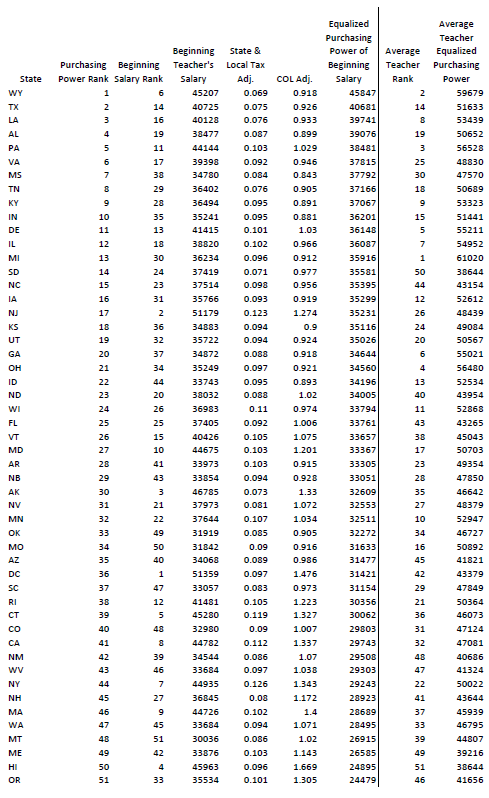
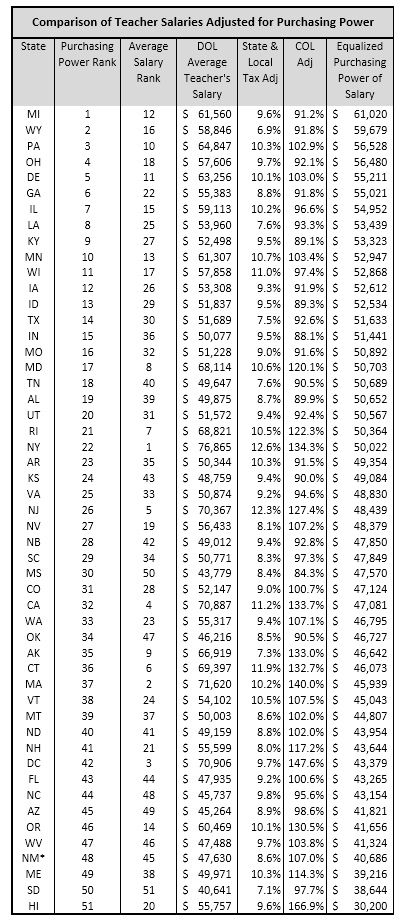
tchr salary

Here at the bottom we see the usual suspects: Florida, North Carolina, West Virginia. Remember this is a ranking of average salary adjusted for the cost of living in the state.

Let’s run the same analysis with starting teachers’ salaries. (Source: https://articles.niche.com/teacher-salaries-in-america/) In case you’re wondering where they got their data, here are the sources the website cites:

Sources

NEA 2016-2017 Average Starting Salaries by State
NCES Estimated average salary of teachers in public elementary and secondary schools, by state, 2016-2017
NCES Average salaries for full-time teachers in public and private elementary and secondary schools, 2011-2012, which is the most current data available for both the public and private sector

For comparison, I combined the data for average teacher salary with that for beginning teacher salary. Feast your eyes on this:

tchrbegsalary

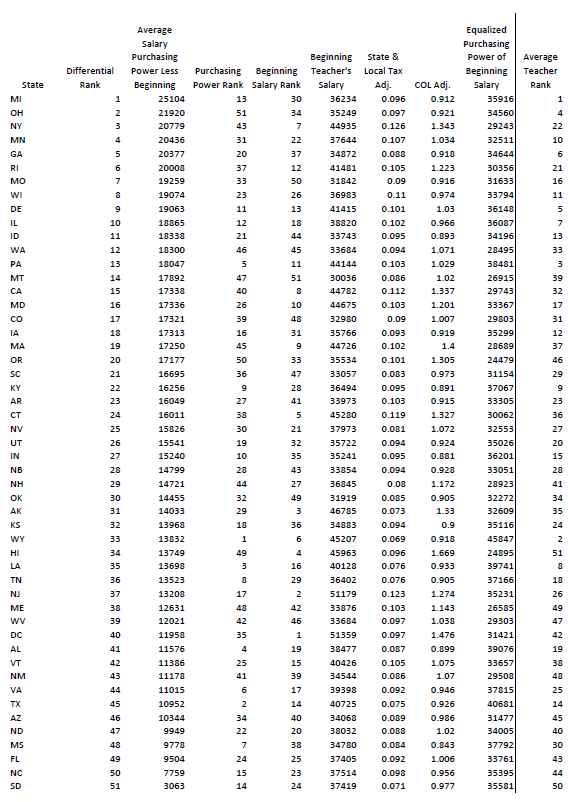
Just for funsies, let’s subtract the purchasing power of the beginning salary from that of the average salary to see where one might best invest a teaching career:

tchrsalavgvsbeg

My fellow Floridian teachers will not be surprised to learn that our state is one of the worst for potential earnings gains during a teacher career. We start in the middle, but fall to the bottom.

But Georgia, I live in Duval County so Georgia is a ‘meh,’ for getting started, but on the whole, with a some hours devoted to driving … South Florida teachers are not so lucky. They will have to uproot their families to improve their lot.

Do they need to? The devil is in the details as the saying goes. This data needs refinement and a breakdown into school district by school district, something beyond the abilities of one blogger sitting at home while on summer vacation.

Also, I looked for a report of the number of years it would take a beginning teacher to reach the average salary. No luck for that, nor for an attempt to find estimates of where a teacher would maximize career earnings.

But it is clear that Michigan, Ohio, Minnesota, New York, and Georgia are the best places for raises despite the starting salary while North Dakota, Mississippi, Florida, North Carolina, and South Dakota are the worst places to expect anything to get better.

A Lack of Candor, Duval Style

So the latest dust-up is the interim superintendent of schools not telling the board or the public that two of the people on the promotion list to principal were relatives: a son and a niece.

But this is nothing new. The last superintendent left us with a budget hole because he spent money he was sure would show up one day. From the wayback machine (only 13 months ago):

Board member Rebecca Couch said that the board approved [expenditures] because they were told that money was available in the budget for the expenditures. Turns out, that wasn’t always true, she said.


Before then, it was EPD laying up the federal largesse under President Obama’s stimulus bill for future needs while telling the board they needed to adopt a very unpopular pay-to-play policy for high school athletics. 

Let’s not get started on Joseph Wise, whose misrepresentations to the Board came to a crashing halt when he published a letter in the newspaper telling a Board member to resign.

Remember that? It was the same Board member who made a habit of writing down everything he said at Board meetings and later calling him out when he tried to deny it.

Oh, people, what is it in the water at 1701 Prudential Drive?

There is a pattern to the superintendent/Board relationship in the county. Let us hope that with new people coming to the board via November elections and the new superintendent, we will have a new beginning and this sorry pattern will be relegated to the dustbin where it belongs.

Seven Deadly Sins in Education: Sloth

Where are our FSA scores? (This post was going to be about politicians and their lack of effort in providing for accountability over public tax dollars they are sending to charter schools and private schools via vouchers, but I got diverted. I will get to it.)

Current speculation is that the Commissioner, Pam Stewart, will not release scores until June 30 under new statutory language enacted with the Florida law known as HB 7069. Here is what the language says (as provided by the legislative staff analysis):

The law requires that state assessment contracts entered into or renewed after April 14, 2015, must provide for a student’s performance on state assessments to be provided to the student’s teachers and parents by the end of the school year, unless the Commissioner of Education determines that extenuating circumstances exist and reports the circumstances to the SBE [State Board of Education]. The law also requires that assessment and reporting schedules must provide the earliest possible reporting of student assessment results to school districts.

Does the Commissioner know that Florida schools end their year weeks before the end of June?

Does the Commissioner know that many of these tests are worth 30% of a student’s course grade and that their report cards cannot be finalized and sent home until FSA scores are reported?

July is too late for students needing to enroll in a summer option because their FSA score caused them to fail a course.

A servant’s heart and a service-oriented attitude in an education commissioner would render these questions moot. She would know and she wouldn’t allow it to happen.

I see you, Pam Stewart, and I name you … SLOTH!

UPDATE: the statutory language gives cover. Thanks to Paula Suzanne, who ran it down for us: 34687254_10204681309868950_5349081428694925312_n

Seven Deadly Sins in Education: Greed

I stand corrected: the love of money is the root of all evil. And oh, how the testing companies and curriculum providers love them some money! By the way, if you haven’t noticed, they are one and the same.

Yep, when a school system is looking to adopt a new curriculum in a tested subject, they should look no further than the company that provides their state’s test. Does your state use PARCC? Then Pearson is the one for you.

Others are using a version of Smarter Balanced, for example, American Institutes of Research. Then the choice is McGraw-Hill.

Money! the fascination it holds on the human psyche. “Money is how we keep score,” said Betsy Devos.

How much money is involved? One estimate for New Jersey is $25.50 per child. In Washington state, it’s $30 per student. Other estimates run around $12 per test and students usually take two or more. Given an estimate of 50 million school-age children in the United States, the pot antes to $1.5 billion.

Wait a minute, you cry! Not all children take these tests. Depending upon the state, it’s grades 3 through 8, plus additional high school tests. True, but then there are AP exams, SAT, PSAT, ACT, exams that colleges are in increasing numbers deciding irrelevant to their admission process, but are marketed heavily to school systems. Millions for the College Board

Florida ditches low cost alternatives for pricey exams: Goodbye, PERT; Hello, PSAT.

How to run all the numbers down? Maybe you can figure how to Google it; I haven’t had any luck. But millions here, billions there, it has to add up to a very lucrative market.

Let’s go with a couple billion. What does that mean for a company like Pearson? Their sales ran roughly $4 billion dollars in 2017 from the North American Market. So the U.S. public school testing market represents 50% of revenue, although it must be said that they don’t have a monopoly and did not get the entire amount of testing dollars states are spending.

In 2017, American Institute of Research garnered $474 million in revenue. So the U.S. testing market, at 400% of that number, represents a huge market opportunity.

What happens when a testing company fails to live up to its contract? Pbbt, no, they don’t lose the contract. They pay fines. This is known as ‘a cost of doing business.’

And what a business indeed! Tests that don’t align with state standards (only 65%, less than two-thirds), unreliable testing platforms, and incomprehensible questions … none of that matters because the ‘cost of doing business’ is minuscule next to the profits being gathered.

And for the children frustrated by these tests? Those who think it means they are stupid? https://www.additudemag.com/school-testing-makes-my-daughter-feel-stupid/https://www.prnewswire.com/news-releases/what-it-can-mean-when-your-child-says-im-stupid-125747098.html

Money! You know, I’m going to disagree with those quibblers who told me I didn’t get the quote right. In education, it’s not the love of money, it’s the money itself, that huge, sweet pot of taxpayer dollars that attracts the worst sort of profiteers … money itself that brings out the greed that would grind children’s lives into dust … because, well, money!

I see you, test companies, and I name you … LOCUSTS.