Not me. I am a Sampson and the ‘p’ distinguishes the English surname from the Jewish name.
Not that confusion doesn’t ensue. In my freshman dorm (circa 1975), the Jewish guys didn’t understand until I explained it.
Although Samson was a badass and I wouldn’t mind the comparison.
Yes, in his last act, Samson pulled down the pillars on a temple to kill his enemies. It was an act of suicide, but he saw it as a heroic sacrifice.
The temple wasn’t strong enough to survive a catastrophic event.
Our schools are. But the commish is about to change that–if he can–if he gets his way. And Corcoran always gets his way. Two years of Florida legislative history teaches us that.
Corcoran believes that a lot of money is wasted on school construction. This is not a new story although GOT is once again failed by Google trying to find a link.
Where will the state find the money? Stop building expensive schools.
Now to sew up the metaphor or analogy if you will and the news story. The biggest way to reduce school construction cost is to stop making them strong enough to serve as storm shelters.
Charters know this. They don’t bother and when a Cat 4 or 5 approaches the state, they politely decline to be storm shelters. Their buildings are not strong enough. They don’t build to those standards. They don’t have to.
So teacher, here’s the devil’s deal. You want to be paid a salary worthy of your expertise, your credentials, and your value? All you have to do is teach in a school that might fall down around your head at any moment.
All it takes is a Samson or, in Florida, a Corcoran.
As Spring Break draws to a close, GOT has a confession to make. He is a horrible teacher. He did nothing over the last seven days to get the children ready for the TEST. He sent home no Spring Break math packet. He didn’t do it for Winter break, either, a/k/a known as Christmas.
GOT didn’t do it last year, either.
The horror! But every year scores have gone up. (As if that mattered, but when winning at the game, it’s hard for folks to argue.)
The same is true of vacations, including student vacations. A break from learning gives the brain a rest. But while students play, their brains work on the subconscious level processing learning.
GOT has observed this many times in the course of his career. A fall unit of middle school algebra goes poorly. Rather than regrind and reteach endlessly, a move ahead in the curriculum produces better results. Somehow, in the Spring, when the class returns to that algebra unit, they do much better.
My geometry classes are wrapping up the third quarter, which contains the hardest topics for geometry students: right triangles and circles. Assessments revealed the usual struggle.
Rather than grind brains and souls to dust, GOT decided to take a break. Let the children have some time off. When we return, the children will be refreshed and ready to tackle anew the math.
We push children too hard these days. We forget development stages and other things in our drive to improve thinking (a/k/a known as reading, but that’s another post) and math skills. We force children to do things before they are ready to the frustration of all.
Often, GOT wonders sarcastically why we don’t teach calculus in third grade?
We push too hard and children do not have the time they need for deep thinking and processing. We include too much in a year of curriculum and children are rushed through important ideas. We fall behind and give out vacation packets of worksheets, create web-based computer assignments, and must-do projects.
We ignore what we know about learning because we are driven by the tests, the standards, and the curriculum that includes too much.
“What’s in a name? that which we call a rose By any other name would smell as sweet.”
–William Shakespeare
The College Admissions Scandal
By now you’ve heard about the test-taking scandal, oops <giggle> which one? For once we’re not reading or hearing about how the high-stakes, your-job-is-on-the-line, your-school-will-close, your-life-is-ruined testing in a K-12 school caused people to collapse under the pressure and break the testing rules states lay down about the Spring ordeal students and others undergo.
It’s not. Here’s a helpful hint to the wealthy: save your money. If you’re not part of the club (Harvard connections are very useful in life but only if your family has had those connections before you got there), going to an elite university is not going to gain your child membership.
Beware the thorns. But healthy are the ones with Vitamin C-packed hips.
What’s in a name? Not much. The rose does not consist of the name, but of the quality of the program offered. After all, roses come in many colors. A red rose is not useful for a course of study which involves yellow ones.
Parents, teens: first decide upon what your interests are. Then, look for a college whose strengths are in those areas. You may be surprised how strong and well-regarded are the programs at your state universities and other colleges.
The value of a college’s education lies upon the strength of its programs. The world is far too large to be swayed by a mere name. After a few years, no one cares anymore. It’s what a person does with the education that enhances their value to future employers and life prospects.
Affordability matters. Look for institutions that will not require taking on student loans that will total more than a mortgage.
Demographics matter. Look for a campus with diversity. One rife with opportunities to try new things, to break out of one’s bubble, and to see how different people live their lives.
As the college years will also be the first place young adults will experience serious love affairs, make sure the college offers what interests the student has.
A rose of a skunk cabbage.
Choose carefully and wisely. The name means nothing in comparison to what the college offers in academics and experience. After all, consider the skunk cabbage. It moves upward in the early Spring because of its ability to melt the ice and frozen ground above it.
Isn’t that what all parents are after? Upward mobility for their children? The skunk cabbage may not have the name, but it has the capacity to deliver that.
So do the many, many universities and colleges that don’t possess elite status. Check one out.
Recently GOT was meeting with a financial advisement firm to review plans for retirement. It’s always good to get an outside viewpoint and GOT looks forward to their analysis and recommendations for his investments. Not having been a teacher for an entire career with the result retirement savings are in four different accounts with four different firms as well as the fact that GOT has borne the market risk for his career means that careful review every so often is good. GOT will not retire with a traditional pension.
As we did the obligatory small talk to get the meeting underway, GOT mentioned the legislative action in Tallahassee and the increasing difficulty for public schools to continue to exist given the new voucher program moving through the legislature. The business people couldn’t believe it. They couldn’t imagine the threat that increasing voucher programs and charter schools pose to the public sector.
They have the belief that public schools will be around forever.
That’s the problem. The public simply doesn’t believe, not yet anyway, the behind-the-scenes machinations of groups like ALEC (American Legislative Exchange Council) and Americans for Prosperity to bring about a libertarian dream to end what they call ‘government schools.’
(Other views for ALEC and AP can be found here and here.)
When GOT told the advisors that the true goal of Florida Republican politicians was to enact education savings accounts, in which parents would be handed the money and they would choose where to spend it, charter, private, home, or public school, further, that public schools would have to compete for the money like a business merchandising its wares, they were against the idea.
Unaware, but opposed. That probably sums up most of the public.
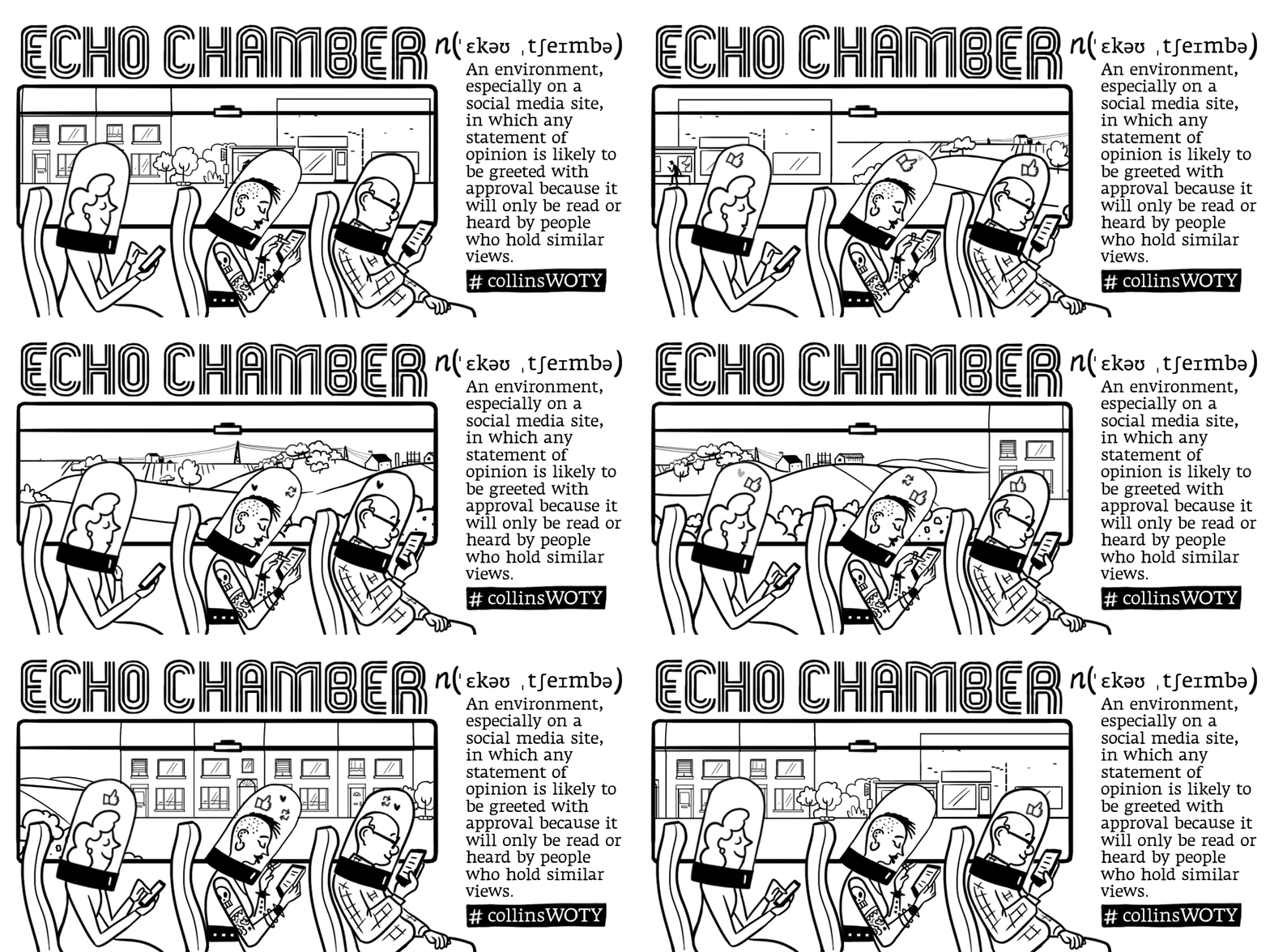
Bloggers write and write and write informative pieces. GOT is gratified that his modest effort has gotten some notice over the last ten months by some of the greats in the educational blogger ranks. But it must be noticed that the typical blog lives in an echo chamber.
Great pieces are written and shared in the usual social media groups. The likes and shares pour in … to like-minded other social media groups. It’s an echo chamber.
We join groups where the members think as we do. We like their comments and flame the people whose comments we don’t like. Those people eventually go away unless they enjoy trolling the group. We settle into a small (sometimes not so small) community where everyone thinks alike.
Back to the problem, the public doesn’t live in the educational blogosphere. If we want to pull in their support before we lose our schools, we will have to find ways to escape the chamber and reach them.
That’s what GOT is working on–a strategy to attract readers outside his echo chamber. It’s got to include a way to get onto other platforms, traditional media, maybe some wacky promotional ideas, and even (shudder) some social media advertising.
Think about it. The latest action taken in Florida was to send postcards to lawmakers pleading for the destruction of schools to stop. The effort was sincere, but perhaps the audience did not care?
Let’s take the leftover postcards, send the same message, but address them to our neighbors and fellow citizens. Get out of the chamber and reach those who support public education but don’t understand the urgency of now.
One year later, while the Florida legislature meets to tweak the well-intentioned, yet hasty, Marjorie Stoneman Douglas Act, districts and schools are still trying to figure out how to implement the full act. Schools have been hardened, guardians have been hired, threat assessment teams … well, read on.
GOT has previously reported that he was placed upon his school’s threat assessment team (TAT). He went to the mandatory training in youth mental health, and since then, well no one seems to know what to do.
While Tally (short for Tallahassee, Florida’s capital, and usually used to mean the politicians that gather there to pass laws and govern the state) debates what to do next and the governor received his wish fulfillment for the empaneling of a grand jury to investigate school districts regarding their implementation of the MSD act, which will be sited in Broward County, thus it doesn’t take a genius to figure out who the targets are, GOT has tried to move forward.
This is not a critique of anyone, but as guidance is not forthcoming, GOT has worked to find resources for school TATs and wants to share them with you.
These are only a few. But, as GOT told his administrator, if guidance is not forthcoming, we need to get on with the work anyway. We’ll do the best we can through research, discussion, and action.
If you are also a part of your school’s TAT and don’t know how to move forward, GOT hopes this has helped.
A salary (not bonuses) that is commensurate with the pay of other professionals and that allows every teacher to live in their district without the need for a second or even a third job to afford the cost of living. Teachers aren’t looking to get rich, but like everyone else, they would like to make enough to afford basics for their families and themselves.
Job security. Teachers want the stability of a position that does not depend upon fluctuating enrollment, the whim of legislative funding, or an arbitrary evaluation process based upon invalid data and administrative checklists.
Respect. An end to all the ‘bad teacher’ tropes.
All of the above for everyone who works for a school system, not merely teachers, but support personnel, counselors, media specialists, paraprofessionals, custodians, cafeteria workers, maintenance, clerks, secretaries, and even school administrators. Think of the change in leadership that would take place if school principals knew that their job did not depend upon annual test scores.
Wrap-around services to meet the real needs of children, including school nurses and medical screenings, enough counselors to handle the load of children carrying trauma and other emotional problems, social services to address hunger and neglect, compassionate truancy officers who will find and solve why children don’t come to school (sometimes it’s as simple as they have no clean clothes to wear.)
Full funding by states as they take seriously their constitutional commitments to provide a system of public schools.
Equity and fairness for all students that includes maintaining or increasing the diversity of student populations at every school, providing the resources needed by schools located in impoverished and minority neighborhoods, and keeping the buildings in good repair. The surrounding neighborhoods need attention, too.
An end to bogus evaluation schemes that no serious researcher, expert, or professional statistician supports. VAM may help a farmer to understand how to get a cow to produce more milk, but GOT knows of no teacher whose instructional practice consists of putting cups on teats to maximize achievement.
Realistic class sizes that allow teachers to give every student the attention they deserve. For Florida, that means respecting the will of the voters for once and giving schools the resources needed to build classrooms and hire teachers so that no high school class exceeds 25 students; middle school, 22 students; elementary, 18 students. Florida voters were given a chance two times to alter the amendment. No dice.
True accountability that measures all we ask a school to do. Riddance to a flawed, narrowly focused measure of test scores. An acknowledgment that testing does not yield a true measure of student learning. Teachers do not want to escape accountability, but they would like it to actually measure how effective they are. Test scores cannot do this and never will.
The drive for “personalized learning,” also known as competency-based education, is the hot, new reform pushed by those who believe that technology will save the day.
The dream is for warehouse-style buildings to house students for eight hours a day to sit in front of computer screens and learn from the programs presented to them.
Reformers tout the benefits: continuous testing, data generation, cost-effectiveness (no need to pay professional teachers, the computer will do the work, and all that’s needed is a minimum-wage paraprofessional to monitor behavior of 50 to 100 students), students learning at their own pace, and profitability of the new model because businesses can open and run these schools. No need for messy democracy, local control via an elected school board, and every other obstacle that stops them from raiding their state treasuries for the tax dollars.
This is a scenario worthy of Isaac Asimov: which is better, the silicon-based teacher or the carbon-based teacher? Reformers want a silicon-based teacher for your children. Their yearning for a teacher-proof classroom is a wish to remove a carbon-based professional from the room. But the carbon-based teacher has an advantage over the silicon-based teacher that the silicon will never obtain.
You see, the silicon-based teacher, that personalized learning a/k/a competency-based education, is provided by a machine powered by artificial intelligence (AI) algorithms that were written by a human being.
That fact is not a refutation. AI algorithms, more commonly called bots, run off on their own and soon their human creators can no longer control their data collection and their reactions given their analysis of their data set.
Isaac Asimov tapped into humanity’s deepest fear about technology and machine-like humans a/k/a androids and wrote his three basic laws of robotics:
A robot may not injure a human being or, through inaction, allow a human being to come to harm.
A robot must obey orders given it by human beings except where such orders would conflict with the First Law.
A robot must protect its own existence as long as such protection does not conflict with the First or Second Law.
The vision of the reformers violates the first two laws.
Technology must not harm a human being, either through action or inaction. Yet technology concerns abound:
The idea that human teachers can be replaced by technology and children can learn from spending hours online violates the first law.
Technology is a tool that should be used by the teacher, not controlling the instructional decisions of the teacher. Even iReady, a much panned educational program from Curriculum Associates, has its software written to turn off a learning module if a child fails it twice. It alerts the human teacher that intervention is needed. It is the teacher’s job to determine the next steps and provide appropriate instruction.
Yet, as an iReady associate admitted to GOT one time, district officials cut off her presentation when she was about to tell teachers how to modify iReady’s instructional pathway if the teacher decided a student should work in a different sequence or needed work in a different topic.
Without human teachers making those decisions, children are at the mercy of the technology. As technology feels no emotions, said mercy is not likely to exist. The vision of dozens of children in a large room, supervised by a paraprofessional whose job is to control misbehavior and keep them on task, having their learning controlled by the AI bots of the software, violates the second law.
Rather than having robots obey humans, children must obey the software bots.
Bill Gates writes software for computers, Laurene Powell Jobs is the widow of the creator of Apple computers, Jeffrey Zuckerberg runs the world’s largest online social media platform, Reed Hastings provides entertainment via internet streaming … the list goes on. Everyone of these self-designated education experts believes in technology because technology is their life and they have made billions of dollars in personal wealth from it.
It’s only human that their beliefs would be swayed into thinking that technology is the best method for educating children.
They are wrong. The tech-based vision of technology violates the laws of robotics, which even AI bots should obey.
Every family has one, that eccentric aunt or uncle, whose public antics give rise to a nervous giggle and an avoided glance when told about what new embarassment has taken place.
Sometimes, that eccentric aunt shows up in a legislature and in Florida, courtesy of Jacksonville’s district 14, we have Kim Daniels.
While offered as “an objective study,” what the bill really proposes is this:
— “A course on the Hebrew Scriptures and Old Testament…”
— “A course on the New Testament…,” and
— “A course on the Hebrew Scriptures, the Old Testament of the Bible, and the New Testament of the Bible.”
Hmmm, while many object to this elective, because everyone knows it is trying to force proselyzation into schools, GOT could teach the class. As a former pastor, with a Master of Divinity from Asbury Theological Seminary, he would be well-qualified for the job.
Dreaming of the curriculum, GOT would begin with form analysis and comparison with other texts from Ancient Near East culture. We would begin with the first chapter of Genesis and realize it takes the form of a creation account like that of every other culture. In fact, it was a theological statement in opposition to others, not a factual account of creation.
We would, however, take a detour into the theory of relativity to realize that time is relative and that a day from the perspective of God is not the same as a day from the perspective of Earth.
We could examine Jacob wrestling with the angel and understand the trope: a river demon story. Then we could look for what is unique in the Bible story versus the stories of the popular culture. And I’m sure teenagers would get a kick out of realizing what a stele is. (Spoiler alert: a phallus.)
As we got into the New Testament (and we might not ever get out of the Prophets, whose call for social justice is powerful and resounds today), we would also read the Quran and Hindu texts to find the similarities in the moral codes and discuss the differences. We would even examine the oral stories of Africa for the same.
Oops, such a course of study might be interesting and valuable to high school students who have the interest. But GOT suspects that it would make Kim Daniels hopping mad.
At least the flowers that always come back in the Spring are beautiful. Far too often, homework arguments are ugly. (And I’m not talking about parents fighting with their children to do it.)
Should children do homework? At what age is it appropriate for children to begin having homework assignments? ON and on and on goes the debate.
I remember being a 3rd-grader. Up to that point, we never had homework. Our teachers thought we were too young.
But my precocious class, looking at our older siblings, thought we were missing out. Shouldn’t we be doing homework? Our 8-year-old little selves asked our teacher to begin giving us homework.
She was astonished. But okay, if that’s what we wanted …
Oh, those wacky days of the 1960s! When it was thought that 8 years was too tender for homework and giving an hour of homework to a 5-year-old was unthinkable.
Reading logs? Unheard of! I used to get my elementary work done quickly and always had a book to pull out and read until the next lesson began. One day, in 6th grade, I was particularly absorbed in reading and didn’t look up when the teacher moved on.
When I did, I immediately put the book away, somewhat chagrined. But it was a wise 6th grade teacher who let me read on, knowing I would pick up on what she was doing without her reprimanding me about it.
So why does Grumpy Old Teacher assign homework and how does he do it?
High school students need to spend more time than 6 hours a day in learning. I might argue for study halls and a longer school day so students continue to work in a supervised setting with experts available to help them in their independent studies as needed (a/k/a known as teachers), but since we have limited time for the educational goals we are given, students have to put in hours outside of school in studies. By the way, GOT teaches mathematics, one subject where independent practice is key to mastery of learning. It may not be the same for other areas.
Adolescents (GOT has taught exclusively on the secondary level) have a developmental agenda as do all of us as we move through life. Adults have agendas, too: Each decade brings new issues: establishing a career (20s), family (30s), midlife appraisal (40s), preparing for retirement, and so on.
For teenagers, it is the intense time of socialization and forming life-long bonds with their generation that carry them throughout their lives. They will experience the same life events at the same time, more or less. Like all of us, as adults they will form friendships with their parents and that generation, and in time, with their children and that generation. But the closest friendships are made with their own generation.
For that reason, I do not assign excessive homework loads. Some of my colleagues do. It may help my students learn more, it could help them do better on tests, especially those state tests, but GOT believes it is inappropriate to ignore the developmental needs of children, which are far more than memorization of academic content.
Thus, I limit myself to 30 to 45 minutes of homework per class. The rough rule is 10 minutes of homework multiplied by the grade level in total. For high school, that’s 90 to 120 minutes per night. Divide that among 4 classes a day (block schedule) and it works out to 30 minutes. Given that some electives do not have homework, such as P.E., and that I work in an academic magnet school, I have come up with the 30 to 45 minutes.
To encourage those students who want to do more, I will offer extra credit for additional time spent in learning. After all, there is too much content crammed into too little time by educational standards.
What is appropriate for math homework? The traditional method is to assign problems. Here again an argument develops. How many problems? Some would do drill: 50 repetitive problems or more a la practice makes perfect. Others say that is too much; only 5 to 10 problems are needed to rehearse the application of learning. I tend to the ‘less is more’ side of this debate.
In my experience, students who know the technique and can do it don’t need a tedious, extensive practice. A few problems will aid in retention. Students who don’t understand and do something wrong, the more they do it wrong, the worse their retention becomes: the wrong way!
The Internet complicates the problem. Ever heard of Mathway? Many other similar sites exist. Not only do these sites give away the answers, they show all the steps to copy down. Telling students to show all their work no longer stops the copying, which is really cheating.
So what used to be traditional homework, practice, must be done under my supervision. I use the first 30 minutes of class for it. That also gives the advantage to teacher and students that I am available to help as needed. As I tell students, I don’t live with you in your bedroom. I’m not there to help you with homework. I am here in the classroom.
Then what does GOT do with homework? A few years ago, I tried to flip my classroom. I assigned instructional videos so that the students would come with the teaching already done and we could focus on the how-to. It did not work because some students don’t do homework at all, some students do it but not before class, and some do it but find it of little help. As one told me, she watches the video but she is so busy writing down what the person is saying in her workbook for the videos that she can’t concentrate on what is being said.
In response, I flipped the flip. Now I do the practice in the room and then move on to the lesson. I teach the concepts and give the students assignments that have them wrestle with the ideas to try to make sense of them. In subsequent classes, they practice.
Then I assign the videos and workbook. Not for the initial learning, but for reinforcement and review.
Thus, I set due dates but allow students to submit their homework evidence afterward because the homework will be beneficial whenever they do it.
The homework is not essential, but it is beneficial. Those who do it, gain; those who do not, lose out. However, the lack of homework is not fatal to the mastery of concepts. It helps, but it doesn’t doom to failure.
Therefore, I limit the impact of homework on the quarter grade. I monitor its percentage of the grade to keep it at 10%. Students who refuse to do homework drop one letter grade. However, they will not fail because they refuse to do homework.
I do not worry about the homework cheaters. Yes, they get that 10% by getting another student to allow them to copy. BUT! those are the students not learning. Tests (60 to 65% of the grade) catch them.
Math is tough. Those who do homework find that it helps support their grade. That is the key to success. Do all the work, do it honestly, and it will provide a cushion against a bad test performance.
While grades capture a student’s performance, I also want the process to encourage students to keep trying.
It’s a delicate balancing act. I am always searching for the next tweak to further this goal.
To make it in the NFL these days, a team has to continually bring in young, new players to keep the talent high for winning. Too many older players commanding high salaries (worth every dollar for their experience, knowledge, and leadership) means the team has too little salary dollars to maintain good players at all positions.
In other words, push those high-salaried veteran players out the door if a team wants to reach the play-offs. For players, that means sweet bonuses on top of their contracts; for teams, that means extra TV and ticket dollars.
Many have written about the push of school districts to get veteran teachers out the door because their salaries are too high.
I won’t recite what you have read elsewhere many, many times, but given the tendency of state legislators to limit the ability of school districts to raise revenue by mandated millage reductions to offset gains in property value for school taxes, by directing general revenue dollars into categoricals, the term for specifying how money must be spent (another term–micromanaging–comes to mind), by creating as many wacky voucher schemes (Florida, a bullying scholarship for private school? Really? And no one is using it, which is why you are proposing increasing the amount of budget put into it) as possible, is it any wonder that there is no money left over for teacher salaries?
Districts make it work by bringing in teachers on the cheap. TFA (Teachers for America) was a favorite option, until people realized the true cost.
Districts have a limited number of dollars for teacher salaries and that is why they offer inducements for older, veteran teachers to get out. In my district, if you retire early (before you can receive a full Social Security benefit), they will pay your health insurance until you go into Medicare.
Yes, in education, we have salary caps thanks to our parsimonious legislatures. Like NFL teams, districts and schools react by moving the high-cost veterans out of the building.







 Grumpy Old Teacher