Or should Grumpy Old Teacher (GOT) title it Life in These Virtual United States.
Either way, a clear rip-off of the feature’s title.
Today GOT experienced one of those hilarious moments of work where an announcement email went out to about 1,000 teachers about a webinar the district was holding at 10 AM.
Most of us were unavailable because we were … um … teaching via our virtual app as we are supposed to. No biggie, the webinar was voluntary, one of those ‘let’s share best practices,’ and it was recorded for anyone who couldn’t be live and wanted to watch it later.
The hilarity erupted as numerous persons replied to the email along the lines of ‘I’m busy with students. Take me off the list.’ It was one of those moments when the divide between the ‘reply tos’ and the ‘reply alls’ came into focus.
Everyone’s email began blowing up. The actions of a few snowballed as more people reacted to say stop it. Even those trying to help by replying ‘stop replying’ went from being part of the solution to part of the problem as those emails went to the thousand and more people replied.
Have you ever tried to teach students when your computer is going ding, ding, ding, ding, ding for about 45 minutes?
Thank Goodness! GOT wasn’t sharing audio from his computer with his students.
However, later reflection brought the realization that this is a teachable moment: how the actions of a few impact everyone. The only proper way that is socially acceptable to stop the crescendo of email responses is to not respond. Good internet manners dictate that practice. Don’t reply all unless your response really has to be seen by everyone. Don’t reply at all when the email was the equivalent of a bulk mail circular sent out by the local grocery store.
Because nobody wrote a children’s book about a dog named Publix.
That’s what the Covid-19 crisis is like. That’s the reality. We must maintain social distancing and not gather in large groups. Our efforts are working–working so well that some people now deem it unnecessary and question the statistics that are published daily.
It’s working. Don’t be that person. Don’t be the one who flouts the necessary social practices who will renew the community spread. Stay home. Work from home if possible. Walk the streets, run in the parks, but keep your distance.
Or you will be the one blowing up people’s lives with disease and death like the people doing a ‘reply all’ to an email that they could have ignored.
Jacksonville Beaches will open! At 5 PM Friday! That’s tomorrow! As long as people follow social distancing guidelines, don’t gather in groups, no picnics, no group activities. Oh, wait …
What changed? Mayor Curry first tried to reduce the number of people on the beach by exhorting them to practice social distancing. The beach-goers did not pay attention. Out of frustration, the Mayor (in cooperation with the beach town mayors) ordered a closure because too many people would not be responsible and voluntarily follow the practices needed to preserve public health.
What changed? The mayor is reopening the beaches for exercise and dog-walking as long as people follow the necessary social-distancing measures.
Hmm, Grumpy Old Teacher (GOT) won’t repeat that tired cliche about the definition of insanity, but he did read a good riddle on social media today:
What borders on the edge of insanity?
Mexico and Canada.
If people would not follow the guidelines before, what makes the mayor think they will now?
Lots of Trump-branded products to sell.
What changed? Ronald Trump-Donald, Clown Prince of America, wants to reopen for business, which is ironic because America never closed for business. It only ordered employees of non-essential businesses to work from home if possible. Any not essential to the living needs of the population, such as clothing stores and bars, were ordered to close their physical locations. But they could offer curb-side service if people ordered over the telephone or internet.
Things are happening behind the scenes and a mayor, once staunch in his conviction that everyone must stay home unless they are absolutely needed in their workplace (think hospitals, grocery stores, and delivery people as well as utility workers, police, and firefighters,) now believes that we can venture out when the peak of the strain on our healthcare system has yet to come. Yes, the spread of the disease is still going up.
And what has this to do with schools? America cannot ‘reopen’ without its public schools ending distance-learning as children, teachers, principals, and staff return to the buildings.
DR OZ: "Schools are a very appetizing opportunity. I just saw a nice piece in The Lancet arguing the opening of schools may only cost us 2 to 3%, in terms of total mortality. Any, you know, any life is a life lost, but … that might be a tradeoff some folks would consider." 😳 pic.twitter.com/aifMeKTsIv
The cost is only a mortality rate of two or three percent of our population. With an estimated population of 330, 607, 633, that means we would only suffer a loss of 6,612,152 persons.
Perhaps Dr. Oz only meant of those who would get sick. How many? We don’t know. There’s not enough testing going on.
One thing we do know: schools are laboratories of contagion. Children easily pass germs to one another and then carry those germs into their neighborhoods and homes to spread disease across cities and counties.
Dr. Oz is not the only one; he is merely the fool du jour mouthing a talking point by those who think profits are not the most important thing, they are the only thing worthwhile in life. (Apologies to Vince Lombardi for torturing his famous quote. But then, these people do equate winning with gathering the most profits.)
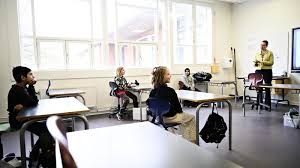
The trap is set and the snare will soon tighten. The reopening of schools is promoted as being possible with the proper social-distancing guidelines in place. Already, we are treated to this image:
See how to do it, America?
Foolishness, indeed! Only people who have never set a foot in a public school or have passed too many years since they have done so think that this is possible.
In GOT’s classroom, this is about the amount of space he has. But he has to squeeze up to 30 teenagers into it for any given class period. He has difficulty in placing them the minimum 3 feet apart for state testing! How can anyone expect a 6 foot distance between students? Foolishness!
What happens when the bell rings and the typical 2,000 to 3,000 student population crowds into the hallways? You say staggered dismissal? How? If GOT holds his class for the time, the next class gathers outside the door waiting to enter!
Everyone touches the door knob to open the door to go in or out. How do we keep that sanitized during the school day?
Locks on the lockers–touched by many hands. Pencil sharpeners, soap dispensers (ironic, isn’t it? To sanitize their hands, students must first deposit whatever unsanitary germs are on their hands to pull the lever on the dispenser.) Don’t touch your face!
Leave those boogers alone! They can stay in your nose. (You think I’m kidding? You haven’t been in a school in a long time.)
We can’t sanitize everything. We don’t have the personnel. Open the schools and the virus will gain a new life.
Competing with the best … with an assist from Florida’s politicians.
A week ago, Grumpy Old Teacher (GOT) dashed off a quick thought about Florida Virtual School, albeit with a provocative title, The Lie of Florida Virtual, and unsurprisingly, that brought clapback from persons associated with the school.
Before reporting the response, GOT would like to answer the question asked about why FLVS (Florida Virtual School) has become controversial. Simply put, on April 1 (no joke), the Florida State Board of Education authorized a disbursement of millions of dollars to FLVS so that the online option could expand capacity to 2.7 million children from its current level of about 200,000 by May 4, 2020.
Not saying they are right, but it is not surprising that persons who resist Florida’s privatization efforts in the many avenues Florida has authorized, charter, schools of hope [sic], vouchers, online including the state-backed FLVS, suspect there’s a bogey in the woods.
Why? Why now? By May 4, Florida schools have only weeks, not even a month, left in the school calendar. What purpose would this serve?
That’s why Florida Virtual is suddenly visible and controversial.
Now for the clapback which came from FLVS teachers. BTW, GOT has no quibble with teachers. It is not those working under systems of misguided policies and offerings that causes concern. We are all in the business of doing the best we can for children and we all deal with systems that, under the weight of ‘ed reform,’ leave us in suboptimal conditions, be that virtual, charter, or tradtional settings.
I. “We can use a library, go to the home, or use our physical space (FL Connections).” Argue with GOT’s point that virtual schools depend upon physical locations in such a way as to make his point. These objections serve to point out that virtual education needs a physical location for state testing. The public school is the easiest option because all that needs to be done is send the child to the school and the people there have to do the rest. Use the library? Okay, but libraries restrict the hours a computer can be reserved. Plus, that means the virtual teacher has to do the actual administration whereas testing at the public school means the virtual teacher has no work to do. C’mon, you know you rely on public schools. If that option is not available, are you really going to go to the library for 90 minutes of each test session, student by student, in the three week test window? It can’t be done. The exception proves the rule: in other words, it is clear that virtual schooling needs the public schools to fulfill this legal obligation to test students.
II. The student-teacher ratio is an interesting point. Virtual teachers reported that they have loads of 145 to 160 students, which is comparable to the load of a core-subject high school teacher. If we do the math, and FLVS intends to ramp up to accommodate 2,700,000 students, that means they need 16, 875 teachers. They offered to train a few hundreds to build capacity. GOT feels very sorry for FLVS teachers who will see their student loads explode should the dreams of the governor and commissioner come to fruition.
III. “Not all courses need an EOC.” No, they do not. But as FLVS is a public school district by state law, that means the teachers are subject to the same laws including annual evaluations as traditional school teachers. They need certification, right? They need the data piece for the annual evaluation, right? Or did Florida sneak through an exemption for them?
IV. “Virtual teachers are on the phone all the time. In fact, their workload is two times as great as a teacher in a brick-and-mortar school.” Yes, in this great adventure that is called ‘distance learning,’ we are finding that out. But why is this a good thing?
V. “Virtual school has to teach the entire curriculum. Public school can stop short at the end of the year.” No, we really cannot. Students have to pass tests. Unlike a virtual school, when students can take as long as they need, public schools have to give students the bum’s rush to finish the meal and get out the door because they cannot delay the test. This is not an issue over which to snipe at one another. We all face unrealistic expectations from politicians and legislators who have never set a foot inside an actual school, virtual or otherwise.
VI. “FLVS is more rigorous than traditional schools.” Really? Seriously? Then you ought to read this: When I worked for FLVS, during the oral assessments (called DBAs- discussion based assessments) I could hear someone prompting students in the background…..furious pencil or whiteboard scratching followed by whispers. It happened a LOT. And it had to happen and be reported more than a lot for anyone to receive any consequences.
VII. “the FLVS Flex program for home-schooled students. They can take courses but they are exempt from state exams.” WTH?! Is Corcoran having his cake and eating it too?!
VIII. “FLVS has a Quality Assurance Department. It listens in and views communication between teachers and students, teacher grading and feedback … if the feedback isn’t personalized, the grade isn’t justified, they step in.” So FLVS micromanages, spies on, and does everything that abusive administrators do in a traditional school. How is this a plus?
IX. “FLVS uses DBAs (Discussion-based assessments).” See VI above.
X. “FLVS uses online proctoring services for tests. They record the screen, use the webcam to watch students, capture audio ….” But in these days of distance learning, these are the very practices that need debate. Are they appropriate? Spying on children in their bedrooms. Not something GOT is going to do.
Yesterday, Thursday, April 9, the governor of Florida, Ron DeSantis, held a media conference along with his education honcho, Richard Corcoran, to spin how well Florida has handled school closings and crisis schooling, which is also known as distance learning.
Invited guests included the Superintendent of Pinellas County, a principal and a teacher from that district, and other teachers.
The presser was a media relations promo. Its theme was how well Florida is doing with its move to online learning for the entire population of school children. When Grumpy Old Teacher (GOT) tuned in, they were promoting the expansion of Florida Virtual School (FLVS).
Occam never met the safety razor. But since the simplest is best, he would stick to a single blade.
GOT is reflecting on Florida Virtual in other posts. For now, he will note the positive push of the presser. FLVS has expanded capacity. In early May, it will be able to accommodate millions of school children … as a means of completing their school year. For free! It won’t cost a thing! (One assumes they mean that FLVS will not try to scoop FTE dollars out of district budgets at this late time in the school year.)
FLVS has teachers standing by ready to determine where each child is at in the curriculum and able to drop them into their course sequence at the right spot.
Implied, but not being said, is that you parents don’t have to put up with the crappy efforts by your public schools to provide ‘distance learning’ with very short notice. (GOT is reporting and interpreting, but definitely not agreeing, with this thought.)
More important, something was said that has been overlooked. Parents choosing to put their children into FLVS may always return their enrollment to their local school district for the 2020-2021 school year.
Let that sink in. Parents enrolling their children in FLVS to finish this year will remain enrolled in FLVS UNLESS they take action over the summer to re-enroll their children in the local school that they prefer.
However, Occam’s Razor: the simplest explanation is the best. GOT does not suspect a deep, dark conspiracy in the expansion of FLVS. Really, do you think DeSantis and Corcoran are that smart?
But they have put in place a means of making brick-and-mortar schools seem unnecessary. We must be vigilant in the months ahead.
Go, go, Corcoran!
Next up, the superintendent for Pinellas County, who must have been a cheerleader in his high school days because he played the role very well. He claimed that in the first week of ‘distance learning,’ Pinellas had a 97% attendance rate and would soon have that over 99%. Corcoran smiled and gave praise.
He reported that everything was running smoothly, a report that defied everything every actual Florida teacher was experiencing and dealing with. A report that insulted every parent trying to manage multiple children in different schools and finding that the platforms were overwhelmed.
But backup was at hand: a principal and teachers who knew what they were there to do.
The Imperius Curse was an invention of J.K. Rowling for her Harry Potter series. But GOT can’t help wondering if it’s real after watching the principal and teachers saying how wonderful it all is. Maybe they’ve been cursed by the FLDOE or the commissioner into saying things that everyone knows are not true.
For the record, students have trouble logging on and accessing their assignments. The internet was not built for this. Every platform, whether Microsoft Teams, Zoom, Google Classroom, and on and on, has struggled to stay up given the unprecedented demands upon their infrastructure.
Emails take hours to arrive in teachers’ accounts. Students upload a PDF or picture of their work, they receive a message that the upload was successful, but teachers don’t see it on their end.
Engagement is far below 97% as every teacher in Florida knows. It’s not happening at that rate.
Remember him?
But the real jaw-dropper was saved for the end, when the presentation was over, the script was read, but the governor took questions.
He declared that schools would soon be ready to reopen, but on a county-by-county basis.
Oh, Ron! What personality defect drives you to become the laughingstock of the nation?
He reasoned that no one under 25 has died from the coranavirus. George Santayana once said that no good deed goes unpunished. In these days of social media, GOT will amend that to say that no stupid utterance of a politician will go unpunished.
Reaction was swift and quick. One example here and another here. These are not the only ones. Florida has news for you, Governor. Parents are not sending their children back to school before August. Teachers, administrators, and supporting personnel are not going back either.
To do so risks a new wave of contagion washing across the state.
It’s not only the cheating: how do you know the student is actually doing the lessons and taking the assessments? FLVS (Florida Virtual School, enshrined by law as a public school district like the 67 real districts run by locally elected school boards, whose ‘board’ is now the state’s school board) tries to head this off by having the virtual teachers call students and orally examine them to make sure they are really doing the work and passing the tests.
It’s not that research has shown that virtual learning is not as effective as learning that takes place in a real classroom (Grumpy Old Teacher–GOT–will look for links later; this is a quick dash-off piece.)
It’s not that a virtual school system, conducted online via the internet, doesn’t have the capacity to handle an entire state’s school population. Florida’s State Board of Education, which is also the local school board for the Florida Virtual School, has granted a request for funding so that FLVS can hurriedly build in additional capacity so that it can accommodate 2,700,000 students by early May. A number that not-so-coincidentally matches the entire school population for the state of Florida.
The lie of Florida Virtual School is that it can replace the brick-and-mortar schools that exist in the state.
You need look no further than the annual state tests that Florida vainly believes are the best measure of student learning when it assigns school grades, a system Florida conceitedly believes leads the nation in educational best practices.
(Well, GOT says Florida, but really is referring to the politicians, ed reformers, et al. who almost always are found to have a connection to a profit-making scheme, a charter school chain, a pass-through non-profit like Step Up for Students, or billionaire-sponsored foundations that promote the privatization of education.)
When May arrives, how do those Florida Virtual School students take their tests? Each and every one of them must go to a brick-and-mortar, real district school to sit in a classroom for the administration.
It doesn’t happen online; it doesn’t happen virtually.
Virtual school remains dependent on real public schools to carry out its mission.
GOT wondered if FLVS received school grades like real schools. Here’s the result. Draw your own conclusions.
Thanks, Scrabble … or should I say Novel Coronavirus?
This is going to be a personal post. Grumpy Old Teacher (GOT) was prepared (emotionally, mentally) for the inevitable snafus that were going to occur on the first day his school district moved to distance learning, an attempt to carry on instruction with students as we all sat at home and connected over the internet.
He was prepared to adjust his grading strategies and how students could fix the performance issues that inevitably set in with the resumption of school in January. At his school, we call it the third quarter slump.
He knew that he would have to lighten up on his push to drive students forward to excellence as the all-consuming tests would have an out-sized impact on their future. At the high school level, opt-out is not as simple as telling students to do a sit-and-stare for the duration. End-of-course exams come with penalties; the state mandates that they count for 30% of a student’s course grade.
He knew that with all the adjustments, some students (the slackers, to use a 1980s phrase) would exploit the loopholes to get the distance-learning grades that they would not earn.
GOT was okay with all of that. What I wasn’t prepared for was … anxiety.
This is personal. I’m going to drop the third-person manner in which I write this blog.
It began a week and a half ago as my district’s teachers spent Friday doing online training, participating in meetings via Microsoft’s Teams app, and otherwise scrambling to figure out how to go live on Monday with students.
Saturday night, Sunday night, how the bowels rumbled. I don’t think I got much more than 2 to 3 hours of sleep between visits to the bathroom.
Monday, when I got up, I felt the pins-and-needles in my fingertips. How would it go? Would it work? What happens if the students misbehave? What happens if the lesson goes poorly?
I’m used to putting on a brave front, but this new format was beyond my experience like it is for every other teacher who no longer welcomes children into her classroom, but must teach them from afar.
The miracle of technology. The impersonal miracle of technology. You can keep your Instagram photos, your Twitter bits, your Facebook posts: it’s not the same as being there.
How do I make this work? I’m in uncharted waters.
Every morning, I felt overwhelmed as I wondered what the day would bring. After the first day, a disaster in which students showed up for the video meeting, expected it to be perfect, and of course it wasn’t, things ran better. I settled into a format that kept things running and avoided most of the technology hiccups due to coding errors and high traffic.
And yet, every day, the anxiety returned.
The lessons are working. Students are completing assignments. I’m taking it easy on them because, if I am experiencing this anxiety, I cannot imagine what it’s like for them.
Someone asked me yesterday, “Is this it? Is this all we’re doing?”
I said, “Yep, it’s enough to chew on for the day.” (It was one of the more difficult lessons in Geometry: applying knowledge about the area of a triangle and trigonometry to calculate the area of regular polygons. I am mixing in a hard lesson with easy ones as the days progress. Even so, there are hard lessons I am holding back on because I simply cannot figure out how to get across the key ideas online when I cannot look at their faces, their papers, and their behavior and know how the learning is progressing.)
Thus, the anxiety. How will this all work out?
My principal is a good one. He tells me not to worry, shut my door, and teach. He’ll handle the rest. There are times I need to hear that message, but face-to-face. He’s been terrific in this closing. Very supportive, helpful, I have no complaint.
But it would be nice to see it face-to-face. You see, that’s who we are as human beings. Language sets us apart from the animals, but language is worthless without the body language, those clues that help us distinguish what’s real from what’s not.
In these days of distance learning, we get no clue. All we have is words, and it’s not enough. (The irony is not lost on GOT that blogging is all about words.)
Yesterday, I taught a class and no one was talking in the chat. I finally said something and a student told me we are talking in the chat–do a refresh. Only then did I realize that my screen had stopped scrolling it. But I had got to the point where I wondered if anyone was out there–no human response for 35 minutes.
The anxiety. Will anyone tune in? Does anyone care? It is disconcerting to talk for so long without some type of feedback.
This isn’t the future.
As I pass through my second week of distance learning, I feel the anxiety decreasing, but it hasn’t gone away. I still worry about the disruptive students who might try to wreck a lesson (they are not showing up), that the technology might fail even though I am using my home computer as our district-provided laptops are too old to reliably run the online apps, and that students will give up even as I try to keep them engaged.
I worry about the timing of needing to finalize third quarter grades. What will happen to those students in overwhelming circumstances who cannot finish and send in their work?
I know I can work it out and submit grade changes later. But that’s my brain talking, my intellect. My amygdala has something else to say.
Master of my classroom, I suffer the tyranny of doing this online. I do not share this easily, I am not seeking reassurance or an outpouring of ‘you got this’ remarks. I am tough, I have gone through much and I will get through this.
But I thought, surely I am not alone, thus, I will share.
In this second post of a series that Grumpy Old Teacher (GOT) hopes will have a very short shelf life, he will answer questions that have arisen in this grand experiment.
? How can I (a teacher) assess my students? How do I give a quiz/test?
Don’t. Just don’t.
? How can I stop students cheating on my test?
See above.
? What will happen when all 67 school districts in Florida go online tomorrow (March 30, 2020)?
No one knows. Have patience, keep trying, and forgive the students, both the ones who tried and the ones who didn’t. It’s not a time to be an <ahem.>
? How does a particular feature work in a particular platform?
Check your network. Someone in your school, district, or social media connections has probably figured it out.
? What happens if everything crashes? OMFG, what now?
Peace. The sun came up, you have food in your house, your children are annoying you (that’s a good thing), if nothing worked, what really matters in life has not changed.
This one was making the rounds on social media (date: March 27, 2020).
Week One is over. Grumpy Old Teacher’s (GOT) Florida district was one of four that reconvened online as the extended Spring break ended. Monday, all 67 districts will be online to provide distance learning as we teach our students from home. This post is a ‘Lessons Learned’ for all those yet to enter this grand experiment.
ONE: The most important thing is to connect with students, who are missing their routine and crave normalcy. Make your first day an easy one. Check-in, ask about their family, ask how they are feeling, assure them you will support them from afar the same as if you were together in the classroom.
One of GOT’s students made a point of showing him her dog yesterday. That’s the kind of emotional connection your students need.
Your first day is going to be rough, full of technological challenges as you find out what works and what doesn’t. Don’t get fussed when things don’t work out or students get upset. They expect the technology to be perfect from the get-go. It won’t be. Don’t make that mistake.
GOT had a class where nothing worked the way the district said it would. (Microsoft at fault; not GOT’s district.) The upshot? Everyone gets full marks for the assignment. It wasn’t their fault.
TWO: Don’t try anything new. You won’t know how it will actually perform and you haven’t had time to train your students in how to use it. All those great apps you’re reading about? Forget it. Don’t use anything you haven’t already been using in your classroom unless you have no other choice.
GOT’s district committed to Microsoft long ago. We use their apps, period. A year or two ago, the district cut off access to other platforms, such as Google Classroom, for many reasons including compliance with FERPA, IDEA, and other federal laws. Don’t get creative. Stick to your district’s plan. It’s the best way to ensure we are protecting the rights of our students.
For example, Teams gives the ability to hold video meetings. If that’s what your district is providing, don’t use Zoom. There are many reports of security concerns with Zoom. You don’t want the trolls bursting into your video classroom in the most inappropriate ways.
THREE: Make attendance easy. Understand that children may be sharing their devices with siblings and may not be able to attend your video meetings when they take place. It may be later in the day. Teens will follow their body clocks: up late at night, sleep in the morning. Adapt to them. Make it easy.
GOT has seen teachers share many ideas for attendance. While he means no disrespect, in the secondary classroom, requiring children to fill out a form or respond to a question is a bit much. They are trying to navigate 6 to 8 classes, all of which have different procedures and expectations, while fighting for computer time with siblings and maybe even parents, if Mom or Dad has a work-at-home routine.
GOT goes the extra mile. If a student interacts with his class in anyway during a two-day period, they are present. When he starts the live video meeting, if he sees the child join, that’s ‘Present.’ If the child leaves a comment in the chat, even hours after the meeting, that’s a ‘Present.’ If a child ignores the video meeting, but views the assignment in Teams within 48 hours of posting, that’s a ‘Present.’ If a child submits work for that class, that’s a ‘Present.’
FOUR: GOT is checking his word count. This post is passing the 600 threshhold. That’s about as long as a blogger can expect an online reader to remain focused on the writing.
Remember the same as true or even more so for children.
Don’t try to replicate your in-person classroom experience online. Cut back on the work. Don’t try to instruct the entire time, then assign the classwork followed by a homework assignment. Parents are reporting that their children are spending upwards of 12 hours online trying to do all the work. We need to stop. Cut back. Teach for 30 minutes, allow the students to work while you give them help like you would in the classroom.
If she reads this, she may figure out who inspired this post.
This one’s for you.
It was supposed to be the Year of the Teacher. The governor proposed to raise all teacher salaries to a minimum of $47,500 a year, including rookies entering their classroom for the very first time.
The existing bonus program, which was called ‘Best and Brightest,’ but scorned as ‘Dumb and Dumbest,’ would be eliminated in favor of a performance pay plan that would compensate teachers at schools that meet improvement goals based upon state test results.
There was a lot of controversy. Teachers hate the plan because it makes no distinction between those with years of experience and those first starting out. Experience makes a difference and, in the classroom, teaching is no exception. Simply stated, the longer someone teaches, the better they are.
But teachers hate the plan even more because it disregards the people who make the schoolhouse work–without whom, there would be no school. Flunky is not the word for them. They are superstars.
When a child vomits on the floor, who cleans it up? The ‘flunky’ superstars.
When children is hungry, morning, midday, and afternoon, who feeds them? ‘Flunky superstars.’
When a school district decides it no longer needs librarians because the clerk can unlock the door, who keeps the media center running? The ‘flunky’ superstars.
What are these ‘flunky’ superstars doing during this time of school closure and distance learning? They are contacting families to check on the students. Are they safe? Are they healthy? What do they need?
They are handing out school lunches and driving school buses to deliver learning materials so children will not regress.
They are coordinating a hundred million details that no one ever thinks of and they don’t ask for thanks. They merely say they are part of the team.
What do we do for them? Most principals will treat them to lunch once a year whenever that particular Wednesday pops up in April.
You can’t pay the bills with a free lunch once a year.
You can’t pay the bills when you only make $11 an hour and your hours run about 1200. Do the math. For all they do, the ‘flunky’ superstars make about $13,200 every year. If they volunteer for extra duty, such as after-school programs, they might extend that about another $2,000 or so.
Face it, we don’t pay them enough, we don’t recognize them enough, we don’t do enough for them even as they put in the extra effort because they are part of the team.
They deserve much better. So while you are congratulating teachers for their sacrifices during the pandemic for their care, concern, and efforts for students, remember the ‘flunky’ superstars.
They are every bit the equal of a teacher.
When this is over, they need attention, too. $15 an hour is the least of what we should start with.
As expected, the unprecedented load on the servers of the nation’s 20th largest school district caused things not to work so well. What was unexpected was where the data logjam occurred.
Running live meetings went well for the most part. Students were able to join the meetings and watch teachers deliver lessons. Some students complained they couldn’t see the video, but since it wasn’t all, they probably had a key setting disabled. Grumpy Old Teacher (GOT) used a whiteboard feature in his first class, but subsequently learned that the whiteboard portion was not recorded. “We’re fixing that bug.”
Assignment files was the big block. Teachers are able to add files to their Teams assignment. Students open a copy and actually fill in responses that are saved by the system for later review and grading by the teacher. Except, it didn’t work. Students couldn’t access files and teachers were scrambling for a work around. “We’re fixing that bug.”
GOT found a workaround. He made his assignment files shareable so students could download a read-only copy, do a save-as so they could edit their own version, and upload via the grade portal we use (FOCUS) or even an old-fashioned email attachment to his work email account.
Except when he sent the links to the students school email accounts, Microsoft’s bots decided GOT was a spam account. At this writing, his work email is suspended. GOT sought advice and has submitted a request for service to his district’s IT department. He hopes that they are “fixing that bug.”
In the last period of the day, during the video lesson, GOT’s mike was muted continually. He told the students to cut it out, but later found out that anytime a student unmuted their mike, it automatically muted his. In a post-school day discussion, another teacher made suggestions for adjusting the video settings, which is possible if the meeting is scheduled. GOT will try to see if it will “fix that bug.”
The problem with scheduled meetings is that the students can start early and hold a pre-meeting. Don’t get GOT started about pre-meetings. He had enough of that in his preacher days.
Maybe IT can “fix that bug.”
Not bad for a first day. But as we move forward, GOT hopes that the distance learning will not become:






 Grumpy Old Teacher