Il Papa è Morto

Rest in glory.

Francis brought a distinct pastoral outlook to his papacy. A simple man, he lived in a small apartment in the guesthouse. He sought to make the church accessible to all with a focus on the marginalized, whether they be poor, living in the Third World, or LGBTQ+. When asked about the latter, Francis famously replied, “Who am I to judge?”

His impact will be felt in the church and the world for years. He had wide-ranging interests, including education, and wrote this encyclical (letter that does not set doctrine or policy) about the role of literature in formation, which for our purposes we may read as education. While much of his letter addresses the preparation of young men for the priesthood, Francis directly talks about general education of children and youth in parts and indirectly realizes that much of what he is saying about priests applies in a more universal way.

A few excerpts:

  • What I would like to address here is the value of reading novels and poems as part of one’s path to personal maturity.” Francis recognizes the importance of reading in the formation of responsible, mature, and moral adults. He will explain as he goes on.
  • Time spent reading may well open up new interior spaces that help us to avoid becoming trapped by a few obsessive thoughts that can stand in the way of our personal growth. Indeed, before our present unremitting exposure to social media, mobile phones and other devices, reading was a common experience …” Too much screen time is not productive while reading is.
  • Unlike audio-visual media, where the product is more self-contained and the time allowed for “enriching” the narrative or exploring its significance is usually quite restricted, a book demands greater personal engagement on the part of its reader.” Books require the reader to be an active consumer of content, even a co-creator with the author in imagining the story developing in the reader’s mind.
  • As a young teacher, I discovered this with my students. … Yet, as they read those works that interested them at that moment, they developed a more general taste for literature and poetry, and thus they moved on to other authors.” Let the kids read what they want to read, dammit. That will encourage them to engage with other works even the classics they once shunned.
  • Literature also proves essential for believers who sincerely seek to enter into dialogue with the culture of their time, or simply with the lives and experiences of other people.” Story is a powerful medium to help us understand other people and cultures. I believe Francis would abhor the book-banning efforts taking place in school and public libraries.
  • From a practical point of view, many scientists argue that the habit of reading has numerous positive effects on people’s lives, helping them to acquire a wider vocabulary and thus develop broader intellectual abilities. It also stimulates their imagination and creativity, enabling them to learn to tell their stories in richer and more expressive ways. It also improves their ability to concentrate, reduces levels of cognitive decline, and calms stress and anxiety.” I have a feeling that Francis hated standardized testing and, if he was familiar with the Common Core’s approach to reading, would have dismissed it as stupid.
  • In reading, we immerse ourselves in the thoughts, concerns, tragedies, dangers and fears of characters who in the end overcome life’s challenges. Perhaps too, in following a story to the end, we gain insights that will later prove helpful in our own lives.” Reading literature results in learning lessons for life.
  • This is a definition of literature that I like very much: listening to another person’s voice.” Through reading, we hear the voices of others and see through their eyes. In other words, we experience the world through a viewpoint different from our own.
  • … the reader is not simply the recipient of an edifying message, but a person challenged to press forward on a shifting terrain … In reading a novel or a work of poetry, the reader actually experiences “being read” by the words that he or she is reading.” Francis compares this to video game players; the game is played through them as they are totally caught up in the action. Reading helps us to know our true selves. Reading helps us experience life as it is.
  • We become more sensitive to the experiences of others. We step out of ourselves to enter into their lives, we sympathize with their struggles and desires, we see things through their eyes and eventually we become companions on their journey.” Reading breeds empathy in our souls as we identify with the struggles of others.
  • The wisdom born of literature instil [sic] in the reader greater perspective, a sense of limits, the ability to value experience over cognitive and critical thinking, and to embrace a poverty that brings extraordinary riches.

So read, people, read, read, read. Make space in the school day for reading and encourage it at home. But for God’s sake and your own, don’t make it a chore. Put those reading logs through the shredder. Like learning for the sake of learning, read for the sheer pleasure of it. There is much more that will be gained from the process.

Francis lived an extraordinary life as the Bishop of Rome. He took his vow of poverty seriously; therefore, his life differed from his predecessors. He has departed now, but he will be with us as long as we remember the wisdom he shared.
Good Evening, Jacksonville! Final Notes from NPE

I’ll be traveling home tomorrow. Today’s sessions focused on justice and fairness for all. I don’t have many notes to share, but that gives me some space to give some overall impressions.

If I was You-Know-Who, I would want you to feel cut off … because if it’s just you alone, you’re not as dangerous.

One thing I heard many times this weekend is how people have been feeling alone, fighting the good fight, but alone. I must confess I have been feeling like this, too. So much of what everyone is doing seems to have no effect. That’s what the privatizers want us to believe. They are winning; we are losing.

So, if for nothing else, conferences like these are essential (not important as one presenter stressed. Public schools are not important; they are ESSENTIAL.) They allow us to reconnect with like-minded persons and realize more than that we are not alone, but there are more of us than of them. This conference re-energized a lot of people who have been doing the hard work, good work, and I felt re-energized standing among them.

There were more tips about cultivating relationships with local reporters to pitch stories that matter and amplify stories about education when found. Tips about cultivating relationships with legislators even if they don’t want to see a defender of public ed coming. Tips about finding existing advocacy groups to join. We don’t have to do it all by ourselves.

I attended a session about justice for the disadvantaged. It began with a session about the Willowbrook School on Staten Island, which existed to institutionalize children with disabilities, and the terrible conditions found there. The woman who presented the history shared that her mother worked there and blew the lid off with the media about the terrible conditions.

That was before the IDEA act and the movement in the 1970s to close the institutions and to provide the services disabled children need to allow them to participate as much as they are able in public education and the workforce. (Personal note: listening to someone recount how bad it was and show pictures brought tears to my eyes.)

What we have achieved since then is important: providing opportunities and dignity for everyone regardless of how they started in life.

In another session, Derek Black talked about the history of literacy and how the suppression of Black learning hurt the South, both Black and white alike. His new book is Dangerous Learning: The South’s Long War on Black Literacy. He is also the author of Schoolhouse Burning, Public Education and the Assault on Democracy.

I have not read either, but I will be soon. I hope the Jacksonville Public Library has copies available.

As the moderator said, “History does not repeat itself, but it echoes through the ages.”

The conference wrapped with a keynote address by Tim Walz, who encouraged everyone to keep doing what we do: educate the public about what is at stake. His message was that he knew he was preaching to the choir, but the choir needs to sing louder. He said we would lose a lot in the years to come, but power will shift and we can build back better our institutions.

Randi Weingarten, President of the American Federation of Teachers, introduced him. She gave us this–there is a shift taking place. Democrat and Republican alike are opposed to the fundamental destruction of our federal government and the services it provides that we need. We must never say, “I told you so.” We must focus on building coalitions of the middle class, the working class, and the poor because people, all people, are seeing that their lives are under threat.

Together, we are many. We are not alone.

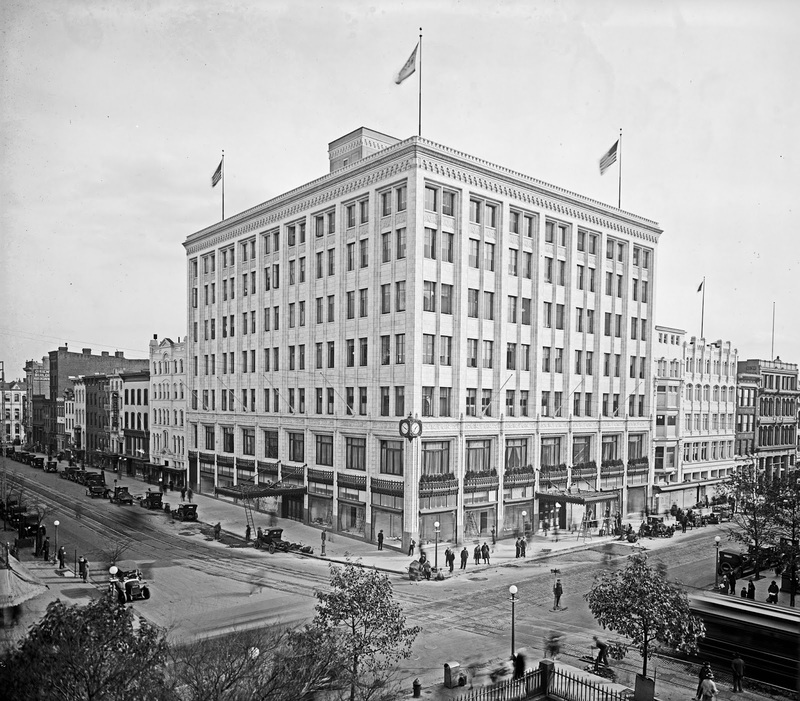
Marshall Fields, Wanamakers, Macy’s et al.

Hecht’s, the store of my hometown.

Time was every city, major and minor, had a homegrown department store. In the age of merchants, they were the original one-stop shopping for consumers.

They offered new conveniences like elevators and escalators to move customers from floor to floor, specialty candies (Hecht’s had this penuche-like confection that was always a holiday treat in my childhood,) and cafeterias.

You could find clothes, furniture, household goods, garden and yard items–if someone made it, they carried it. They were fully staffed with employees, okay salesmen, to provide assistance and escort customers to the checkout stand. Every department had them, salesmen and checkout stands, to serve customers.

Imagine a Walmart where each department (yes, they have departments but they blend them into one another so it’s not always easy to see) had dedicated people to help you (and let’s be honest, to suggest and sell you items to go with your purchase.) In addition, you didn’t fill a shopping cart full of items and go to the front of the store hoping for a little, trite interaction with the checkout clerk, but you paid at each station and could have a meaningful conversation with the helpful clerks.

Those were the days. You paid in cash or by check. If you had their credit card, which did not revolve (now there’s an old-fashioned term,) that you paid every month, your credit was gold. Only the most trustworthy customers qualified for store cards.

You got a meal in the store cafeteria, and most important, the food was good! It was one more draw to bring downtown workers into the store who more often than not purchased items on their way in or out. It always amused me that lady’s perfume was the first department people encountered when they walked in the door, the most impulse of impulse buys.

Department stores existed for a purpose and they served that purpose well as the one-stop shop. They had it all.

Federal departments exist for a reason. They gather under one roof all the government services and help that people might need. They administer the funding for the purposes that Congress appropriated the money for. They monitor for civil rights violations so that equality will be achieved for all. They carry out all the laws that pertain to their purpose.

Only if you think that the education of children is unimportant, a luxury, would you decide that the United States Department of Education is not needed. It exists for a reason, one that was so compelling that Jimmy Carter was able to persuade Congress to create it during his term, no matter how much it p*ssed Ronald Reagan off.

But that was then and this is now, critics say. Let’s go back to that department store, which has now suffered a 50% staff cut and closure of departments.

Customer: I need a blue suit. Where is menswear?

Second customer: I don’t work here. I’m looking for a couch. Got any ideas?

Employee walking out the door smacking her gum loudly: We had cutbacks. Men’s, women’s, and children’s clothing, along with cosmetics, jewelry, watches, and shoes, have been consolidated into the Human Adornments Department. Go to the basement. As for that couch, check the dumpster in the back alley.

First and second customers: Wow. Let’s go to the fourth floor cafeteria, have a drink, and talk about this.

Employee (with a snigger): We franchised that spot to Burger Queen a few years ago. They couldn’t make it and we certainly weren’t going to waste store money on a subsidy. Basement, dumpster. Get your sorry backsides to your locations.

Customer: How dare you talk to me like this?

Employee: Get thee to the basement. The big boss will walk through here with a Brazilian chainsaw in five minutes. Trust me, you don’t want to see that.

(In the basement) Customer: I need a blue suit.

Sole employee: Don’t bring that ‘I see color BS into MY store.’ All we carry is brown. That’s it. No color allowed in here; we follow Henry Ford’s philosophy, “My customers can have any color car they want as long as they want black.”‘

Customer: I want blue.

Employee: That’s the problem with you libs. Color this, color that. Well, let me TELL you something! Color is binary. We carry brown and black. Anything else is against nature.”

Customer: All I want is a blue suit. Are you going to sell me one or not?

Employee: If I do, then you’ll want alterations to make sure the suit fits you. We sell off the rack. One size fits all.

Customer: Well, I did have a growth problem in childhood. My right leg is one inch shorter than my left leg. I will need the store tailor to make alterations.

Employee, chortling: Oh, that’s rich. We fired all of them. They aren’t needed.

Customer: Whut?!

Employee: Look, pal, you aren’t meant to wear a suit. You’re not a suit-wearing guy, more like a crop-picking guy. Go down the street to the Farm Supply store. Or would you rather play with glue and glitter in the back of the classroom?

Customer: This is disgusting. This town doesn’t need a store like yours.

Employee: Finally getting it, hey Sherlock.

Customer: I need a blue suit. I have a funeral to go to.

Employee: Funeral? You wear black unless it’s your funeral.

Customer: Maybe it is.

Employee: OK, I’ve got you covered. Here’s a black suit, put it on, and go to the second floor, Paint Department. Let them spray you with the tint of your choice.