Cold As Ice: Update #3, The Posse

This series began with its first post February 4. Updates quickly followed: #1 on February 6; #2 on February 9. Now we are ready for Update , the deputizing of college campus police to enforce immigration law.

How fitting that when we think of undocumented immigrants coming across the southern border, we think of the American West with its images of deserts, sand, river gorges, buttes, cowboys, cattle, shallow rivers, watering holes, cottonwood trees, and bluebonnets. I suppose I should mention tumbleweed as well, an illegal alien from Russia, that invaded in the latter half of the nineteenth century, but well, tumbleweed is Russian so that illicit crossing of our nation’s borders is probably okay with the Trump administration.

Part of that nostalgic view of the West is the traveling judge holding court in the local saloon to deal out justice according to his idea of the law. Attorneys not being around, frontier justice was presented as a rough sort of justice enforced by a local sheriff and the men he chose to deputize.

Completing the picture was the outlaw, sometimes a loner but often part of a gang. The sheriff gathered a posse when outlaws were in the area to ride out and bring them in for whatever justice the sheriff had in mind. Printed posters proclaimed in loud, large letters: WANTED DEAD OR ALIVE.

While it is debatable as to whether that remembrance is more 1950s Hollywood than the historical reality, what is not debatable is that vision underlies the deputization of local police and other law enforcement agencies to act as ICE agents under deputizing agreements.

From a TV show.

Florida (state motto: where every bad idea is born) leads the way. The governor, senate president, and house speaker had squabbled over what to do when the governor called a special session to ramp up immigration law enforcement. In the end, during a succeeding special session, they enacted a law to force local law enforcement to assist with ICE and immigration enforcement by screening individuals for their status when they are detained or pulled over for a traffic stop.

This effort has now reached Florida’s college campuses. Florida Atlantic University, University of South Florida, and the flagship campus University of Florida are seeking to enter into deputy agreements with federal authorities. Other universities are joining them, including Jacksonville’s University of North Florida.

Joshua Glanzer, spokesperson for FAU, said this, “We are simply following guidance from the Governor’s Feb. 19 directive to state law enforcement agencies, of which FAUPD and other state university police departments are included.”

Under a 287(g) task force model, such as the agreement being pursued by the University of Florida, participating officers would have the authority to interrogate “any alien or person believed to be an alien” about their right to remain in the country, as well as the power to make arrests without a warrant in some cases.

https://www.news4jax.com/news/florida/2025/04/14/florida-universities-to-deputize-campus-police-for-immigration-enforcement/

Students have a different viewpoint from their universities. This new ability is making them feel unsafe and unable to participate in normal campus activities or access other campus resources students need like counseling or health care.

ICE says racial profiling is forbidden under its guidelines for local law enforcement, but let’s tell the truth. Racial profiling is a characteristic of the new administration’s policies overseen by Stephen Miller, Deputy Chief of Staff.

One worries that she could be pulled over on the flimsiest of excuses because a campus officer may decide that she doesn’t look like she belongs here, i.e., in the U.S and will be detained. What will happen then? (As if we don’t know.)

She cannot be the only one.

But the officers are being deputized and their posse is riding to root out undocumented immigrant students. This is the new reality descending upon Florida’s college campuses.
Good Evening, Jacksonville! Final Notes from NPE

I’ll be traveling home tomorrow. Today’s sessions focused on justice and fairness for all. I don’t have many notes to share, but that gives me some space to give some overall impressions.

If I was You-Know-Who, I would want you to feel cut off … because if it’s just you alone, you’re not as dangerous.

One thing I heard many times this weekend is how people have been feeling alone, fighting the good fight, but alone. I must confess I have been feeling like this, too. So much of what everyone is doing seems to have no effect. That’s what the privatizers want us to believe. They are winning; we are losing.

So, if for nothing else, conferences like these are essential (not important as one presenter stressed. Public schools are not important; they are ESSENTIAL.) They allow us to reconnect with like-minded persons and realize more than that we are not alone, but there are more of us than of them. This conference re-energized a lot of people who have been doing the hard work, good work, and I felt re-energized standing among them.

There were more tips about cultivating relationships with local reporters to pitch stories that matter and amplify stories about education when found. Tips about cultivating relationships with legislators even if they don’t want to see a defender of public ed coming. Tips about finding existing advocacy groups to join. We don’t have to do it all by ourselves.

I attended a session about justice for the disadvantaged. It began with a session about the Willowbrook School on Staten Island, which existed to institutionalize children with disabilities, and the terrible conditions found there. The woman who presented the history shared that her mother worked there and blew the lid off with the media about the terrible conditions.

That was before the IDEA act and the movement in the 1970s to close the institutions and to provide the services disabled children need to allow them to participate as much as they are able in public education and the workforce. (Personal note: listening to someone recount how bad it was and show pictures brought tears to my eyes.)

What we have achieved since then is important: providing opportunities and dignity for everyone regardless of how they started in life.

In another session, Derek Black talked about the history of literacy and how the suppression of Black learning hurt the South, both Black and white alike. His new book is Dangerous Learning: The South’s Long War on Black Literacy. He is also the author of Schoolhouse Burning, Public Education and the Assault on Democracy.

I have not read either, but I will be soon. I hope the Jacksonville Public Library has copies available.

As the moderator said, “History does not repeat itself, but it echoes through the ages.”

The conference wrapped with a keynote address by Tim Walz, who encouraged everyone to keep doing what we do: educate the public about what is at stake. His message was that he knew he was preaching to the choir, but the choir needs to sing louder. He said we would lose a lot in the years to come, but power will shift and we can build back better our institutions.

Randi Weingarten, President of the American Federation of Teachers, introduced him. She gave us this–there is a shift taking place. Democrat and Republican alike are opposed to the fundamental destruction of our federal government and the services it provides that we need. We must never say, “I told you so.” We must focus on building coalitions of the middle class, the working class, and the poor because people, all people, are seeing that their lives are under threat.

Together, we are many. We are not alone.

Hello, Jacksonville! Notes from NPE

I am currently attending the Network for Public Education conference in Columbus, Ohio. Here are some notes of interest from the sessions I attended this morning.

I. Strategies for School Board Elections.

Avoid an ‘us versus them’ mentality. Approach voters and community members with something like “Can we agree that strong public schools benefit our community, city, and district?” Emphasize that regardless of the choice of school a parent makes, the anchor that public schools provide to their communities is essential to the stability and wellbeing of their communities.

Fundraising is difficult. One panelist said that she would handout lists of 20 addresses to people who supported her but couldn’t make a donation. She would ask them to write a message, spring for the stamp, and send the cards. Elections are expensive with the costs of advertising and mailers.

Once a candidate declares they are running, they will be met with an onslaught of lies and deception about who they are. Unless countered, people will believe these messages. One panelist said she sat at her kitchen table and made a video for online sharing about who she really was: a parent, head of the PTO, and community member. “Do I seem like the person the opposition groups are making me out to be?” Another went out door-knocking every time a new mailer was dropped so people would realize she wasn’t the crazed fanatic she was made out to be. In both cases, they won their elections.

It takes time to win elections. If someone wants to run, start early to have time to organize and build a campaign, especially with acquiring staff. Finding skilled campaign staff can be difficult.

II. School Closures.

The playbook we’ve seen in Duval County is the same as the playbook being used all over the country. The panel began by asking us how many have heard of declining enrollment and budget shortfalls. Everyone raised their hand. Then, how many of us have had schools closed in the last two years. Everyone raised their hand. Finally, how many of us have planned closures coming in the next two years? Almost all of us raised our hands.

They outlined the strategy:

  1. The school district raises the issue of declining enrollment and budget concerns.
  2. A consultant is hired (from a limited group that operate nationally and make this their specialty) to develop a plan.
  3. The consultant creates a list of schools to close.
  4. The public finds out about the consultant and the plan, but has a short time to organize and fight the plan. (This one really resonated with me because I went back through school board minutes and workshop agendas to find out when the Duval consultant was hired. I couldn’t find the meeting where a contract was approved. The panel talked about how most of work done by district staff is done in secret.)
  5. The school board votes to close schools.

Often, budget presentations are made without detailed, supporting data or context, but with a presumption that closing schools will save money. Many times, that presumption is not verified through analysis.

One audience member pointed out that school systems who have lost their enrollment (e.g., Columbus, Ohio had 110,000 students in 1971 but currently has 46,000 students) combined with the accompanying budget shortfalls cannot sustain the number of schools that they once needed.

This, of course, is true of Duval, one of the reasons I have not written or worked in this area. Closing schools is an emotional wrench for the parents and communities. I will not have the hubris to think that I know which ones should close and which ones should stay open. But this session has opened my mind to looking at the problem in other ways.

School property is valuable property. Developers push the failing narrative to get their hands on it. Even now, a bill is in the legislature to force Florida districts with schools that do not meet an enrollment threshhold (I believe it’s 50%) to turn those schools into senior residential living, community centers, or charter schools. These options would require renovation and that gets private developers in the door.

The panel proposed a change in the mentality–districts should stop managing decline and focus on growth with a community school concept in mind. I heard mention of Cincinnati, which utilizes portions of their school buildings for community needs like dental clinics and meeting space for community organizations. I haven’t had time to research this as I mention it in passing.

Boards, superintendent, parents and community members need to organize and work together to accomplish the following:

  1. Pause school closures
  2. Engage the entire community
  3. Develop a plan for growth that matches the growth of the area
  4. Keep, not sell, school buildings.

Choose targets wisely, that is, those with decision-making power. Use the media to change the narrative. Shape popular decisions.

That’s it for now. Afternoon sessions are starting. I’ll report what I learned later tonight.

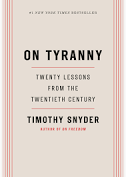
On Tyranny: Lessons for Educators 6

Reflections on the short yet deep book of Timothy Snyder.

Be wary of paramilitaries. When the men with the guns who have always claimed to be against the system start wearing uniforms and marching with torches and pictures of a leader, the end is nigh. When the pro-leader paramilitary and the official police and military intermingle, the end has come.

We need to rewrite those first sentences to make an analogy for educators. After all, no extralegal authorities are strolling our schools’ hallways–at least, not yet.

Be wary of astroturfed community groups. When the people with a political agenda who have always claimed to be against public schools start wearing the same t-shirts and showing up at school board meetings marching in lockstep, the end is nigh. When they take seats on the school board and hire like-minded superintendents, the end has come.

Oh, Duval! You are low-hanging fruit for this post. But I have bigger fish to fry. Lest you think that’s a mixed metaphor, feast your eyes on this.

Yum?

Moms for Liberty, anyone? Other groups who use the public comment portion of a school board meeting to tag team a reading of passages from a book they consider obscene? But they are not satisfied with performative politics on the outside.

They are running for office. Most places, a few individuals may win, but they don’t grab control of the school board. In some places (Duval, cough, cough) they find success.

When federal and state authorities conspire together to castrate their respective Departments of Education, the end has come. Linda McMahon is such a disappointment. Given her background in the pro wrestling biz, we know the outcome is scripted but at least there should be a good show.

Kitty litter boxes for furries, slandering teachers as groomers and pedophiles, and faking outrage over the issue du jour, they are riding their high horses into positions of power.

We are left to ask, “Has the end come?”

You know the answer.

On Tyranny: Lessons for Educators 5

Reflections on the short yet deep book of Timothy Snyder.

Remember professional ethics. When political leaders set a negative example, professional commitments to just practice become more important. It is hard to subvert a rule-of-law state without lawyers, or to hold show trials without judges. Authoritarians need obedient public servants, and concentration camp directors seek businessmen interested in cheap labor.

What are ethics? According to dictionary.com, ethics are “the rules of conduct recognized in respect to a particular class of human actions or a particular group, culture, etc.” Also, “a system of moral principles.”

Most states have ethical codes for teachers. You can find Florida’s here. It’s subdivided into three categories regarding obligations to students, the public, and the profession.

Florida’s code of educator ethics is based upon the model code developed by the NEA (National Education Association.) It’s based upon an educator’s obligations to students and the profession.

Among the ethical obligations are not to restrain the freedom to learn even that experienced through independent action, to ensure equal opportunity for all, allow access to varying points of view, and not to suppress or distort subject matter so as not to impede a student’s progress in learning.

Living through these dystopian times, aren’t we seeing the subversion of quality education as these ethical obligations are plowed under much as a Deere harvester machine mows, threshes, and leaves the residue behind for a plow to turn under the ground?

Public schools, despite all the attempts to end them, have stubbornly held on. Much of that has come as educators have resisted the reforms that have worked to park students in front of computers for the entire school day (independent action NOT,) resegregate schoolhouses through the use of charter schools and targeted marketing (equal opportunity NOT,) script curriculums and assign test preparation that steer students to the one allowed answer (varying points of view NOT,) and remove books from school libraries, suppress Black history courses, and eliminate anything other than Lost Cause-inspired views of history (suppress or distort subject matter YES.)

“When political leaders set a negative example, professional commitments to just practice become more important.” Educators following the ethical code must maintain their ethical commitments and follow through as necessary.

No one is saying this is easy, but no one is saying that it means being combative or self-righteous as an educator goes about her daily work. Every educator has to determine how to navigate the path they are on. Authoritarians come in many guises and they work on many levels in a district’s bureaucracy. The first thing an educator can do is learn how to recognize them.

Then, resist. Don’t be an obedient public servant. What form and action that takes depends upon an educator and their circumstances. But don’t become complicit and a tool of the forces decimating public education. The ethical commitment to students and the profession demand it.

The Tesla Tank

I will not offend your eyeballs or your ears with a picture or a mention of that vehicle. Suffice it to say that today I saw two on the brief stretch of interstate I use between my library branch and home. It still is ugly to my eyes, even if one owner painted theirs all black and another painted theirs with a black roof and olive green sides. I kept an eye out for flying side panels.

The Rise and Fall of the Elon Empire.

This is the tank I’m talking about–the tumble in stock price of Elon Musk’s central business, one that has lost 48% of its value from its peak in mid-December till now. (Although this is a concern for Musk, it does not mean his house of financial cards is about to fall. Note that today’s price is the same as it was in October.)

Around the world, Tesla has lost its cachet. 94% of Germans say they would never consider buying a Tesla. Sales are down across the globe. In America, Tesla owners are desperately trying to shed their vehicles, but Trump’s supporters are all-in on gasoline, not electric-fueled vehicles.

Not to mention the competitive challenge Tesla faces as Chinese EVs (Electric vehicles) overtake it. Tesla is the overpriced Macbook to Chinese Windows-running computers. But the snob appeal is gone as Musk has become in only two months a toxic personality that consumers loathe.

It’s so bad that the huckster-in-chief, the con of cons, the man who wrote the book on how to build and then ruin a brand, the man whose picture is on the page when you look up grifter in the dictionary, had to promote someone other than himself and staged a Tesla sell-a-thon in the driveway at the White House.

Why, it’s almost like parents CHOOSING to abandon their public school for one of the many options now available. Why are people who push hard for school CHOICE upset now that automobile owners are CHOOSING to abandon their Teslas for a different vehicle? Isn’t that their CHOICE?

Muskrat Love is NOT on my playlist.

Just as the Muskrat wielded a chainsaw on stage, one gifted to him by Argentine’s current president, Javier Milei, and said he would use it on the federal bureaucracy, including the Education Department, investors took a look at the stock price and rebelled. It seems Elon has become toxic and Tesla’s Board of Directors is concerned to the point of discussing his continuing involvement with the company. They also are looking out for themselves as they sell off their stock in the business.

Not even the best oligarchs can save this mess. Their expertise lies in monopolizing markets and taking choice away from consumers. Then, they can charge whatever they want, which is probably their end game. I used to think that they wanted parents to have to bear the full cost of educating their children, thereby eliminating public schools and school taxes. But the profit motive is strong–strong enough for them to want to eliminate public schooling as the most cost-efficient and effective means of delivering education to children so parents have no choice but to pick a profit-generating alternative.

Then again, I don’t think this is a universal plan among the ‘garchs. Some of them must be planning to replace their wage-busted undocumented workers, now deported or soon to be, with children. After all, if their parents can’t afford to send them to school, they are available to work. Isn’t this why states are weakening child labor laws?

What a dream! It’s as if the Gilded Age has returned in all its ugliness and fury as a few ‘garchs gather control of the entire economy into their hands. Vanderbilt, Morgan (JP), Gould, Carnegie, Rockefeller et al. approve.

We used to think Connect-The-Dots was a children’s game as we adults try to figure out what the ‘garchs and their stooge in the White House are really up to. Maybe it still is, but the children no longer hold the pencil. They are the dots.

On Tyranny: Lessons for Educators 3

Reflections on the short yet deep book of Timothy Snyder.

Beware one-party states. The parties that remade states and suppressed rivals were not omnipotent from the start. They exploited a historic moment to make political life impossible for their opponents. So support the multi-party system and defend the rules of democratic elections. Vote in local and state elections while you can. Consider running for office. (Timothy Snyder, On Tyranny, Chapter 3)

I suppose I could write this post in one word: FLORIDA.

Florida, a state now suffering under super-majority Republican rule, which means the Democrats still in office cannot use the few privileges of a minority party to stop bad laws.

Combine that with a governor who pushed the power and reach of his office to unprecedented levels, who cowed the super-majority into supporting his policies and ambitions, and you have a state beyond the control of the people because the radical Republicans have hopelessly gerrymandered the state into an enduring network of fiefdoms. This despite the fact that Florida has Fair Districts Amendments in its constitution. See here for an explanation of how the amendments work and the shenanigans that followed.

I am disappointed in the impotence, ineffectiveness, and incompetence in the current Democratic leadership to form an effective opposition to Republican steamrolling both nationally and statewide. I have been ready to switch my registration back to NPA, but then I thought, if I live in a one-party state, maybe I should grit my teeth and register Republican because the real choice to be made is in the primary.

But I cannot stomach that thought or take that action. In the afterlife, I don’t want to have to explain why I got into bed with devils.

What has been the effect of this one-party state, one with the most extreme of radical educational reformers destroyers?

  • Unlimited vouchers most of which now go to people who already were paying for the children to attend private or parochial schools.
  • Book-banning in which the school library is restricted to only those books that contain the correct thinking.
  • Abstinence-only sex education for adolescents, which has been shown to impair health and increase unwanted pregnancy.
  • A testing regime that goes on and on even when it has lost its purpose.
  • The casting aside of elected officials on the flimsiest of excuses, a phenomenon that cannot have escaped the notice of elected school board members.
  • A state school board made up of sycophants and toadies, whose only purpose is to serve coffee and donuts and receive marching orders written on napkins.
  • A take-over of universities, all for the purpose of purging academic freedom that goes back 1000 years to the first centers of education and for pillaging the finances and rewarding presidents, whose only qualification consists in shouting, “Hear, here,” to the governor.
  • A state mired in mediocre or worse academic achievement in its schools no matter how loudly it blasts the success of the Florida model.

Beware one-party states, America. Don’t be Florida.

Catfight

Control of the litter box is very important.

When there’s a change in power on a school board, the hope of the electorate is that they have chosen serious people who will focus on issues of importance, the ones on which they based their vote.

Sometimes, it doesn’t work out that way.

In the latest news from Duval County, FL, the school district where I worked for 18 years before retiring and still live, the school board members are feuding over travel reimbursements.

In December, the Board approved the travel of five members to the School Boards for Academic Excellence conference. Much has been written about the SBAE and there’s no need to rehash it. Suffice it to say they are another start-up group with right-wing views and cultural grievances. To read a little about what the conference was like, check out Accountabaloney’s report on her attendance.

It was a controversial decision. Here’s the screenshot from the Board minutes:

Interestingly, SB Member Blount voted against the reimbursement even though he was one of the members registered to attend the conference.

At the latest meeting, Member Willie asked for approval for travel to attend the Council of Great City Schools, an organization with which the school board has a long-standing relationship and has recently appointed Mr. Willie to its executive committee.

While most boards would celebrate the recognition of one of its members as worthy of a leadership post, Chairperson Joyce disagreed. She announced she would vote against all travel for Mr. Willie to attend meetings.

We call this tit-for-tat. While this petty behavior is disappointing for the top leader of the school system to indulge in, it is not surprising. Ms. Joyce ran her first campaign as the friend of public education in the race stressing her employment in a local middle school versus her opponent who was an outspoken supporter of charter schools.

However, when Ms. Joyce was elected, one of her first votes was to authorize a new charter school that was woefully unprepared to operate a school. Her explanation? Her husband told her to vote yes on the application.

As she continued down the path of public bad, private good, she explained it’s what her voters wanted. (Gotta call BS on that. It’s not what THIS voter wants; I live in her district.)

Now, not satisfied with denying Mr. Willie’s travel, she plans to end the district’s participation in the Council of Great City Schools altogether. She will vote no in the coming months against renewing the membership.

This is Level 4 conflict, a concept that needs a full post of its own. Suffice it to say, she won’t be satisfied with winning on the issue leaving Mr. Willie the loser, she wants to pull the district out of the Council altogether.

With a $100,000,000 budget shortfall, building closures and resetting neighborhood boundaries, crowded schools and schools under 50% capacity, schedule changes, class size issues, and more, it is strange for the board to get caught up in ‘spat about travel.’ (I put the words in quotes because it is the headline for the article that prompted this post.)

Parents, students, and community members deserve better.

Cold As Ice: Update #2

The contagion spreads. Last week, I described a new policy issued on a pre-emptive basis for what Duval County (FL) Public Schools should do if Immigration and Customs Enforcement shows up at the door. Then, the School Board’s attorney explained his reasoning for issuing his memo establishing the new policy, which resulted in an update. But it seems this will be the never-ending story and thus, a never-ending series.

From Florida Today, as reposted by the Florida Times-Union: Six central Florida school districts have issued their own policies regarding what to do if ICE shows up. Spoiler alert: it’s worse than Duval. The six districts are Brevard, Orange, Volusia, St. Lucie, Osceola, and Seminole.

  • Verify ICE agent’s identity via badge, photo ID, or business card. (Business card?! As in all it takes is a trip to a local print shop in order to gain access to schoolchildren?)
  • Warrants are not needed for ICE to gain access to a campus, although agents must sign in and out following visitor procedures in the front office.
  • Administrators should attempt to contact parents before agents interview their child, but if the agents tell the school not to, they shall comply with the order.
  • Administrators should attempt to remain in the room during the interview, but if the agents order them to leave, they shall comply with the order.
  • If a child is arrested, the parents should be informed immediately, except in Brevard, which says that is the responsibility of the law enforcement agency, which in this case would be ICE. In St. Lucie and Osceola, if ICE directs the school not to notify parents, that should be documented.
  • St. Lucie, Volusia, and Seminole districts warn employees that they are subject to arrest or other legal consequences if they do not follow the directions given to them by ICE.
  • A subpoena or court order is needed for ICE to access student records.

Credit to Finch Walker of Florida Today, who investigated and wrote the story. (Sorry for the paywall, but the USA Today chain does not give subscribers the ability to gift articles like the New York Times or Washington Post.)

Soooooooooooooooooooooooooo, school employees are told to follow ICE orders even if not legal or they will end up in the slammer themselves. As for the children, they have the right not to answer questions and request a lawyer, but, as an ACLU lawyer notes, that’s really hard for someone so young to do as they are conditioned to follow the directions of adults and answer questions, especially on school campuses.

It’s hard to say where this is going. Most of what’s been done and publicized by the new administration has been for show. In reality, detention centers are full, the Trump-derided-as-catch-and-release (a fisherman’s conservation principle) policy is still being followed, and ICE lacks by magnitudes the resources needed to carry out what the Trump campaign bragged what it would do on its first day.

However, it is alarming that these school districts are falling into line ahead of an actual need. They signal they are ready, able, and willing to help deny the rights of children, all children regardless of immigration status, to a free and appropriate public education.

As for now, due to a 1990 court case between the Florida State Board of Education and various advocacy groups, schools are not allowed to ask immigration status when enrolling children, schools may not refer students to ICE, and, as noted, may not deny educational services based upon immigration status.

I wonder how long that will last.

Teaching the Full and Complete History of a Nation

February is Black History Month. If your first instinct is to snarl, whine, or otherwise complain that there’s no white history month, you can skip this post. Every month is white history month. Others need a point of emphasis once a year to remind us that their history is our history, too. The accomplishments, triumphs, defeats, hardships, and resilience of others have contributed to the history of America as well.

Great nations do not spin a mythology to proclaim their magnificence. Great nations face their past, the glorious and the shameful, to learn how to be a great nation. Great nations celebrate the contributions of all their people, the lesser and the more, that have made them what they are. Great nations do not shy away from the truth of their past because it informs and shapes their present.

That brings us to the joint statement released by the American HIstorical Society and Organization of American Historians regarding the January 29 Trump executive order regarding the teaching of history in school:

The executive order “grossly mischaracterizes history education across the United States, alleging educational malpractice.” “The executive order’s narrow conception of patriotism and patriotic education does more than deny the actual history of American democracy; it also undermines its own goals of a rigorous education and merit-based society,” the statement reads. “We reject the premise that it is ‘anti-American’ or ‘subversive’ to learn the full history of the United States with its rich and dramatic contradictions, challenges, and conflicts alongside its achievements, innovations, and opportunities.”

This month, we celebrate Black History Month and the contributions and hardships that Black people have faced as they live in the United States of America. We’ll follow that with Women’s History Month (March); other months will follow including Hispanic Heritage (mid-October to mid-November) and Native American (November).

We will also have Pride Month in June. All of these are Americans and their story is a part of everyone’s story. We need to borrow those red hats and change them from ‘Make America Great Again’ to ‘Make America Great as She Has Never Been Before but Aspires to Be.’

(But MAGASHBBBATBE doesn’t have the same ring, does it? Especially the stutter in the middle–not to mention trying to fit that on a baseball cap!)

The propagandization of a white-washed history has no place in our schools as the statement points out: This executive order, however, mandates ideological instruction and the politicization of history grounded in ahistorical thinking. The order draws upon the deeply flawed and roundly debunked 2021 report of the “President’s Advisory 1776 Commission”—a panel devoid of experts in the history of the United States—which the OAH characterized in 2020 as a partisan attempt to “restrict historical pedagogy, stifle deliberative discussion, and take us back to an earlier era characterized by a limited vision of the US past.”

It’s worth your time to click on the link and read the full statement. I’ll close by quoting their final paragraph, “Like all histories, American history is complicated and fascinating; learning about our past should stimulate discussion and debate rooted in evidence and professional scholarship. For that to happen, we must let our teachers do what they do best: teach without interference or ideological tests. And let our students learn how to think, rather than what to think.” [Emphasis mine.]