On Tyranny: Lessons for Educators 3

Reflections on the short yet deep book of Timothy Snyder.
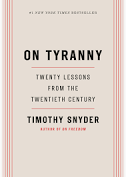
Beware one-party states. The parties that remade states and suppressed rivals were not omnipotent from the start. They exploited a historic moment to make political life impossible for their opponents. So support the multi-party system and defend the rules of democratic elections. Vote in local and state elections while you can. Consider running for office. (Timothy Snyder, On Tyranny, Chapter 3)

I suppose I could write this post in one word: FLORIDA.

Florida, a state now suffering under super-majority Republican rule, which means the Democrats still in office cannot use the few privileges of a minority party to stop bad laws.

Combine that with a governor who pushed the power and reach of his office to unprecedented levels, who cowed the super-majority into supporting his policies and ambitions, and you have a state beyond the control of the people because the radical Republicans have hopelessly gerrymandered the state into an enduring network of fiefdoms. This despite the fact that Florida has Fair Districts Amendments in its constitution. See here for an explanation of how the amendments work and the shenanigans that followed.

I am disappointed in the impotence, ineffectiveness, and incompetence in the current Democratic leadership to form an effective opposition to Republican steamrolling both nationally and statewide. I have been ready to switch my registration back to NPA, but then I thought, if I live in a one-party state, maybe I should grit my teeth and register Republican because the real choice to be made is in the primary.

But I cannot stomach that thought or take that action. In the afterlife, I don’t want to have to explain why I got into bed with devils.

What has been the effect of this one-party state, one with the most extreme of radical educational reformers destroyers?

  • Unlimited vouchers most of which now go to people who already were paying for the children to attend private or parochial schools.
  • Book-banning in which the school library is restricted to only those books that contain the correct thinking.
  • Abstinence-only sex education for adolescents, which has been shown to impair health and increase unwanted pregnancy.
  • A testing regime that goes on and on even when it has lost its purpose.
  • The casting aside of elected officials on the flimsiest of excuses, a phenomenon that cannot have escaped the notice of elected school board members.
  • A state school board made up of sycophants and toadies, whose only purpose is to serve coffee and donuts and receive marching orders written on napkins.
  • A take-over of universities, all for the purpose of purging academic freedom that goes back 1000 years to the first centers of education and for pillaging the finances and rewarding presidents, whose only qualification consists in shouting, “Hear, here,” to the governor.
  • A state mired in mediocre or worse academic achievement in its schools no matter how loudly it blasts the success of the Florida model.

Beware one-party states, America. Don’t be Florida.

Teaching the Full and Complete History of a Nation

February is Black History Month. If your first instinct is to snarl, whine, or otherwise complain that there’s no white history month, you can skip this post. Every month is white history month. Others need a point of emphasis once a year to remind us that their history is our history, too. The accomplishments, triumphs, defeats, hardships, and resilience of others have contributed to the history of America as well.

Great nations do not spin a mythology to proclaim their magnificence. Great nations face their past, the glorious and the shameful, to learn how to be a great nation. Great nations celebrate the contributions of all their people, the lesser and the more, that have made them what they are. Great nations do not shy away from the truth of their past because it informs and shapes their present.

That brings us to the joint statement released by the American HIstorical Society and Organization of American Historians regarding the January 29 Trump executive order regarding the teaching of history in school:

The executive order “grossly mischaracterizes history education across the United States, alleging educational malpractice.” “The executive order’s narrow conception of patriotism and patriotic education does more than deny the actual history of American democracy; it also undermines its own goals of a rigorous education and merit-based society,” the statement reads. “We reject the premise that it is ‘anti-American’ or ‘subversive’ to learn the full history of the United States with its rich and dramatic contradictions, challenges, and conflicts alongside its achievements, innovations, and opportunities.”

This month, we celebrate Black History Month and the contributions and hardships that Black people have faced as they live in the United States of America. We’ll follow that with Women’s History Month (March); other months will follow including Hispanic Heritage (mid-October to mid-November) and Native American (November).

We will also have Pride Month in June. All of these are Americans and their story is a part of everyone’s story. We need to borrow those red hats and change them from ‘Make America Great Again’ to ‘Make America Great as She Has Never Been Before but Aspires to Be.’

(But MAGASHBBBATBE doesn’t have the same ring, does it? Especially the stutter in the middle–not to mention trying to fit that on a baseball cap!)

The propagandization of a white-washed history has no place in our schools as the statement points out: This executive order, however, mandates ideological instruction and the politicization of history grounded in ahistorical thinking. The order draws upon the deeply flawed and roundly debunked 2021 report of the “President’s Advisory 1776 Commission”—a panel devoid of experts in the history of the United States—which the OAH characterized in 2020 as a partisan attempt to “restrict historical pedagogy, stifle deliberative discussion, and take us back to an earlier era characterized by a limited vision of the US past.”

It’s worth your time to click on the link and read the full statement. I’ll close by quoting their final paragraph, “Like all histories, American history is complicated and fascinating; learning about our past should stimulate discussion and debate rooted in evidence and professional scholarship. For that to happen, we must let our teachers do what they do best: teach without interference or ideological tests. And let our students learn how to think, rather than what to think.” [Emphasis mine.]