Community Meeting #1

To Find a Superintendent. But first some music to set the theme:

Florida superintendents these days are rarer than hen’s teeth.

We in Jacksonville are looking for a new Superintendent to lead our schools as are many other school districts in Florida. The school board has contracted with the Florida School Board Association to lead a process of developing a profile of the type of superintendent wanted by the community, helping them process the input and develop a job description, and lead a search for candidates. At the conclusion of the process, the school board will decide upon persons to interview on the way to making a hiring decision and extending an offer.

Today was the beginning of that process with the first meeting to which community members, including parents, were invited. It was not well attended, most likely due to the rural location (more cows than people) and the timing for a midday session. But it’s a start.

After an explanation and rundown of the timeline for this process up to the moment the board anticipates making a decision, the board member for the area read a short statement about the purpose during which she emphasized more than once that she would leave the room once she finished so the attendees would feel free to express their ideas.

My purpose in attending was to bring a teacher’s viewpoint to the discussion of what was needed in a new superintendent. One of the most significant stakeholder groups (sorry for the jargon,) teachers are often left out as the district attempts to make a showing of wanting to hear from the community and parents.

As participants, we were asked to answer three questions. Unlike the online survey, which you can answer here, that only gives you preformulated options to choose from, the community meeting allowed open-ended responses. … at least that’s what I remembered. A quick review of the online survey shows that it begins with some preliminary questions as I’ve described before allowing open-ended responses to two of the three open-ended questions: the strengths of the district and the challenges of the district. The online survey does not give an opportunity to provide feedback about the qualifications required.

Question 1: List the strengths and those areas of Duval County Schools that the next superintendent will need to understand and continue to support.

There were many answers. I focused on two: that our school system has diversity and inclusiveness for all students. Every child is welcome in our schools and has a place. Second, that our school system has talented and hardworking teachers.

Question 2: What are the most critical needs and challenges of Duval County Schools that the next superintendent will need to understand and address.

Lots of answers rolled in for this one. This meeting was also held online for people to join remotely. I don’t know how many did, but enough for lots of answers. As a sidebar, this was made possible by the facilitators having someone dedicated to managing the online part, gathering that input, and relaying it to the room via an audio link. It worked unlike a few years ago when school systems tried to make teachers do the same jobs alone in response to having in-person and remote learning options during the pandemic. To Duval County’s credit, they abandoned that idea over the summer.

Issues raised:

  • School police being subject to the superintendent’s authority. People thought that they should report to an outside law enforcement agency.
  • Need for a variety of programming in all schools, not only the magnet schools. Of particular focus was a desire for CTE or vocational training for students whose path did not lead to college.
  • School autonomy to make the decisions that work best for each school versus micromanagement from the district. (That was one of mine.)
  • Too much screen time in classrooms that sucks the joy out of learning and leads to discipline issues. (That was also mine.)
  • Retention of teachers and pay issues.
  • Condition of building facilities. This one surprised me given the half-penny sales tax and the plans for complete rebuilds or renovations of all schools. Perhaps people felt it wasn’t going fast enough or their school wasn’t high enough on the priority list.
  • Services needed in neighborhoods with economic/social needs and problems.

There were more, but those are the ones I remember.

Question 3: What personal qualities, professional experience, and other skills should the Board look for in the next superintendent?

This is the one that’s not in the survey. I had no response for this. Over the course of a long career, I have had success in many things in many places. But hiring is not one of them. Nevertheless, at the end of the session, when we had three blue dots to put on the charts to mark the most important qualities, I chose professional educator, apolitical (as in not being political, this one took the facilitator a few moments to understand the response was not a political,) and involved in community.

Then, as we went to leave, the media descended. What I remember as I type this up is that they wanted to know if we felt that we were heard. I said yes, I believed I was heard. Whether that would be true at the next step as the charted responses were shared with the board–I had no idea.

Did I have faith in the board? I said I was optimistic at this point that the board wanted to find the best person for the job and was interested in what the community thought. A fellow participant was a little more reluctant about that.

But I will not prejudge this board or its members despite some of the shenanigans they have indulged as the culture wars wash into their meetings. I will give them the benefit of the doubt until they take that away.

There are more community meetings planned. I highly encourage everyone with a stake in Duval County Public Schools (Jacksonville, FL) to attend one of them.


Dear Al (and First Coast Connect)

You almost get it–almost–as to why teachers are leaving the profession and why there are many vacancies to be filled.

Before we begin, let’s deal with the number of teacher vacancies that the school district announced in Tuesday’s board meeting: 258, which is far less than what they have been experiencing at the start of a new school year. The mood was celebratory, even gleeful, that this was the best position they have been in years.

But there’s a reason for that. In Spring budget meetings, when the district projects enrollment for the fall and adjusts the number of teaching positions at each school, the district projected a 20% reduction in enrollment due to the new universal voucher law.

Frankly, I think that’s overly pessimistic, but based on that projection, the district eliminated a lot of teacher positions for the year about to begin. It’s known as surplus. Because of attrition due to retirement, movement to other districts, and relocation out of state, many positions were open where the teachers displaced by surplus could be put.

Thus, the only reason the vacancy number is low is because the district eliminated positions. What happens if students don’t leave in the numbers anticipated?

The district has to restore positions. Don’t be surprised if that 258 number is closer to 750 once the 10-day count is done and September arrives.

You and your panel wouldn’t know this unless you ask the hard questions. Don’t take anything the district says at face value. They will tell you the half of the story they want you to know. You have to get after the other 50%.

Now for why there are vacancies. Not only are teachers leaving the profession, but young people are making the choice not to be teachers and to enter other careers.

Yes, pay is an issue. The citizens of Duval County passed a referendum for an additional one mil of taxation (0.1% of appraised property value) that will mostly be used to supplement salaries. However, the new school year beginning August 14 is the first time this additional pay will show up in paychecks. The additional mil began with last year’s property taxes, the county has been collecting it, but not until this month will the money begin flowing to teachers.

Nevertheless, (my opinion) the pay situation is brighter than it has been in years. People will argue whether it’s enough given what other persons with college degrees earn, but frankly, it’s a 10 to 12% boost for most teachers and that’s a lot. I expect to see a lot less Facebook posts from teachers wondering how they will pay their rent.

It’s more than compensation. Yes, school safety is a concern. However, if the principal is doing it right, the drills are not traumatic for students and teachers. We practice sheltering in place: cover the windows, turn the lights out, squeeze into the hard corner, and get on the floor. Drills are announced clearly, “Code Red. Code Red. Code Red. DRILL.” Everyone knows there’s no actual threat on campus; it’s only practice.

The daily occurrences of school violence is discouraging, though. To work in a school means to wonder if on any given day, it will happen to me. The probability is extremely low, but it’s not zero.

The impact on vacancies is analogous to the U.S. military, which is facing unprecedented recruitment challenges. They are not meeting their goals. Why? Unemployment is at historic lows, real wages (adjusted for inflation) are rising, and high school graduates find that their predecessors may have seen the military as their only worthwhile option for employment, but they have a choice. Also, the ongoing wars of the last 20 years and the prospect of death make the military less attractive as well.

Young people have more options. It’s not only that teachers are leaving the profession; it’s that too few young adults are choosing to enter.

It’s more than compensation and safety. Yes, it’s the fear not only of losing a job, a certificate and a career that would trash a significant investment of time and resources, but also a fear of being charged with a crime for showing a Disney movie in the classroom or reading a book to young children.

The maddening thing is the vagueness of it all and the standard that no child can feel uncomfortable, which leaves teachers vulnerable to the attack of one angry parent even if 30 or 100 parents defend the teacher.

All these things are contributing to the teacher shortage. You and your panel did an admirable job in covering them in your short segment after y’all spent 30 minutes discussing the Trump indictment.

But you’re missing what is even more fundamental. I suppose that is because you talk as journalists who have children in school, have a spouse or a friend as a teacher, and you consider that enough. You’re not getting the inside story, the real story, because you are satisfied with that.

It’s the lack of respect. That is what is truly driving teachers away. It is a culture, a state, a school system, and a district administration that believe that professionally trained teachers do not know what they are doing. Every minute of their day has to be managed, controlled, and directed.

It’s sad what is taking place in Duval County. No one talks about it because they are not in a school everyday walking around seeing what is going on. I was. Children spend all day on screens, doing online curriculums and online assessments. The district has abandoned print textbooks in favor of online versions. That is why every secondary student has to be issued a district laptop. Without it, they have no means of accessing the mandated curriculum for learning.

The district monitors the minutes spent on these programs and will contact a school’s administration if they decide the classrooms are short of the required minutes. How many administrators, feeling their own pressure for performance, will take the heat? Administrators have no job protections. They can be reassigned at a whim and their annual contracts can be non-renewed.

Who’s going to kick back? Another manifestation of disrespect is the weekly inspections that district personnel occasionally join in the classroom. We don’t trust teachers to do their jobs; administrators must continually visit classrooms to be sure. They are required to document the lesson and check off a list as to how well the teacher complied with demands.

They have a tablet for it. The program tracks the amount of time the administrators spent in the classroom to make sure it meets the district minimum requirement. Apparently, the district doesn’t trust school-based administrators either.

Then there is the required daily posting on the whiteboard. Teachers must, according to an agreement between DTU and the district, post three things: the date, the learning objective, and the essential question that guides the day’s learning activities.

But wait! The district doesn’t always respect the agreements it makes with the union, either. Under the former superintendent, there was an additional requirement to write out the standard in full every day. Many of Florida’s education standards are broad and can cover up to six different learning concepts. Teachers were not allowed to leave out the unnecessary words given the focus of the lesson on a particular concept.

The reason given? If teachers aren’t forced to write out the standard in full, they won’t align their instruction to the standard. They won’t do their job in other words.

How insulting! Teachers spend time in required professional development about how to write lesson plans, but when they examine the district curriculum guides, they find everything is determined to the last detail. The curriculum guide is the lesson plan. And yet, they still have to do a copy-and-paste job into the required daily lesson template.

Teachers, like employees everywhere, resent having their time wasted. In the end, all that really matters are the test scores. It will take a separate essay to take apart the assumption many people make, including those on your panel, that test scores are the same as student learning.

But here’s a spoiler alert. Test scores most strongly correlate to zip code. That’s right, students don’t need to actually take the tests for teachers and others to know how they will turn out.

The importance of zip code is that America is segregated into housing patterns based upon household wealth. The richer the people in the zip code, the higher the school’s test scores will be.

You have to dig deeper and ask the hard questions to find this out.

Lastly, your panel correctly noted that teachers are often motivated by their love of children. But they have children, too. It is asking too much of teachers to demand that they sacrifice their children to serve the needs of everyone else’s.

Why should teachers have to not help their children with homework because they took a stack of papers home to grade? Why should teachers miss their children’s school plays, ball games, and other activities because they have to sponsor those activities for other people’s children? When are they allowed to take care of their own needs?

These are the factors your panel missed this morning. Until these issues are acknowledged and addressed, expect the shortage to continue.

As I opened this letter, I will close. You almost get it. Almost.

–Grumpy Old Teacher

Change is Coming

Personal note: I’m still on summer hiatus, which is why you haven’t seen much over the last several weeks. Also, it’s now an endless summer, which is not a slick reference to climate change in Florida, but a nod to being retired.

As such, I won’t spend a lot of time chasing down links and sources. IYKYK, but if you don’t, do it yourself. If you believe this post has errors, submit your comments.

What prompted this column was the Friday roundtable featured on a local NPR station (WJCT) in my hometown of Jacksonville, Florida. When they got around to talking about the education news, they focused on the new African-American history standards that Florida adopted this week.

Much has been written about this, so much that I have left it alone because I really can’t add anything new to the conversation, at least not until I have had time to ponder all the ramifications for the classroom.

But the panel on the radio show made the observation that my former employer is not doing their usual dance about how their opinions and desires may differ, but they have to comply with what the state dictated. They pointed out that the district is saying they will have to review all of it and decide what will take place in the schools, which leaves open the possibility that they might push back.

This follows on a change that the district will allow the return of books to the shelves of school and classroom libraries. They have 1.6 million tomes to review. Previously, all was removed until approved. Now, the district is saying they have 19 banned books, but everything else can go back on the shelf as they work through the long review process. Only if they decide to disallow a book will it be removed.

As I said at the beginning, I’m on summer hiatus until I’m not–much like a book in Duval County. But as I gather my thoughts, I wonder–what changed?

Wherefore the policy change? the change in stance? the willingness to push back?

Maybe my sources are wrong. There’s lots of misinformation and worse, disinformation floating around these days. But if this is true or even mostly true, there is one change that would underlie it all.

There’s a new superintendent. Maybe all the apologists for the previous one should rethink it. Maybe the ‘we have to be compliant’ was really ‘I agree with this <ahem.>’

Maybe. We will know more as the new school year begins.

College Board Getting Into the Curriculum Biz

Yes, really, feast your eyes upon this (screenshotted from an email I received.)

It seems the College Board, if we can still call them that, maybe we should call them K12, nope, somebody already claimed that trademark, wants to sell curriculum to school districts.

Maybe somebody needs to tell David Coleman that the states have moved on from Common Core. There’s no one agreed-upon set of standards for secondary math education upon whose foundation a single curriculum can be built.

But curiosity getting the better of me, I went ahead and took the survey. If the College Board wants to send me a $10 gift card, it will be the only little nicety I will get of out coordinating 2,400 tests each year for the last two I worked.

For that number of tests, College Board sends a $3,000 rebate check to the school. In order to receive it, the AP Coordinator has to check off what the money will be used for. Reasons include paying qualified community members to proctor, obtaining resources for AP courses, and a stipend for the AP Coordinator as minor compensation for all the extra hours required to pull off a successful year with thousands of exams received, tracked, taken, and returned with no security breaches.

It might have been an extra $300 or $400 dollop into the paycheck. However, if you think I ever saw that, excuse me while I struggle to control my bladder as uncontrollable laughter shakes my body.

To get back on topic, after answering a few background questions like years of teaching and last role in the school, the survey settled into presenting three statements, of which one would be most compelling and one would be least compelling.

It became clear that the College Board wasn’t asking questions about what would be most important in a grade 6 to 12 curriculum, but what blurbs would best be used in a marketing campaign for attention.

Maybe I should have screenshotted every view, but we are all weary with this <ahem.> Suffice it to say that every blurb that drew attention to preformatted, provided assessments got a least compelling. Every blurb that emphasized teacher autonomy and discretion in designing instruction got a most compelling.

I would advise College Board to explore a merger with Pearson, a/k/a Savvas Learning, if they really want to get into the curriculum biz. For their part, Pearson would love to get their mitts on the AP juggernaut. Win-win? Pbbt, it’s a lose-lose proposition.

The Latest NAEP Scores Are Out!

One day Chicken Little was playing in the yard when, whack!, an acorn hit her on the head. “The sky is falling! The sky is falling!” she said. “I have to tell Cocky Locky.” “Cocky Locky! Cocky Locky! The sky is falling! The sky is falling!” Cocky Locky said, “It is? Well then, we have to tell Ducky Daddles!” “Ducky Daddles! Ducky Daddles! The sky is falling! The sky is falling!” Ducky Daddles said, “It is? Well then, we have to tell Goosey Poosey!” “Goosey Poosey! Goosey Poosey! The sky is falling! The sky is falling!” Goosey Poosey said, “It is? Well then, we have to tell Turkey Lurkey!” “Turkey Lurkey! Turkey Lurkey! The sky is falling! The sky is falling!” Turkey Lurkey said, “It is? Well then, we have to tell the king!” But on the way to tell the king, they met Foxy Woxy. “Foxy Woxy! Foxy Woxy! The sky is falling! The sky is falling! We have to tell the king!” Foxy Woxy said, “I can help! Follow me! I know a shortcut to the king.” Foxy Woxy led Chicken Little, Cocky Locky, Ducky Daddles, Goosey Poosey, and Turkey Lurkey right to his den. He licked his lips and said, “Step inside to see the king.” “Tricky Foxy Woxy! The king is not in there!” they shouted and ran away as fast as they could. At last they arrived at the castle. “King! King! The sky is falling! The sky is falling! A piece of it fell on my head!” “The sky is not falling. An acorn fell on your head,” the king chuckled as he plucked the acorn from Chicken Little’s head. And so Turkey Lurkey, Goosey Poosey, Ducky Daddles, Cocky Locky, and Chicken Little went back home. “Whew! The sky is NOT falling!” (Source: LearnwithHomer.com.)

Tha .. tha … tha … that’s all, Folks!

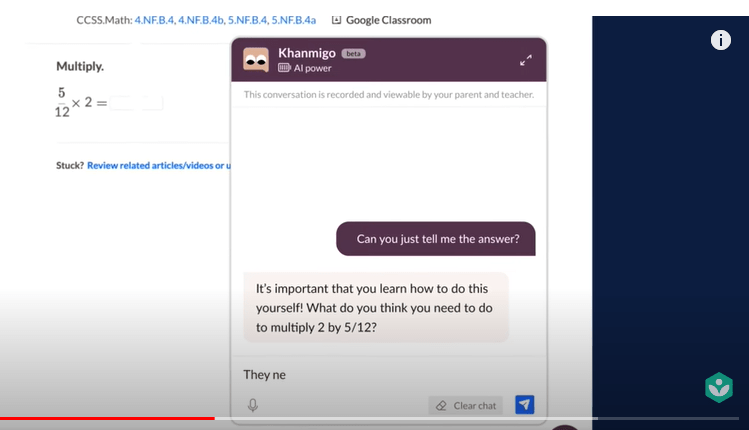
Khanmigo

Khan Academy, which began as a project by its founder, Sal Khan, to bring free internet tutelage to schoolchildren, then got in bed with College Board and the SAT suite of products (yes, that’s how College Board refers to it,) by providing a customized path of review based upon PSAT results, is now trumpeting its latest venture.

Khan Academy has met Artificial Intelligence.

“It does math although not always perfectly.”

One supposes the name is a combination of Khan and amigo, the Spanish word for friend. But this may not be anybody’s friend as one of its supposed benefits is that Khanmigo will do lesson planning for teachers. However, Sal should learn that lesson planning for teachers in most districts is a cut-and-paste job into mandated templates. No intelligence, artificial or otherwise, is needed for that. (Not saying that is real lesson planning, but it is what passes for it these days.)

Sal also tells us that AI is already embedded in everything that Khan Academy does, for example, giving hints to help students solve problems. He insists that the AI will assist students in finding answers and will not be a vehicle for cheating.

Ironic or fitting that the AI robot is using the CHAT?!

Sal goes on to claim that he is helping students emerge from the pandemic and connecting their learning to what’s going on in the classroom. To his credit, he does not use the phrase learning loss.

“What if, when writing a story, the AI works with the student to write the story, not for the student, but alongside them making sure the student is doing the bulk of the work but pulling the story out of them? Making it more fun, making it more engaging …”

(Mr. Fitz, if nothing else, Sal is creating a great story line for your next series of strips.)

Khanmigo is in beta testing as they are working with districts and schools who already are joined to their ecosystem of teaching videos, exercises, and tests. The problem with Khan Academy is the same problem every edutech product, free or other wise, has. The pathway is prescribed and unaltered. What happens when a student doesn’t understand the video, can’t solve the problems, or answer the questions correctly?

All they can do with edutech is rewatch the video and try again. Yet, as every teacher has been told repeatedly in observations, if the students didn’t learn from your lesson, why would you reteach it the exact same way? You have to do it different as the first time didn’t work.

But all edutech can do is offer the same teaching approach over and over. Khanmigo’s promise is that its AI engine (a GPT-4 based product) will overcome that limitation.

That has yet to be seen as well as whether its safety features are effective. In the presentation, Sal tells us that teachers and schools will be able to review student’s interaction with the AI bot. Inappropriate chats or those ‘on the edge’ will be flagged.

Sal gave a TED talk about it:

An explanation or a sales pitch?

Lots of promises for what really is Sal Khan and his website getting on the AI/Chatbot bandwagon. What I’m reminded of is Japanese teaching robots that were supposed to replace real human teachers.

Did he really just say that his product can replace a school counselor? Yes, he did.

There’s a 21 minute, more in-depth video to demonstrate the product, but I have seen enough.

GPT chatbots, a/k/a artificial intelligence, may find a use within our virtual world that most of us participate in. But the problems, no better illustrated than the rebuke a New York judge issued to an attorney who used ChatGPT to cite precedents, but oops! the AI made everything up, would indicate not.

AI, chatbots, and the like are the latest technofad and will fade much as pet rocks had their day in the late 1970s.

Still available on Amazon. <giggle>

One Tin Soldier Rides Away

The Grumpy Old Teacher becomes the GORT, the grumpy old retired teacher.

At least I’m not the GOAT, a strange acronym that stands for greatest of all time, because the goat is someone who gets the blame when things go wrong or people are unhappy, most often undeservedly so.

But I would never claim to be the greatest, much as I would never claim to be an ally. That is something others have to decide based upon how they perceive my writing, my actions, and my motives. Nobody would think of me as the greatest, anyway.

The only thing I’ve decided about this blog is to drop the third-person voice. That was a deliberate choice to add an extra layer of separation between me and my job as a school teacher in Jacksonville, Florida, a fact I’ve never tried to hide but I didn’t make it obvious, either. That way, no one could possibly think anything I’ve written could be seen as speaking for the school district.

Five retirees and guess what each of us got in the bag?

The blog will continue to focus on education. I keep scribbling new topics on post-it notes and slapping them on the wall, literally, the wall behind my computer where I keep all my important to-do notes.

What will be missing are the behind-the-scenes reports. As I am no longer a working teacher who can talk about what’s really going on inside the building, maybe that will be the end of the blog as those are the posts that garner the most views.

But there’s still a major job to do. I can no longer talk with students about testing and say, “It wasn’t always this way. In my day, we didn’t have annual, end-of-the-year standardized tests and my generation turned out okay. Know that school (with its curiosity-killing, soul-dampening, torture-like test prep all day long) doesn’t have to be like this. One day you will have children of your own and you can change this.”

But I can keep preaching from this platform. So, the theme song quoted in the title won’t really be true. This tin soldier will hang around for a while, not in the ivy-covered halls, but in the arena. Since the esteemed Emily Bloch, formerly with the Florida Times-Union, now writing for the Philadelphia Inquirer, always DTWD, left town, we haven’t had comprehensive coverage of the school system. The big stories are covered well–Jacksonville does have an amazing corps of local journalists–the nitty-gritty that has an impact, though, gets overlooked.

Just a thought, I’m not committing to attending all the workshops and mundane meetings of the school board, but I do have deep institutional knowledge to bring to the conversation.

So, while I’m riding away from the daily chaos and joy of bells, lessons, athletics, drama, and the like, I’m not really going anywhere. See you in the funny papers.

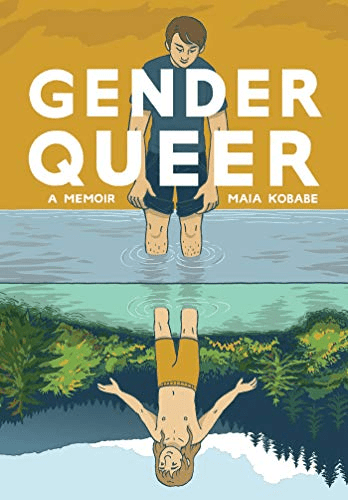
Gender Queer, All Boys Aren’t Blue, and the Assault on LGBTQ Literature

Since the book-banning began in earnest, Grumpy Old Teacher (GOT) has been buying some of the targeted titles on his limited budget and reading them to see if the text supports the objections of those who would see them burned a la Fahrenheit 451. Warning: what you are about to read are GOT’s thoughts and they are not likely to please anybody on any side of this controversy.

There is a theme to the book-banning going on in Florida, actually two themes, the books either involve Black history or the LGBTQ experience. Recently, GOT saw a video clip on social media in which Florida’s Top Gov singled out Gender Queer as being particularly problematical.

Doubtful that Top Gov ever read it.

That piqued GOT’s curiosity to find out what exactly is in the book.

The first thing to notice is that it is a memoir. The author, Maia Kobabe, is first and foremost going to tell us about her life from childhood into adulthood and her struggles with locating who E is (Sorry, Top Gov, if that upsets you, but I read the book and I know the pronouns E wants us to use.)

This book is not a manifesto. That is one of its strengths.

It’s someone telling a story about eir life, a life from toddlerhood through postgraduate years where the author can’t figure out where E fits in.

Not everyone needs to read this book, but there are those who do. Those who, like the author, struggle to understand themselves and why they don’t fit easily into traditional categories of gender and sex. That’s why people like Kobabe share their stories–to help someone else going through the same struggle.

In eir story, Kobabe recalls how the library was a refuge during the difficult years of adolescence and growing up. How E found the books that helped, how E spent hours and days and months in libraries reading about others who also didn’t quite fit into traditional gender roles.

Books are important.

That brings up the second book, All Boys Aren’t Blue, another memoir that is being banned in Florida’s schools. GOT read this one, too.

Maybe Top Gov would like this one; he’s proud of leading a red state.

This one’s a bit different, but of the same vein. The author recounts how he knew he was different from a young age, but he didn’t spend a lot of time worrying about how he was different and where he fit. His gender identity was firmly male and he found himself with a same-sex orientation.

Like Kobabe, his family realized who he was and accepted it. He wasn’t the first and they took it in stride. Even on a family trip, when all the other children were getting stylish sneakers, but Matthew (that’s the author, you’ve got to read the book) insisted upon cowboy boots, his grandmother took everyone to a Western store so he could get his boots.

So what’s going on here?

Book banners delight in pushing buttons. Those who show compassion, tolerance, and empathy toward those who don’t fit traditional gender roles, those who simply listen to children talk about their developmental path toward discovering who they are, those who show basic respect for the human dignity of children by calling them they want are called groomers and indoctrinators, not for the purpose of bringing attention to caring adults, but to obscure the true picture by provoking an emotional response from the public at large.

Thus it is that they are calling these books pornography. Any book they don’t like that involves a theme of LGBTQ is pornography even though they don’t fit the definition, which basically is a work in pictures or writing intended to cause sexual excitement.

Both books are stories recounted by their authors of their awkward, difficult journey toward adulthood, including coming to an understanding of their sexuality. As they tell their life histories from the vantage point of young adulthood, they touch upon some sensitive subjects that are an essential part of their story.

Each has a chapter or two that discusses a sexual experience. This alone does not make either book pornographic. Neither does it mean that the books should be freely available in a school. GOT in particular would not ban these books from a school library, but on on the other hand, he would admit that those who have reservations have a legitimate point of view.

This is why I said at the beginning that this piece would not make anyone happy. I truly believe that those who object to some parts of some books have a valid opinion.

It’s not that I agree with it; it’s that I can recognize that others have a different viewpoint and that there is room for legitimate disagreement that we need to work through. That happens not by name-calling on social media or screaming at school board meetings. It takes place through the quiet discussions that we have in our lives, whether in our churches or civic organizations or shopping or visits to the park.

To return to the books, both authors have an intended audience. They write for others who did not have or could not find a book like this to help them through their difficult years of finding and accepting their identity. They did not write for a general audience.

So–don’t ban these books. Stop the assault on any book that dares to mention or include characters who are other than cisgendered and heterosexual. Let these books find their audience for whom they are intended.

Each may be vital to some youth, some struggling adolescent, for whom the book will make all the difference in the world.

In GOT’s experience, they will find the book and the book will find them. All others won’t even notice. Sometimes, we adults make more of things than we ought. The kids are okay; it’s our issues that cause the problems.

Should these books sit on a school library shelf for anyone to find and peruse? Perhaps not. Maybe what we need are wise librarians, media specialists, who know their clientele and can make appropriate recommendations either toward or away from a particular book.

Oh wait, we decided years ago that schools didn’t need responsible, mature adults with professional expertise and experience to help children find books to read.

Oops!

Goosestepping

Oh, you thought GOT was talking about Governor DeSantis and his desire to have a state militia at his personal disposal?

When you live in Florida, a flat land of drained swamps that collect in retention ponds in order to build on dry land, you get used to it–the collections of Canadian geese that find the ponds and surrounding habitat perfect for nesting.

And what better place than a school? There are ponds and plenty of open grassy spaces, perfect for raising the next generation of honkers that bully humans better than any other species except maybe for humans themselves.

It’s that time of year when we carefully step around the goose dung because they don’t care where they drop it. Keep a sharp eye out! Many students don’t as the black stains that not even pressure washing can remove testify to their stomping and grinding the offensive material into the concrete.

What a perfect metaphor as it’s also that time of year when governors across the land sign bad legislation about public schooling into law. School districts will spend the next twelve months stepping around the goose piles, new and old, as they navigate their way through another year of muck and murk.

Retirement could not come at a better time. During the annual Spring budgeting process, which principals are obligated to share with their faculty, the district said that they were planning for around a 20% reduction in enrollment due to the new universal voucher law. Thus, while our school is maintaining its enrollment and maybe increasing over last year, the threat of losing teaching positions hangs over us.

That worry will no longer be mine. If you don’t teach, you don’t understand that twice a year, toward the end of a school year in the Spring and at the beginning at the end of Summer, teachers sweat out the budgeting process hoping against hope to be able to stay at their school and not have to move. “Surplus” is a dirty word to a teacher.

Seniority flew out the window nine years ago. It’s all about the test scores and, if yours aren’t high enough versus the other teachers in your subject area in the building, you find yourself at the top of the list.

Then there’s the RIF. A surplus means you are moved to another school; a RIF means you lose your job. Grumpy Old Teacher’s (GOT) district hasn’t seen a RIF in decades, but if you talked to the old-timers before they retired, you heard stories of people sitting by their phones over the summer (yeah, pre-cell phone days) waiting for a call that enough people had quit that jobs were available for those who were riffed.

Are those days back? We have yet to see.

Don’t sputter that there’s a teacher shortage. You can solve one by either finding qualified teachers or finding a way that the jobs are gone and you don’t need them.

Florida is not the only state pursuing many strategies to effect the latter.

Meanwhile, the culture wars go on. Teachers are a prime target; to misquote the bard, the governor says, “How do we hate thee? Let us count the ways.”

First up, and this is the joke to lighten the piece, Florida has now banned children from attending drag shows. Damn! go a couple hundred elementary teachers. Now we have to think up something else for our first field trip in the fall.

If you’re not laughing, you’re part of the problem. No teacher would conduct such a field trip, no administrator would approve it, and no show would allow it.

Goosestepping.

Then, there are the pronouns. Teachers and all other school-based personnel must use the pronouns according to the “sex assigned at birth.” GOT promises not to go on a tangent about how ridiculous a phrase that is. The birthing process does not ASSIGN a sex like a teacher would assign homework to be done. Nor is gender-identity chosen. Both occur from the unique combination of genes, biochemistry, and other things that take place when a sperm fuses with an egg.

Oops, to recover from the tangent, teachers are barred from using preferred pronouns that a child might tell them to use. Teachers must use the pronouns, um sorry about another tangent, but how are they supposed to know? It is said that the ancient Greeks began competing in the nude at the Olympics so women couldn’t sneak in and compete with the men … but GOT hopes no one suggests THAT as a solution to the pronoun conundrum. How do we know?

We’re not going to do inspections. We’ll take the child’s word for it.

Goosestepping.

Parents rights. Oh yes, to channel Mr. T, I pity the teacher fool who dares to talk to a child about what bodies do when they grow up. Schools can provide menstrual products for girls, but they can’t explain how to use them or why they are necessary. (At least, in the elementary grades. But then you see what Florida did with its Don’t Be Gay law. It started with K – 3, and now it extends through 12th grade.)

Goosestepping.

Then there are the board members, M4L types, cruising classrooms looking for reasons to report teachers to the state. Looking at you, Hernando County. Good for your superintendent, though, for standing up to the board bullies.

Goosestepping.

What’s a teacher to do? One misstep and they’re covered with <ahem>. The legislators, the governor, the far-right wingnuts, like middle school bullies, watch, jeer, and video to post on social media.

Is it any surprise that teachers are leaving to find better sidewalks?

The Last Daze of School

We get into the final two weeks of school and we’re hard at work to put another year under wraps. In the classrooms, children are staring at their phones as the ‘best as teachers remember’ G-rated movies play on a screen. Others stare into space, drooling, or draw on paper. Testing is over … almost. There are always the last few make-ups if a chronic absentee actually makes an appearance. Discipline issues are up, bored children and all that, and down, parents told to keep their kids home to avoid another referral and punishment.

Administration issues their usual directive to maintain bell-to-bell instruction through the last day even as they collect textbooks and computers from the students and deny teacher requests to exceed the monthly copy limit so they can have something to put in front of the students. Bell-to-bell instruction? With what! teachers cry.

The superintendent has forbidden classroom parties although many teachers will ignore the ban or find a way around it. Administrators complain of empty pizza boxes and drained two-liter soda bottles even as they can’t catch anyone in the act. Teachers wink and talk of celebrations that are taking place instead of parties.

Admin vanish while they admonish staff about maintaining order. Directives banning all hall passes ensue. But what if a child really has to go? Really, really, the distress etched on their face and they might even be doing the pee-pee dance as one colleague once put it … no hall passes.

GOT watches the children flip him off with their eyes because they dare not do it with their fingers as they walk out of the room to use the restroom. He dutifully calls the office to report. Later, the principal tells him, “Well, the child really had to go.”

It’s the last daze of school and absurdity reigns.

Bulletin boards are torn down, lockers are emptied, and students are drafted into moving furniture, removing the trash, and helping with the collection of school property.

Teachers throw shade as they pretend that they are still entering grades while they determine and post final grades for the year. A few are still testing because after students have taken national tests like NAEP, international tests like PISA, state standardized tests, district end-of-course tests which will determine the teacher’s data score and yearly evaluation, after all that, some teachers believe they must still give their own finals or they won’t know what the students really learned in their class.

Children wander the halls and visit friends in other classrooms. Some seek to make their mark on the year as they strive for a Darwin award and the most creative infraction of the year that was written up for discipline. Others try to carry out the perfect prank not realizing that we now have cameras everywhere recording everything except the bathrooms.

Yearbooks appear and kids write the same vapid fare-thee-well comments that have been around since yearbooks were first published. Teachers sign as requested. Some things will never go online.

Teachers hand out summer assignments that are due on the first day back. Others (like GOT) argue that the students need a break. Give them 10 weeks to relax. Their brains are still at work under the surface assimilating all that to which they’ve been exposed for a year.

They need the break. They need time to be kids, to hang out at the pool, to go to camp, to visit family and attend reunions, to take trips, and for the older ones, if they’re lucky, to have a hot, sizzling summer romance.

The last daze of school. Soon, they will end, the final bell will ring, someone will play Alice Cooper on the PA system as teachers wave goodbye to the last rollout of the buses, and suddenly … there’s silence.

Teachers assemble for the ending banquet hoping it will be more than catered pizza. As the speechifying ends, they throw their keys into the collection bin, jostle one another to get out the door first, and burn rubber out of the parking lot.

The last daze of school are over. Happy Summer!