Reblog: Masquerade

From a year ago: an essay about the new tests for math that students have to take.

In one of the all time favorite Broadway shows, Phantom of the Opera, we get this stupendous chorus and dance:

The Masquerade: where everyone hides behind a mask and pretends to be someone different.

But who is that fellow who appears at the end? None other than the phantom, who has something to say about the theater.

Today that is me. Let’s talk about the masquerade of the standardized testing, Common Core-styled, a/k/a PARCC, Smarter Balanced, and variations on the theme as it pertains to mathematics, in particular, the technologically-enhanced items that have you convinced that at last, at long last, the states have a test to measure student achievement in a meaningful way.

Multi-Select:

This type of item tries to do away with the test-taking technique of narrowing down multiple choice answers until there is one obvious answer to choose. The student must evaluate a number of choices and select each one that is correct.

An example:  What is 4 + 3?

() 7

() 3 + 4

() 5 + 2

() 43

() 12

() 1

How does a student need to tackle this problem? By looking at each choice and deciding if it is correct or not!

This is not a new type of question: It is an old-fashioned TRUE/FALSE quiz item.

Drag and Drop:

This type of item presents open boxes and circles to be filled with numbers, variables (letters), and symbols from an answer bank.

An example:
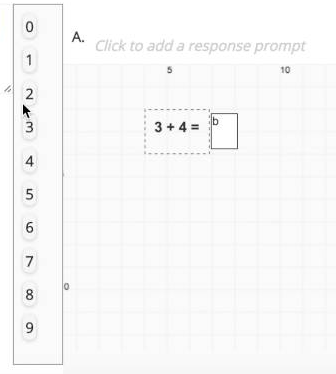
Fill in the blank! Generations of school children have dealt with this type of quiz question and hated it because they had to think up something for the blank. But wait! Our newfangled CC tests give them an assist: all they have to do is grab something from the bank for the blank.

Matching:

Let me quote from Florida’s Item Specifications for Grade 8 mathematics to give you an idea of this one: “The student checks a box to indicate if information from a column header matches information from a row.”

Which, as every student knows, can be worked out by making all the obvious matches and then seeing what’s left. Since these item types don’t ask for more than 3 or 4 matches, once the student works out the obvious ones, all that’s left is to connect the one pair they don’t know but have to go together.

Drop-Down Menu:


    Meant to mimic “Cloze Reading,” this time asks students to complete a paragraph by choosing the correct response from a drop-down menu.

An example:

    Sorry that the screen capture is small, but hopefully you can see that all a student has to do is select one of the choices presented. Yes, this type of question is really multiple choice.

Equation Editor:

    At last, an item that requires a student to determine a correct answer without a list of choices or a 50-50 guess. Perhaps we finally have an item that truly measures student understanding and skill. But wait, take a look at this:

We are asking students to generate original thought, but there are two problems with this. One, the interface. The equation editor is hard to use and students frequently ask for help during testing to get their desired response entered correctly. To which every smart teacher says, “I cannot help you,” for fear of being accused of cheating. Two, student don’t understand the response required. Once, a student asked me how to enter his response when the screen showed ‘y =’ and then the response box. He asked, “Do I put ‘y =’ into the box?’ That would have resulted in an incorrect answer because the computer would have seen ‘y = y=.’ Yet, the student had the correct answer. So these items don’t measure student understanding of mathematics as much as they measure the student’s ability to navigate the interface.

Free Response:


    At last, an item worthy of testing students. An example:
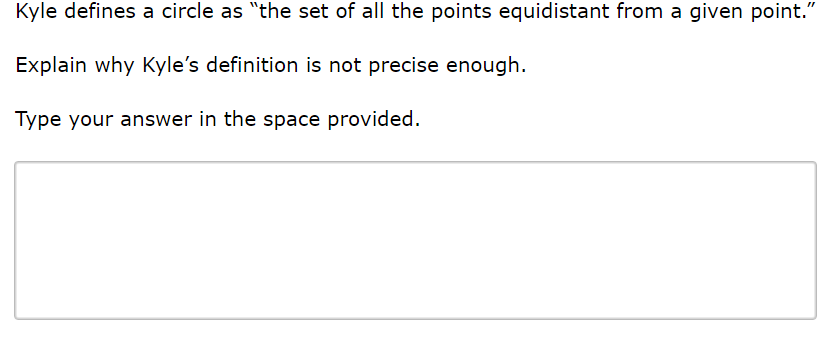
But this requires a human to score it, which negates the argument for computerized testing. In fact, it suggests that the best person to score a response is the student’s teacher. Oops! We can’t have that. So we’ll advertise on Craig’s List and other places for warm bodies to read and assign a grade. I wonder how much time this item’s response will get when we have previously had reports from persons grading writing test that they get about a minute per essay.

The Take-Away:

You have been told that computer testing has eliminated the limitations of standardized testing in which students eliminate possibilities and guess/select the best answer. Nonsense. Most of these item types are old wine in new wineskins. The only types that are new come with limitations that make them of limited use: the interface gets in the way or we simply ask less qualified persons than professional teachers to evaluate the responses and assign a grade.

Why does anyone think these Common Core era tests are better than what was done in the past?

Why does anyone think that these tests measure anything other than the test-taking skills a child possesses?

It is nothing more than a masquerade.

Demolition Derby

If you’ve been wondering about what Florida’s Republican governors and legislature have been doing to public schools for the last 20 years, this will give you a good idea:

I especially like the background noise of the crowd cheering as that represents Florida’s voters well: they keep electing the same politicians who are hell-bent on destroying the schools they say are important and should be maintained.

Lately, the governor-elect Ron DeSantis interviewed three persons to be the new Education Commissioner, a position he does not directly appoint; the commissioner is hired by the State Board of Education.

Why is the governor-elect even interviewing people? It is not his choice.

But wait, this is the era of the neo-robber-barons, where laws and constitutions don’t matter.

DeSantis interviewed three people for the position, Pam Stewart and two others whose names I cannot now find via internet searches. I suppose that’s because the fix is in.

https://www.politico.com/states/florida/story/2018/11/30/desantis-quietly-telling-education-leaders-corcoran-likely-next-commissioner-720589

Corcoran, the abusive House Speaker of the last two years, a self-styled Oliver Cromwell who will not honor a bipartisan agreement on an education bill, but will gut it to force his will upon an unwilling state, to put into place a new scheme for new charter schools.

A scheme, by the way, that died in committee as it could not find support for its own merits even among the charter-loving politicians in the Florida legislature. That is how HB 7069 came to pass.

One of the most, if not the most, powerful politicians in the state becoming Commissioner of Education? Answerable not to the governor, but the state board of education?

What a step-down.

Why would this happen?

Demolition Derby. The privatizers are ready to take down Florida’s public schools … forever.

No more nibbling around the edges of the cookie.

It’s time to crumble it and let the crumbs fall on the floor.

Arizona’s voters turned down a proposal (actually, a law passed by their legislature but Arizona can put laws on the ballot for a decision of the voters) to establish education savings accounts, whereby the money allocated for each child is turned over to parents to spend as they will with little to no oversight.

That’s what a Corcoran appointment will mean.

And did you know, Florida? We can’t put it on the ballot.

The endgame has started and Mozart is dead. No one is left to write the requiem mass.

Secret Santa

I must confess that at this time of year, I am the secret Krampus.


You got it; the grumpy Christmas demon not really in the spirit.

Now comes the usual workplace Secret Santa gift exchange. The others really get into it. They like the fun of finding gifts and watching the joy light up a co-worker’s face. That is cool.

But I would rather not because I am old enough to have arrived at a position where anything I want, I can get. I don’t need to wait for Christmas. I don’t need anyone trying to find that special gift. My brain won’t get a dopamine rush. I might even feel bad that I put someone into a panic trying to figure out how to get past my grumps.

However, I would like to not be that person, that one guy who always dampens the party, at this moment.

I was going to opt out (pay especial attention to that language; it’s a deliberate choice even if not too subtle), but then I decided I will participate.

Only when I fill out the form about my hobbies, favorite movies, etc., etc., I will do something else.

I am going to list my favorite charities.

Anyone trying to figure out how to give me a gift, pass it on.

Puerto Rico is still hurting.

Florida Panhandle Counties need help to recover from Hurricane Michael.

The Heifer Project helps the poor to gain a means of production that gives them a means of earning the income they need.

World Wildlife Fund is trying to save species from extinction.

I could go on and on, but you get the idea.

Like the Wicked Witch of the West, you could melt Krampus and find the true Santa within if only you bypass a useless token of esteem and direct the money to a place where it will truly help to meet the needs of the powerless, broken, and despised.

Cosplay

Don’t do it. Just don’t.

Another day, another poor decision that breaks into the day’s news. In this case, a Missouri teacher had students dress up as historical characters that existed when constitutional amendments were passed to show the passions and opinions that were for and against them.

Sadly, when it came to the 15th amendment, one of the historical characters, an unnamed student, came in a replica of a KKK costume.

There was no racist intent, we are told. The student was only displaying something from history, we are told. It was part of a group project, we are told. No harm meant.

This is what privilege looks like. We have no ill intent; we only mean to look at history, examine what took place, and try to get a lesson from it. We think this is supportive of people of color. We want children to imagine how it was back then and that reenacting is the way to help students develop empathy.

We don’t stop to consider that racism is still active today and that people of color still experience it. We don’t consider that seeing someone come into a classroom in the white robes of evil will trigger passion, fear, and suffering in others.

We’re tuned into what a good thing that we think we’re doing that we overlook its effects on others, in particular, our students of color. This isn’t history for them; it is life.

I’m not a hero. Whenever I read a story like this, it sends me into reflecting on my classroom and how my interactions with students were helpful or, despite my best intentions, were harmful. As a math teacher, I have little opportunity to do something like the news story, but! what about those teachable moments that arise, that have nothing to do with mathematics, but I should not let pass? It’s easy to direct attention back to the content, but are there not times to throw the lesson out the window when something important is raised by students?

Something like this is easy to flag, address, and punish. What is harder to admit is that we don’t talk about issues of racism in our schools. We ignore it; we pretend that everyone is equal and all is fair. Whenever an uncomfortable issue arises, it is better to pretend than to begin to have painful conversations that have to start with the staff.

If we as teachers, leaders, and staff cannot talk among ourselves about difficult issues of race, how can we expect that our students will?

If we want to pretend that everything is fair, then the disparities of punishment and suspension that hit our students of color disproportionately and the hardest will go unrecognized.

Please do not quote Martin Luther King, Jr. at me. All the people who use his words to justify the ongoing inequitable systemic racism … you don’t want to hear what he would say to you if he was alive today. You lift some words out of context to comfort yourself rather than get what he really was saying.

As for the cosplay in the classroom, don’t do it. Just don’t.

Reblog: The Philanthrocapitalist

From July 2017–it seems relevant today given the comments of the new School Board chair about mending fences with some organizations in the city:

Philanthropy: altruistic concern for human welfare and advancement, usually manifested by donations of money, property, or work to needy persons, by endowment of institutions of learning and hospitals, and by generosity to other socially useful purposes.

(altruistic: unselfishly concerned for or devoted to the welfare of others.)

–Definitions from dictionary.com

Philanthrocapitalism: Philanthropy that is marked by a belief that charitable work should be done according to business practices, is best performed by a business, and that the donor should control the policies and decisions of the philanthropic object, namely, the educational institutions, hospitals, and other relief organizations.

A century ago, the great industrialists (Carnegie, Rockefeller, Ford, and others) established foundations for their philanthropy. They did not try to choose the recipients for their largesse or direct the distribution of funds; they hired experts in the areas of their concern who best knew the needs and how to meet the needs.

In our time, we have seen the rise of the philanthrocapitalist. The great industrialists (Gates, Zuckerburg, Jobs (via his widow), and others) have established foundations for their philanthropy, but insist upon maintaining control of their gifts and demanding control of the recipients through conditions imposed upon the gifts. They believe in the free market as the ideal environment for all charitable endeavors: education, health care, and social welfare. Where the profit motive is absent, they introduce it. They raise a banner of individualism and choice, maintaining that those in need are consumers who should make the choice, but by the direction of their efforts, they often leave those in need with few choices.

The movers and shakers of our burg have chosen the philanthrocapitalist model through which to benefit our community. While the likes of Chartrand, Weaver, and others do not have the billions of the Silicon Valley tycoons, they do have enough wealth to wield a large influence over the city of Jacksonville, Florida and to impose conditions on their gifts that must be met or they will take their marbles and go home.

How else to interpret the letter that Gary Chartrand penned through the Quality Education for All board and was joined by the chair, Wayne Weaver (original Jaguars owner), Lawrence DubowCindy EdelmanMatt Rapp, and David Stein?

“If you are not willing to invest in those programs that have proven successful, we must consider that this bond has been broken and we will have no choice but to step back our part of this arrangement until a new understanding can be established.”


What distinguishes the philanthrocapitalist from the philanthropist is the insistence upon dictating policy and program despite their lack of expertise. Of the individuals named, only one, Cindy Edelman, has any actual teaching experience and that was 12 years at The Bolles School, an elite, private school on the Southside. I wonder how well Ms. Edelman would fare if she was teaching art at a public school, say Highlands Middle, Northwestern Middle, or Westside High? I wonder if she truly understands the issues and challenges of our public schools.

But they know best and they will dictate to the school board what must be done if they will keep donating and, to make their point, they have held up their five million dollar check.

This is philanthrocapitalism, charitable giving with an agenda, and an unwillingness to look at new circumstances.

This is philanthrocapitalism, the belief that expertise in one area of life makes the donor an expert in all areas of life, unwilling to trust, even condemning, those who have spent their lives in arenas like education.

This is philanthrocapitalism, the belief that struggling, impoverished families in the Northwest corridor should share the values, opinions, and behaviors that mark the wealthy and privileged. And if they don’t, they are judged and deemed wanting.

I can imagine them pledging $50 million to improve the neighborhoods along Moncrief Road, but wait, the young men let their pants sag, never mind.

(Was that too sarcastic?)

Duval County Public Schools (Jacksonville, FL) is facing a triple whammy this year: Florida law that does not allow them to raise property tax rates, HB 7069 that is diverting property taxes from the needed maintenance of public schools to the capital needs of charter schools, and a 12 million dollar deficit left by the golden boy, now running Detroit Community Schools, that the QEA board would not want mentioned.

The philanthropist would say, “Tough year. Let me help.” These philanthrocapitalists say, “Don’t talk to us about your problems. You have to chip in or else.” Students say, “How come there’s no toilet paper in the restroom?”

Sorry, kid, we have no money. Ask Wayne, Gary, Cindy, Matt, and David.

A Christmas Carol

Thanksgiving is here and I’ve been watching Christmas movies. Somehow I’m in the mood early this year.

The latest is “The Man Who Invented Christmas,” a story about Charles Dickens creating perhaps his best-known story, A Christmas Carol, about Ebenezer Scrooge and the haunting of the Christmas Ghosts.

This movie’s interpretation of the story and depicting the author’s struggles to work it out seems to be entirely made up, but yet, it shows the importance of the story and why it has lasted for two centuries.

At the heart of the story is the belief that people can change.

What made the difference?

Scrooge not only saw and felt the consequences of his actions; he saw the hurt he had caused to all the people in his life. He relived his experiences with the good people who cared about him. He had to ponder what went wrong in his life.

A Christmas Carol is a story of restorative practices. The ghosts did not come to punish, but to force the villain to consider his ways and make a change. They gave him an opportunity to set things right.

The feel-good ending to the story is that Scrooge took advantage of the new life granted to him and became the epitome of love and charity.

Charles Dickens wanted us to know that people can change. It won’t be easy, not as easy as the novelist penned in the last chapter, but it can happen.

A reminder as the season comes upon us of why we need restorative practices in our schools. Children can change. They will change if we create the community and belonging that they crave.

Let’s get to it.

Badass Teachers

I became a BAT, which is to say I joined the Facebook group, about a year after it formed. I didn’t know anything about the group, but I thought it would be funny to tell people that I am an official badass teacher.

After a while, I caught on to the group’s mission and decided to hang around. Others I knew left because they thought the group was too hard-core and they couldn’t take the social justice approach that defines BATs.

As of this moment, BATS have 64,757 members. Anyone expecting that every member is in complete agreement on any issue appears as ridiculous as people who think that Rush Limbaugh’s audience are mind-numbed robots waiting every day for noon when they will be told how to think.

Both notions are false. Limbaugh built his audience because he found a way to reach the people who have a consensus about political and social issues. BATs has grown because of all the people who believe in defending, advocating for, and going on offense for public schools.

The social justice aspect gets stickier. In many comment threads upon various posts, people show discomfort with that part of the BATs mission.

A few years back, I was one of them. I didn’t always “get it.” But I hung around because it’s important to listen to people who think differently, look for their reasoning, and determine whether one’s beliefs should change.

For example, white privilege. I first encountered this phrase 20 years ago. It was flung in the face as an epithet, as a condemnation, and a hateful ‘you shouldn’t be allowed to breathe.’ At least that’s how it felt.

BATs helped me learn that when people of color raise issues of privilege and microaggression that it’s not personally directed against me. Because of BATs, I can listen, sympathize, and learn. BATs has made me a better teacher in my classroom.

It’s important to remember that BATs is not a teachers’ group. It is a coalition of like-minded educators, teachers and administrators alike, parents, and community members who believe in public schools and a fair deal for everyone regardless of race, gender, sexual orientation, and everything else our society uses to label us and divide us.

For that reason alone and the great, long battle we are waging to save our schools, we don’t want to turn into cannibals and eat our own. Bashing parents or students is not allowed.

BATs is not the forum for debate on its founding principles. Thus it has been moderated from the beginning, which means that periodically a protest will arise that the group only allows comments and posts if they fit the particular views of the moderators.

Please don’t confuse first amendment rights with a social media group. The first amendment guarantees that the government cannot prosecute or imprison people for the views they express. It does not mean that people can say whatever they want wherever they want.

Recently, these issues have arisen again in the group. While some may decry the moderators’ attempts to maintain a productive group, sometimes the comment threads can turn counterproductive. It happened over the weekend and then someone posted about suppression of viewpoints and censorship. (They didn’t use those exact words, but that’s the gist of it.)

And again, the comment thread turned counterproductive. Some persons couldn’t resist the personal attack. When I read someone say that ‘you shouldn’t be in a classroom in front of children if you think that,’ I knew another post had to be shut down.

And, despite the protests, a moderator did allow a dissenting and critical post to appear on the Facebook wall.

It’s important to remember that BATs is not a teachers’ group. It is a coalition of like-minded educators, teachers and administrators alike, parents, and community members who believe in public schools and a fair deal for everyone regardless of race, gender, sexual orientation, and everything else our society uses to label us and divide us.

For that reason alone and the great, long battle we are waging to save our schools, we don’t want to turn into cannibals and eat our own. Bashing parents or students is not allowed. Or anyone else.  ^0^

Threat Assessment Teams

Among the many provisions enacted into law by the Florida legislature following the tragedy at Marjorie Stoneman Douglas High School was a requirement that every school establish a Threat Assessment Team (TAT).

In my district, the TAT comprises the School Resource Officer, an administrator, a guidance counselor, and a teacher. I am the teacher appointed to the TAT for my school.

I found out through email when I was ordered to attend a mandatory training, Youth Mental Health First Aid. It was a good training, much of what I already knew but going through a reminder session is always useful.

But other than that, I had no idea of what my exact responsibilities are going to be and how the TAT actually works.

Since then, I have garnered some information and that is what I will share.

  1. The TAT is run by the School Resource Officer because it is a function of our school police department. It is the SRO who schedules the monthly meetings and chairs them.
  2. 9th-grade students will take a test via computer. The results will be scored and used to determine if a potential threat exists. (Oh, Florida! Why is your go-to strategy always a test, a score, and a judgment upon children?)
  3. The TAT will review the scores. (At this point, I’m not sure I really want to be a part of this process.)
  4. There is concern about liability among TAT appointees for false positives (identifying a student as a threat when they are not) and for missing students who are threats and do commit an atrocity.

Beyond this, I am still in the dark. As things become clearer, I will update.

What We Now Know

News moves fast in this world and the 24/7 availability of facts, alternative facts (lies), and propaganda that comes to us via social media when events are happening and people are trying to sort it out …

Legitimate news providers routinely post stories with the above headline as events unfold and they try to keep up with them.

This popped into GOT’s head yesterday as I attended a training in Youth Mental Health and we got into what has gone wrong during our break and lunch conversations.

What we now know:

  1. Pre-K and Kindergarten should be mostly playing. Kids need to play with their peers, get into disputes, and learn how to resolve their conflicts without adult mediation. That happens on the playground. That happens during play. Math and reading can wait. Socialization is the huge priority during these years.
  2. The Common Core and 20 plus years of school reform have forced schools to teach academic skills at these young ages before the children are ready, The tests are coming.
  3. Recess is crucial. Young children need the activity. Much of the ‘hyperactivity’ we see in the classroom is not due to ADD or ADHD, although those are real conditions for a certain percentage of children, but because children need to move. They have to be active. When we deny them those opportunities, it will manifest in fidgetiness and other problems.
  4. Social-emotional learning is the flavor of the day. Can we admit we can’t teach it, it has to be learned through experience, and that takes place on the playground at young ages when kids get into conflicts and have to learn ways to solve their own problems without violence?
  5. For schools to be successful, we have to build community. Restorative practices are not merely intervention or reintegration; they are prevention.
  6. Given the institutional needs of school systems to survive, leaders mandate an all-academics approach. Given the tests that determine who survives and who fails (not talking about the children), all the rest is driven out. If we want to create safe and supportive school environments, we have to give time for children to begin their day in circles to talk about how they’re feeling and what’s happened in their lives overnight.
  7. Elementary teachers report their mandates that their days are so structured they can barely hit all the required minutes in math and reading.
  8. As for secondary schools, these types of circles would work well … in homeroom.
  9. But secondary schools don’t have homeroom anymore. Once the first bell rings, we jump to the lesson. We can’t do otherwise because the curriculum cramming and testing regimes allow no time for that.
  10. We are seeing an increase in mental health issues, distress, and anxiety in our children because of these things.