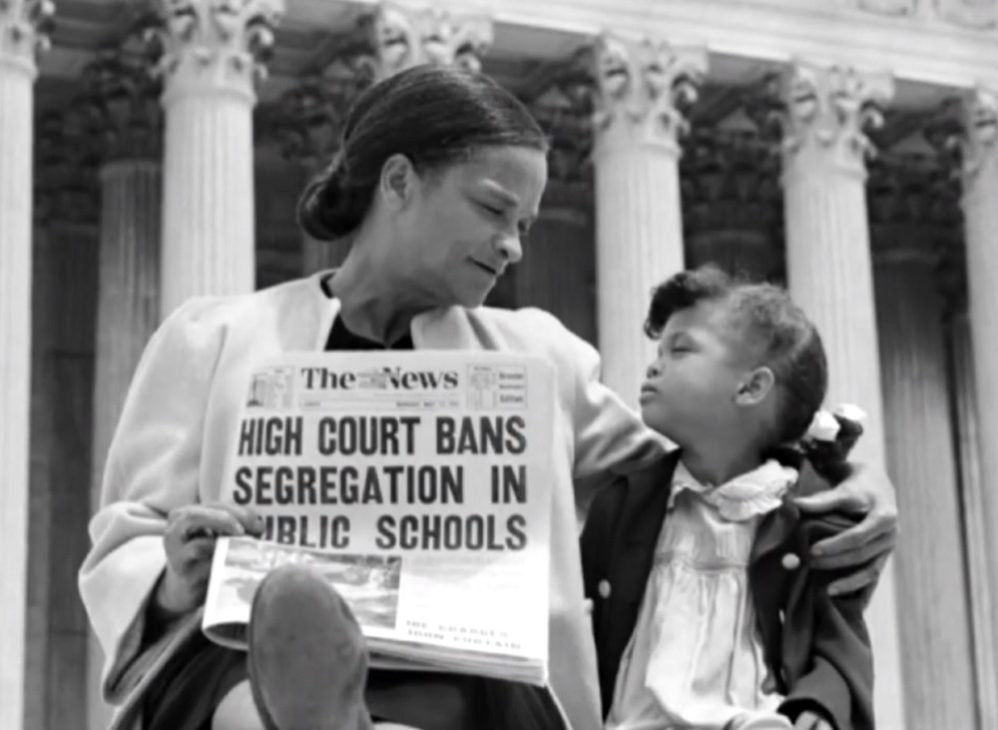
“Separate Is Inherently Unequal”

So decided the United States Supreme Court in 1954 in their decision for Brown vs. Board of Education.

Image result for brown vs. the board of education

It took 50 years, but segregationists finally figured it out. You can put a Brett Kavanaugh on the U.S. Supreme Court as he opines that Brown vs. Board is one of the four greatest cases ever decided by that court, but you can resegregate schools through charters.

So GOT applauds the superintendent of Duval County Public Schools as she worries about a charter that thinks it can achieve diversity goals (diversity means integration of schools, that is, a diverse school has a student body that matches the demographics of its district) by opening a new school in a mostly black section of town to counter criticism that its other schools are almost all-white because they are located in the mostly white parts of town.

The school district is pressuring the charter to diversify its existing schools. But rather than working on attracting more students of color to those existing schools, the charter operators figure that opening a new school in a different part of town so it has more schools, some white and some black, will allow it to report data of a blended population.

But students of different races and backgrounds will not be together. They will be separated into different campuses miles apart.

“Separate is inherently unequal,” thundered nine justices as they rebuked (okay, the legal term is overturned) a court that 60 years before them made a poor decision.

Yet here we are today, resegregating schools under the mantra “school choice.”

GOT wonders how a new Brown lawsuit would fare today. Would a challenge to charter schools with supporting, irrefutable evidence of resegregation lead a court to strike down charter authorizations? Would they order an exchange of students among all schools accepting public tax dollars until we achieve a proper racial balance?

Would they order charters to be absorbed into public school districts? At least, to fall under true accountability to local school boards with the threat that if they did not achieve a true diversity in their population, they would be closed?

Something to ponder as February approaches to the rush of the lion. (That is, March comes in …)

Also, bravo Diana P. Greene.

Again, Harry?

I must ask you not to do this again.

Stop looking into that mirror for a world of your deepest, most desperate desires.

Because when you do so, it’s all about you. What you want, what the supporting cast around you should be like, … how you will create a lesson for black history month that checks all the boxes on your administrator’s checklist.

Yet again, we have a lesson on black history that has gone terribly awry. Michael Harriot of The Root provides the best explanation with his usual sardonic humor why it is a bad idea to have school children reenact any part of America’s history that involves slavery.

This time, a school in Northern Virginia had its P.E. teachers set up an obstacle course for children to run that depicted the underground railroad.

The lame (my interpretation) explanation from the school district was that no children were designated as slaves or slave-owners as groups were made to run across the course.

As if that prevented children of color, those who experience the racism of America every day, from feeling powerful emotions about what it means to be black, not in the quaint days of yore, the antebellum South, does anyone know what the word means today? … Back to the point, black children still carry an enormous burden of America’s racist history.

It doesn’t matter how you try to frame it. To do something like this is to force them to undergo a distress of history and experience.

Because this history is not the past for our students of color. It is the reality of the lives they live now.

So, white teachers, I have a suggestion. The next time you think you dreamed up a great idea for February, the month designated for Black History, before you go about it, run it by your black colleagues first.

And when they say, “No, HELL no, stop that stupid racist <ahem>,” listen.

And don’t do it. Just don’t.

2019 Jax Dog and Pony Show

Otherwise known as the once-a-year formal observation.

Ah, Teacher Life via the Charlotte Danielson framework.

Confession: I don’t put on a dog-and-pony show.

I merely try to be a better teacher than I was the year before. All the observer sees is what I do every day in my classroom.

For the first time this year, I am utilizing TAs (Teaching Assistants.) I picked mine carefully and fortunately, each one agreed. It’s a mutual choice. I chose three students from my first year at the high school that I taught, knew, and trust.

It’s worked out well. But sometimes, as they sit in the room and occasionally look up from their tasks to watch as I instruct this year’s Geometry students, I wonder if they think back to their year with me and go: Why didn’t he do this with us? I would have understood it better.

I like my administrator and, more to the point, I respect his experience and expertise. I wish he could visit my room more often because the follow-up conversation helps me understand what takes place in my classroom. Our conversation focuses on how to help students learn more, not on teacher performance.

That’s the way it should be.

Today, though, I am reflecting on a piece of feedback with which I am going to disagree.

Praised for circulating among students and assisting as needed during their independent work time, praised for the meaningful math discussions in which they engage with their peers, and praised for a room where students are motivated to learn, yet my observer felt I needed to share myself more during this time. Enter the student conversation. Be a part of the process. Have it more about me.

That’s where I have to disagree. If there’s one thing math teachers constantly complain about, it’s students who act like they’ve never been taught what the teachers know they learned in previous years.

The problem? It’s not part of semantic memory. The students know something, but that something is tied to the particulars of when, where, and from whom it was learned.

They can’t recall it later without remembering back to the time, the day, and the circumstances.

I don’t want that. Teaching is not about teachers. It’s a shame that the test-and-punish policies of our educational systems have made it about teachers.

Therefore, I am not going to change my practice. I am going to continue to stand aside and allow students to talk among themselves and figure it out on their own. That’s true learning.

To any observer who disagrees, I’ll spout the tired cliche about being the ‘Guide on the Side, not the Sage on the Stage.’ I’m there if needed (there are times when students need a push in the right direction and I will give them as much and only as much of a push that they need), but I will not interrupt the learning process.

My real job is not to teach mathematics, in particular, geometry. My real job is to teach children how to teach themselves. That will carry them a long way through college, grad school if they choose, and their adult lives.

The Pledge of Allegiance

To be clear, in 1943 the United States Supreme Court ruled that students could not be coerced into saying the pledge of allegiance, the daily morning exercise that takes place in school. Fresh challenges have led succeeding courts to uphold this ruling.

From Tampa comes the story of a sixth-grade student who was confronted by a substitute teacher for not standing and reciting the pledge. After an argument with the teacher ended, the substitute called the district office to report the situation because she did not want to continue dealing with the now angry 11-year-old.

Before we move on with the story, let’s linger on that point. Whatever happened were the actions of a child.

Reports and social media debates seem to ignore this very important point: it was a child. Why do we expect an 11-year-old to respond and behave like an adult?

Later, the student was arrested on a charge of disrupting the classroom. However, with the admission that none of us knows all the details, it is reasonable to wonder who was doing the disrupting? GOT could argue that it was the teacher choosing to confront a child over a refusal to stand who initiated and therefore is responsible for what ensued.

All because the child was exercising his constitutional right.

Story Quote: In the Florida school, district spokesman Kyle Kennedy told the Ledger that the student was arrested for being “disruptive and refusing to follow repeated instructions” from an officer and school officials – and not for refusing to recite the pledge. Doing so is voluntary, Kennedy said. In fact, the Supreme Court ruled in 1943 in West Virginia State Board of Education v. Barnette that schools cannot require students to salute the flag or recite the pledge, citing First Amendment rights. (Emphasis mine.)

Does refusing to follow repeated instructions include those of the teacher to stand? Does it mean the child was so angry that he shut down? Out of anger, he said some things he didn’t really mean?

We don’t know the details, but hopefully, we can recognize that a minor situation got way out of hand because of the actions of the adults.

Many do not understand restorative practices and why they are important for schools as an alternative to traditional discipline.

But if you take the time to read the story, you realize that the conflict resulted from a failure to understand the point of view of another.

Restorative practices looks at the harm done to others and asks that persons take responsibility and repair the harm. It does not seek to assess guilt and punish.

If I was the principal of the school, I would seek to use a restorative circle after meeting with the parties individually. I would ask them to voluntarily participate so the following questions could be asked:

  • In your view, what happened?
  • What were you thinking at the time?
  • How were you feeling?
  • What could have gone differently?
  • What impact has this had on you and others?
  • What do you think needs to be done to make this right?

The substitute needs to hear from the student and his family what their experiences have been and why they may not feel the same way as the teacher does about reciting the pledge. It would be useful for the student and family to hear from the teacher why she reacted the way she did.

We know that the student’s rights were violated and that the substitute was wrong in what she demanded. That’s not the point of a restorative circle. The point is to repair the harm that was done so that all can rejoin the school community with a feeling of belonging, support, and trust.

A restorative circle could eliminate the need for punitive actions such as arrest for the child and dismissal for the substitute.

That’s why it’s a better way.

Read the story here (one of many media versions circulating.)

The Shoe Drops

Although the sword of Damocles still hangs above real public schools in the state of Florida.

“If the taxpayer is paying for education, it’s public education” regardless of where the student attends, DeSantis said.

Applauded by operators of religious schools, who are definitely not public schools by any reasonable understanding of the idea, DeSantis has announced his proposal for an ‘equal opportunity scholarship’ program.

DeSantis adds that he cannot fathom why people would want to deny opportunity to needy children.

(Someone should tell the governor that type of argument may have worked years ago, but people see through it now.)

Opportunity is not being denied to needy children. True public schools, the only ones in the state that actually have to obey federal and state laws, regulations, court decrees, and dictates, deny no child.

Some parents think otherwise. That doesn’t change the truth. When public schools are not meeting a child’s needs, the parents have multiple avenues to find a solution, including speaking at school board meetings and hiring a lawyer.

When every other type of school, the non-public ones, are not meeting a child’s needs, the parents have only one choice (hoping the irony does not escape you): find another school.

DeSantis is motivated by ideology, not facts. If he really wanted to know how well his ideas work, he has only to look a few hundred miles west on I-10. New Orleans shows that he is wrong.

But the Republicans have been in charge too long in Florida. Money corrupts, the money of the Koch brothers and their pet, ALEC (American Legislative Exchange Council) and their ‘brothers in greed,’ otherwise known as every billionaire whose name you know, Gates, Walton, Broad, Devos, and many others you don’t, and that billionaire money corrupts absolutely.

Every religious school in the nation, including Catholic parochial schools, hopes to score a heaping helping of that taxpayer money.

It has been said many times and it must be said again: Mulitple school systems cannot exist on the funding that can only support one. (Credit to Peter Greene.)

As for opportunity for educational choice, that has always existed. What we’re really talking about is who is going to pay for it and the accountability that should go along with any school accepting public dollars.

You’re a Wizard, Grumpy

Or so it felt on this morning of Valentine’s Day, February 14, 2019, when GOT was drafted into the team of on-site personnel to conduct a search of all bags and a wanding of all students.

GOT wielded a wand. As teenagers shuffled up to the table to drop their bookbags, gift bags (it was Valentine’s Day and teenage hormones never take a holiday), turned to me and extended their arms at shoulder height, GOT wielded his magic wand with the ability to detect metal.

Any metal. All metal. Keys, cell phones, wallets (something metal in there), ids and their lanyards, the magic wand found them all.

Not to mention the rivets in jeans, zippers, the brass button used to fasten the waistband of pants, and even the metal in the concrete floor. Fortunately, GOT remembered to hold the button that decreased his wand’s sensitivity so he wouldn’t have to go all in and make the kids take their shoes off.

When wished a Happy Valentine’s Day by his students once all students had been screened and he reached his first period class, GOT had to laugh and respond, “Happy Valentine’s Day to you! Did you like our special celebration, in which you had to pull up the hem of your shirt so we could confirm that the magic wand was only detecting your belt buckle?”

Every high school in my county, because the school district is county-wide, conducted this exercise this morning. Every high school student arriving on campus was put through a search and a wanding. That’s 22 campuses and 30,979 students.

The justification offered was that we don’t know if a teenager might decide to duplicate the massacre that happened one year ago. This effort reassures everyone, students, parents, citizens et al., that we did something to prevent a reoccurrence of school violence.

This is like trying to open a new bank account. Because 0.3% (that’s not a real statistic, GOT is pulling it out of the air but estimates that the number is in the ballpark, as the expression goes) of people who go to a bank to open an account have a criminal intention, the rest of us–99.7%–have to prove to the bank we are not a crook. (Not to slam banks because federal and state regulations require them to treat us this way.)

We have to put all students through the experience because maybe one in 30,979 (0.003% or only a three in ten thousand chance) of students might do something horrific.

How high is the Powerball prize this week? Maybe the odds of winning are better than the odds of a repeat.

Strictly speaking, that’s not true, but hyperbole is the stock and trade of everyone who writes persuasively.

We put everyone through the wringer when there is a better way and it was a part of the Marjorie Stoneman Douglas School Safety Act signed into law almost a year ago.

Every school must have a Threat Assessment Team (TAT).

The TAT consists of a teacher, a guidance counselor, an administrator, and the SRO (School Resource Officer.)

I am the teacher for my school.

I know the truth.

Florida’s Governor, Ron DeSantis, has asked the Florida Supreme Court to convene a grand jury to investigate school districts’ compliance with the 2018 law and their efforts to ensure school safety for students.

My superintendent touts the policy passed by my school board a month ago, says the teams have been organized and seems to imply that they are doing what they are supposed to do. She sent an email today to all employees to make this point.

Never have I been so conflicted. Do I speak out? GOT wants no part of a grand jury investigation.

Do I tell my principal that I will not be a member of the team?

Do I go to the next school board meeting and sign up to speak in the public comment section?

The reality of the MSD tragedy is that everyone knew the shooter was a risk and the probability was high. All the red flags were flying high.

We don’t need to screen everyone, not on any given day, not every day. We simply need to do what we know to do: identify, investigate, and act upon the very few cases of kids in crisis who meet the profile.

That would better ensure school safety.

Hard Corners

It flows downward, doesn’t it? When I worked in a corporate world, we often spouted a saying about what flowed down and nowhere does it seem to be more true than in education.

Image result for flows down
Nope, but it’s a pretty image.

In reaction to the Parkland tragedy, almost one year ago, the Florida legislature rushed into the statutes a law that specified, among other things, that classrooms mark off hard corners.

A hard corner is the space in a classroom that cannot be seen from the hallway door window. The Parkland shooter never entered a room, but as he was able to see through the windows into the rooms, he was able to shoot through the glass to visible targets (people).

If only they had known to crowd into a space in the classroom that could not be seen, and if not seen, then it could not be directly targeted from the hallway.

Every time this topic arises, people say, but what about the outside windows?

That’s a good point. Hard corners out of range from an interior door window are almost always exposed to exterior windows. Presumably, though, those windows are locked and the blinds are drawn (can’t have student attention wandering away and looking outside), therefore a shooter wouldn’t fire through the window anyway.

Hard corners are a response, a reaction, to one incident of a school massacre. A review of what happened revealed that the shooter walked the hallways and shot into rooms when he could see people inside. When there is no time to cover the window, squeezing into a hard corner seems to be the best way to hide.

There is no way to bullet-proof a classroom unless we want to rebuild our schools as prisons: no windows or narrow slits of glass eight feet high; steel doors; razor-wire fencing on the perimeter; controlled access 24/7.

GOT isn’t all that fussed about marking hard corners. It cannot hurt. Thursday, he put blue masking tape on the floor as directed even as he wondered how long painter’s tape, designed for placement upon a surface only for as long as the painter needs to apply a coat quickly–usually it’s removed within hours, will last upon a grimy floor that is only swept, never mopped, during the school year. We are 2.5 quarters through the school year. The next cleaning will take place in the summer.

GOT really doesn’t have a hard corner. The design of the room limits the number of persons who could squeeze into that space. At best a dozen, maybe only ten.

But the point of this post is that the responsibility for marking the hard corner was put upon the teacher. Always, the undesirable tasks like the unmentionable substance in the saying flow down to the lowest person in the hierarchy.

We have a large school system full of security experts. We have a school police department. We could scrape together the money to hire an outside expert. But no, this undesirable job that no one wants to do is sent to the principals, who promptly pass it down to teachers.

GOT wants to know: if something happens at my school, if a tragedy occurs, and it turns out my hard corner wasn’t so hard after all, will my employer hold me harmless? Will they defend me against the inevitable lawsuits? Or will they simply say, “We didn’t do it.” Will they hang their teachers out to dry in the wind?

Do I have a hard corner to hide in?

Ron’s Rundown

Florida governor Ron DeSantis has moved swiftly to make his mark upon the Florida landscape, including education. Within the last 40 days, since taking office, he has set in motion the following:

  1. 21.7 billion dollars for state education funding in his proposed budget.
  2. A new set of standards that would, among other things, address complaints about unfamiliar math procedures in the early elementary grades.
  3. A streamlining of standardized testing required under Florida law.
  4. An emphasis of Civics instruction in Florida schools.
  5. $23 million in additional funding for Gardiner scholarships, a voucher program for students with IEPs (Individual Education Plan) to find a school best suited for their disability.
  6. A restructuring of the Best and Brightest program, which directs annual bonuses to teachers rated ‘highly effective,’ that eliminates the SAT/ACT score requirement but adds others.
  7. Selection of former House Speaker Richard Corcoran as Education Commissioner.

There is more to come. Now that he has compiled the list, GOT will add to it as what appears to be a very activist governor continues to issue directives about education.

UPDATE : (Eight) The state DOE will begin keeping a list of ‘bad actor’ charter schools.

UPDATE : (Nine) A review of all school disciplinary diversion programs (such as restorative practices), DOE and the Department of Juvenile Justice (!) to collaborate on school discipline, extension of Guardian program applications, and a ‘repository’ for school safety data maintained by the DOE. Another link here.

UPDATE : (Ten) A call for a grand jury investigation of school districts regarding their ‘school safety practices.’

UPDATE #4: (Eleven) Expansion of voucher programs to any parent wanting to send their child to private school using public money. DeSantis proposes diverting general revenues and local effort taxes to this purpose.

(Twelve) Executive Order mandating the DOE and Department of Juvenile Justice to investigate all ‘diversionary programs’ from traditional school discipline.

Sima Qian and Dennis Baxley

Image result for sima qian quotes
The Gov’s Executive Order regarding the replacement of Common Core has a chance of success
if he meant it when he directed Commissioner Corcoran to have parents and teachers involved  in the rewrite of Florida Standards.

The historian of the first Chinese Emperor, Shi Huangdi, Sima Qian left behind many memorable quotes. One of them involved the time Shi attempted to silence voices of dissent, those that contradicted the official government view propagated across the land: The First Emperor collected up and got rid of the songs, the documents, and the sayings of the Hundred Schools in order to make the people ignorant. This was done so that no one could use the past to criticize the present.”

“[It] represented a brazen attempt to obliterate the past and restart it beginning with the Qin.” –Gregory S. Aldrete, ###, via Lecture 22 on the Great Courses, The Teaching Company.

What is it with the attempt of conservative, religious right politicians with their attempt to obliterate science and replace it with their atheological, albeit ideological, stances on science?

GOT read the reports about how a Florida state senator, Dennis Baxley, has introduced a bill to require that alternative concepts to established science be taught in Florida classrooms.

Image result for blue marble

“The purpose of this bill is to allow people to question and challenge certain ideas rather than saying ‘This is the way it is,'” Baxley said. “We pursue all kinds of diversity but then we are like, ‘Don’t dare question anything that is set science,’ and the whole pursuit of science, for example, is pursue everything. There was a time in science that the world was flat.”

Senator Baxley is not alone in what he is trying to do. Before calling him out, let’s take a look at his background.

His Form 6 disclosures over his years in the Florida House and Senate state that he is another millionaire whose years of public service are accompanied by a falling net worth. You can see the first one here and work the link to see the rest.

While his net worth falls across six years of financial disclosures, after a couple years, he reports owning a second home in addition to a vacation residence. That second home is in Dunnellon–a long way from Tallahassee but not too far from his primary residence in Ocala.

His reported income in the Hiers-Baxley Funeral Home disappears after two filings. Did he sell his ownership stake? Pass it on to family? Or was he only drawing income from a family business owned by others? We cannot assume, but it does give an insight into his background.

Beyond the strange inclusion of a pronunciation guide to compound last names that he included in his latest Form 6, GOT also sees several forms mentioning his inclusion on a Council on the Social Status of Black Men and Boys. GOT presumes his appointment to the Council is because the law establishing it requires two members of the senate and house to be on it–one from each political party.

GOT would like to pursue this angle to the story, it is February, but let’s get back to the purpose of this post.

Why do the members of the Florida legislature try to micromanage curriculum in our public schools?!

Image result for sima qian quotes

Conservatives pushing a particular viewpoint, flattering themselves it is spiritual, religious, and theological when in reality it is only ideological, are trying to shut down anything they think challenges their ideas or worse their status in society.

Why mandate foolishness, Dennis Baxley? Climate change is real. We can debate the causes and how much each cause is contributing to the change in earth’s climate, but only a fool denies the evidence. The polar ice is melting, the oceans are warming as they absorb the heat, and we are experiencing more extremes in weather as the years move along.

No one can obliterate science despite the attempts to silence scholars, journalists, and scientists. Shi Huangdi failed in his attempt to silence those whose historical viewpoints were a counterpoint to his rule.

So too will the arguments of climate change denial fail. Legislate away, Senator Baxley, but when Florida is covered by the sea, neither of your two homes will be of use unless you can breathe underwater.

The End of The Core, Asterisk Edition

It’s the end of Common Core (as we know it? We’ve already had that.)

I’ve used this song before so I searched for a new version. Hope you like it.

The End of Common Core State Standards (CCSS), Part 2: Part 1 was when most states, included Florida, proudly announced that they had dumped the Core when in reality all they did was to rebrand it (here known as the Florida Standards), add and modify, and carry on.

News broke via a gubernatorial pronouncement that Florida’s new governor, Ron DeSantis, was issuing an executive order directing the Commissioner of Education, Richard Corcoran, to write new standards in time for adoption by the 2020 session of the legislature.

GOT salutes the replacement of a failed experiment in establishing national standards for education as do most educators. The only real protest GOT has seen mentions that CCSS had established a uniformity so a lesson from Idaho could be taught in Florida with no adjustment needed and that it resulted in an explosion of quality teaching materials. But neither is true and those who hold such a belief betray a naivete akin to that of the CCSS writers and those who pushed it.

GOT can’t use a lesson plan written by a colleague down the hall without tweaking it for the students in the room and his teaching style. Neither has there been an explosion in quality teaching materials. GOT has spent the last four years producing the materials needed for the Florida standards in Geometry that are not available anywhere, including the textbook, yet the students are responsible for the knowledge under the standards and the testing.

As long as the governor and commissioner bring the experts on board, unlike what happened with CCSS, so that early childhood and adolescent development professionals help to design age-appropriate expected outcomes for children, Florida will take a large step forward. With teachers, parents, and others, we can have a set of standards to lead the nation.

But there is an asterisk. A huge blot of caveat upon what should be positive news. CCSS complaints and criticisms do not lie solely upon the words; they also apply to the practices that have accompanied the CCSS that have made the CCSS more toxic in every way.

While rewriting the standards to restore literature and reading whole books to a prominent place in education, traditional arithmetic algorithms alongside new ways of manipulating numbers, and writing as a means of saying something meaningful, the practices around the standards need a careful review.

In addition to eliminating inappropriate standards, the following toxic practices must go as well:

  1. Scripted curriculums. Nothing is more devastating to teacher morale than the supposition by amateurs who know nothing about pedagogy and development that curriculum could be made idiot-proof (and by the way, teachers always knew that those pushing the curriculums targeted them as the idiots) by producing a script that teachers must read without deviation. It is also detrimental to true learning. No written curriculum can possibly anticipate all the questions a student might ask or the unending ways in which a student might misunderstand.
  2. High-stakes testing. There are many factors involved in educational outcomes and testing measures none of them. GOT is not calling for an end to testing, but that the stakes should be lowered and be only one of many factors used in evaluating the success of teachers, administrators, schools, school systems, and what is often overlooked as well, the policies of state bureaucrats and legislatures. (No, really, after twenty plus years of mandated reforms and changes by legislatures, when do the politicians stand up and accept the accountability they thrust upon others?
  3. Value-added models for teacher worthiness. Debunked by science and professional statisticians, these models reveal nothing about a teacher. The learning process is human-based and cannot be reduced to a data formula.
  4. School grading. School grades are based upon nothing but test scores, which have long been shown to correlate most strongly to zip code, that is, socio-economic status. We don’t need testing and grading to find out where a child lives. We have their address already in our records.
  5. Computer-based teaching. Online schools and vendor programs do not replace teaching. Even iReady, a program in wide use in Florida, recognizes how essential a teacher is. If a student tries a module twice and is unsuccessful, iReady switches the module off and notifies the teacher to intervene. iReady is an example of how computer programs are misused. Rather than be a tool in the hands of skillful teachers, where the program does not carry the load of teaching but is a means of practice and reinforcement, districts mandate its use and monitor hours as a means of test preparation.
  6. Data for data’s sake and the endless meetings to discuss data that waste time teachers could use more productively in planning lessons, gathering resources, and providing meaningful feedback on student work. GOT notes that his formal observation is two weeks away, when he will have to pretend to capture data on each student at the end of a lesson even as he knows that what he is marking down is meaningless for what needs to be done next in the class.
  7. Mid-year and baseline testing. An experienced teacher knows that baseline testing is useless: why give a test on the first day of school that only reports that students do not know what they have not yet been taught? Any benchmark that scores well on a baseline is misleading. Almost always, when a teacher reaches that point in the curriculum, she discovers that students did not have that one mastered on day one. Mid-year testing yields no useful data for a classroom teacher. Its purpose is to give the district an idea on how well the students will score on the annual tests in May. Many beside GOT question the loss of two instructional days to assuage the worries of district management.
  8. Checklist rubrics for evaluation. Danielson and Marzano contributed useful insights into the art of teaching, but reducing their work to a checklist is counterproductive. Campbell’s Law tells us that this approach puts the focus of teachers on the rubric and how to move over to the highly effective column. In other words, teaching stops being about student learning and more about teacher ratings.
  9. Misguided turnaround efforts doomed to failure. It’s not working and doubling down only intensifies the effort in futility. By the way, charter operators have figured this out. That is why they now seek to set up shop beside excellent public schools, not struggling schools. Sweetening the profit potential to convince them to take over a struggling school is not the correct incentive.
  10. Micromanaging by legislatures. Here in Florida, our legislature questions the teaching of science and would undermine it by requiring the teaching of all ideas as opinions and equal in validity. Sorry, but the earth is not flat and to pretend that idea is equally valid as the knowledge that the earth is a sphere is ridiculous. Sneaking in Bible classes as a mandated offering is another piece of foolishness in Florida this year.

Dear readers, you will probably think of more practices to add to the list. Comment away.

UPDATE: I wondered if I had missed something and I did–a whopper, a huge fist in the gut, what is arguably the most destructive practice ever imagined: third grade retention for 8-year-olds who didn’t pass the state’s reading test.