Reflections on the short yet deep book of Timothy Snyder.
Be wary of paramilitaries. When the men with the guns who have always claimed to be against the system start wearing uniforms and marching with torches and pictures of a leader, the end is nigh. When the pro-leader paramilitary and the official police and military intermingle, the end has come.
We need to rewrite those first sentences to make an analogy for educators. After all, no extralegal authorities are strolling our schools’ hallways–at least, not yet.
Be wary of astroturfed community groups. When the people with a political agenda who have always claimed to be against public schools start wearing the same t-shirts and showing up at school board meetings marching in lockstep, the end is nigh. When they take seats on the school board and hire like-minded superintendents, the end has come.
Oh, Duval! You are low-hanging fruit for this post. But I have bigger fish to fry. Lest you think that’s a mixed metaphor, feast your eyes on this.
Yum?
Moms for Liberty, anyone? Other groups who use the public comment portion of a school board meeting to tag team a reading of passages from a book they consider obscene? But they are not satisfied with performative politics on the outside.
They are running for office. Most places, a few individuals may win, but they don’t grab control of the school board. In some places (Duval, cough, cough) they find success.
When federal and state authorities conspire together to castrate their respective Departments of Education, the end has come. Linda McMahon is such a disappointment. Given her background in the pro wrestling biz, we know the outcome is scripted but at least there should be a good show.
Kitty litter boxes for furries, slandering teachers as groomers and pedophiles, and faking outrage over the issue du jour, they are riding their high horses into positions of power.
Reflections on the short yet deep book of Timothy Snyder.
Remember professional ethics. When political leaders set a negative example, professional commitments to just practice become more important. It is hard to subvert a rule-of-law state without lawyers, or to hold show trials without judges. Authoritarians need obedient public servants, and concentration camp directors seek businessmen interested in cheap labor.
What are ethics? According to dictionary.com, ethics are “the rules of conduct recognized in respect to a particular class of human actions or a particular group, culture, etc.” Also, “a system of moral principles.”
Most states have ethical codes for teachers. You can find Florida’s here. It’s subdivided into three categories regarding obligations to students, the public, and the profession.
Florida’s code of educator ethics is based upon the model code developed by the NEA (National Education Association.) It’s based upon an educator’s obligations to students and the profession.
Among the ethical obligations are not to restrain the freedom to learn even that experienced through independent action, to ensure equal opportunity for all, allow access to varying points of view, and not to suppress or distort subject matter so as not to impede a student’s progress in learning.
Living through these dystopian times, aren’t we seeing the subversion of quality education as these ethical obligations are plowed under much as a Deere harvester machine mows, threshes, and leaves the residue behind for a plow to turn under the ground?
Public schools, despite all the attempts to end them, have stubbornly held on. Much of that has come as educators have resisted the reforms that have worked to park students in front of computers for the entire school day (independent action NOT,) resegregate schoolhouses through the use of charter schools and targeted marketing (equal opportunity NOT,) script curriculums and assign test preparation that steer students to the one allowed answer (varying points of view NOT,) and remove books from school libraries, suppress Black history courses, and eliminate anything other than Lost Cause-inspired views of history (suppress or distort subject matter YES.)
“When political leaders set a negative example, professional commitments to just practice become more important.” Educators following the ethical code must maintain their ethical commitments and follow through as necessary.
No one is saying this is easy, but no one is saying that it means being combative or self-righteous as an educator goes about her daily work. Every educator has to determine how to navigate the path they are on. Authoritarians come in many guises and they work on many levels in a district’s bureaucracy. The first thing an educator can do is learn how to recognize them.
Then, resist. Don’t be an obedient public servant. What form and action that takes depends upon an educator and their circumstances. But don’t become complicit and a tool of the forces decimating public education. The ethical commitment to students and the profession demand it.
Reflections on the short yet deep book of Timothy Snyder.
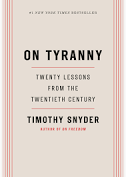
Take responsibility for the face of the world. The symbols of today enable the reality of tomorrow. Notice the swastikas and other symbols of hate. Do not look away, and do not get used to them. Remove them yourself and set an example for others to do so. (Timothy Snyder, On Tyranny, Chapter 4.)
The symbols of hate are around you because our students are as divided as we are. Do not look away.
I’m not going to define for you symbols of hate. You know what they are. But I will share a few memories from my teaching career that show division.
Black Lives Matter did not begin with the killing of George Floyd. The movement came into being after the killing of Trayvon Martin and the subsequent acquittal of George Zimmerman. Sometime afterward, the clapback began with Blue Lives Matter (police.)
This played out in one of my classes. One boy felt strongly about supporting the police, wore blue silicon bracelets, and other items that made his feelings clear. Other students took exception and muttered in the back of the classroom about how they were offended. It became one more problem for classroom management and keeping the peace.
We were supposed to be the safe school, the one where a large LGBTQ+ community existed and teens could find their people. Yet, there were students on the other side of that culture war. I was always on the lookout for brewing trouble.
Teenagers have a talent whereby they can say things to their peers just loud enough to be heard by their target, but not the teacher. They can act in passive-aggressive ways to stay out of trouble. There was an incident in another classroom where a LGBTQ student was getting more and more upset. The alert teacher realized she was being bullied by the student next to her and moved to intervene.
I have had a student complain about bits of pencil being thrown at him. The offenders were careful to do it in a way that I would not see. Being alerted, I then caught them at it.
The symbols of hate that show up in school are not always tangible. We, as educators, have to be on the alert and not look away. We cannot dismiss divisiveness in our classrooms as not belonging in our subject area, for example, math or science. We have to address it.
Sometimes, that means taking a student aside for a quiet conversation about what they are doing and that it won’t be tolerated. Sometimes, that means a conference to facilitate communication and provide a means for students to understand one another. Sometimes, that means consulting with the school counselors to get a bigger picture. If there’s one adult in the building who has knowledge about the undercurrents, it’s the counselor.
It can mean setting the tone for the classroom and making it a place of mutual respect. At the beginning of every school year, I worked to establish my mathematics classroom as a place where it was okay to make mistakes, even encouraging students to make mistakes because that is how humans learn: experimentation, failure, and reflection on better or different ways to approach a problem.
Students would put solutions to problems on the whiteboard. I never said right or wrong. I asked the class to give feedback. “Do we agree on this solution? Or does someone have an alternative to propose?” The best classes happened when students disagreed on the solution and through the back-and-forth came up with the correct answer.
Hate is best met with openness and discussion with others. This is the approach of restorative justice, a process that some unfamiliar adults condemn, because they do not understand it and what it can and cannot do. That makes it ripe for culture war issues.
The culture wars, a neat little euphemism we’ve used for decades to we can avoid the reality of the division and hatred inherent in the phrase, attitudes, and actions of those who engage.
“Take responsibility for the face of the world.” What we do today sets the stage for what people do tomorrow. If we are to put aside the divisiveness and hate, which is not to say that we cannot disagree on matters of little and great importance, we know what we need to do: tone down the rhetoric, stop trolling on social media, and talk reasonably with others, not hyperbolically.
I will not offend your eyeballs or your ears with a picture or a mention of that vehicle. Suffice it to say that today I saw two on the brief stretch of interstate I use between my library branch and home. It still is ugly to my eyes, even if one owner painted theirs all black and another painted theirs with a black roof and olive green sides. I kept an eye out for flying side panels.
The Rise and Fall of the Elon Empire.
This is the tank I’m talking about–the tumble in stock price of Elon Musk’s central business, one that has lost 48% of its value from its peak in mid-December till now. (Although this is a concern for Musk, it does not mean his house of financial cards is about to fall. Note that today’s price is the same as it was in October.)
It’s so bad that the huckster-in-chief, the con of cons, the man who wrote the book on how to build and then ruin a brand, the man whose picture is on the page when you look up grifter in the dictionary, had to promote someone other than himself and staged a Tesla sell-a-thon in the driveway at the White House.
Why, it’s almost like parents CHOOSING to abandon their public school for one of the many options now available. Why are people who push hard for school CHOICE upset now that automobile owners are CHOOSING to abandon their Teslas for a different vehicle? Isn’t that their CHOICE?
Not even the best oligarchs can save this mess. Their expertise lies in monopolizing markets and taking choice away from consumers. Then, they can charge whatever they want, which is probably their end game. I used to think that they wanted parents to have to bear the full cost of educating their children, thereby eliminating public schools and school taxes. But the profit motive is strong–strong enough for them to want to eliminate public schooling as the most cost-efficient and effective means of delivering education to children so parents have no choice but to pick a profit-generating alternative.
Then again, I don’t think this is a universal plan among the ‘garchs. Some of them must be planning to replace their wage-busted undocumented workers, now deported or soon to be, with children. After all, if their parents can’t afford to send them to school, they are available to work. Isn’t this why states are weakening child labor laws?
What a dream! It’s as if the Gilded Age has returned in all its ugliness and fury as a few ‘garchs gather control of the entire economy into their hands. Vanderbilt, Morgan (JP), Gould, Carnegie, Rockefeller et al. approve.
We used to think Connect-The-Dots was a children’s game as we adults try to figure out what the ‘garchs and their stooge in the White House are really up to. Maybe it still is, but the children no longer hold the pencil. They are the dots.
Reflections on the short yet deep book of Timothy Snyder.
Beware one-party states. The parties that remade states and suppressed rivals were not omnipotent from the start. They exploited a historic moment to make political life impossible for their opponents. So support the multi-party system and defend the rules of democratic elections. Vote in local and state elections while you can. Consider running for office. (Timothy Snyder, On Tyranny, Chapter 3)
I suppose I could write this post in one word: FLORIDA.
Florida, a state now suffering under super-majority Republican rule, which means the Democrats still in office cannot use the few privileges of a minority party to stop bad laws.
Combine that with a governor who pushed the power and reach of his office to unprecedented levels, who cowed the super-majority into supporting his policies and ambitions, and you have a state beyond the control of the people because the radical Republicans have hopelessly gerrymandered the state into an enduring network of fiefdoms. This despite the fact that Florida has Fair Districts Amendments in its constitution. See here for an explanation of how the amendments work and the shenanigans that followed.
I am disappointed in the impotence, ineffectiveness, and incompetence in the current Democratic leadership to form an effective opposition to Republican steamrolling both nationally and statewide. I have been ready to switch my registration back to NPA, but then I thought, if I live in a one-party state, maybe I should grit my teeth and register Republican because the real choice to be made is in the primary.
But I cannot stomach that thought or take that action. In the afterlife, I don’t want to have to explain why I got into bed with devils.
What has been the effect of this one-party state, one with the most extreme of radical educational reformers destroyers?
Unlimited vouchers most of which now go to people who already were paying for the children to attend private or parochial schools.
Book-banning in which the school library is restricted to only those books that contain the correct thinking.
Abstinence-only sex education for adolescents, which has been shown to impair health and increase unwanted pregnancy.
A testing regime that goes on and on even when it has lost its purpose.
The casting aside of elected officials on the flimsiest of excuses, a phenomenon that cannot have escaped the notice of elected school board members.
A state school board made up of sycophants and toadies, whose only purpose is to serve coffee and donuts and receive marching orders written on napkins.
A take-over of universities, all for the purpose of purging academic freedom that goes back 1000 years to the first centers of education and for pillaging the finances and rewarding presidents, whose only qualification consists in shouting, “Hear, here,” to the governor.
A state mired in mediocre or worse academic achievement in its schools no matter how loudly it blasts the success of the Florida model.
Beware one-party states, America. Don’t be Florida.
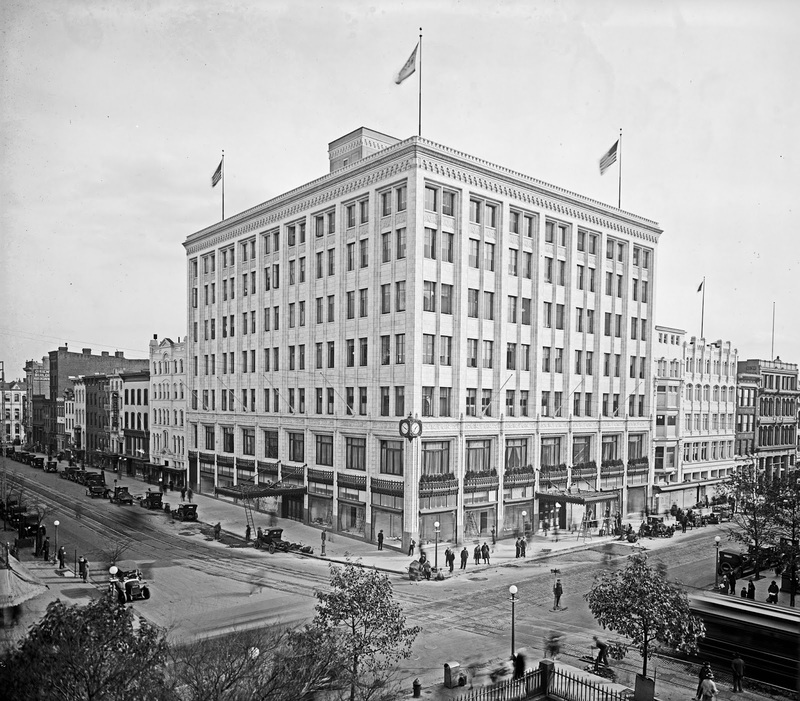
Time was every city, major and minor, had a homegrown department store. In the age of merchants, they were the original one-stop shopping for consumers.
They offered new conveniences like elevators and escalators to move customers from floor to floor, specialty candies (Hecht’s had this penuche-like confection that was always a holiday treat in my childhood,) and cafeterias.
You could find clothes, furniture, household goods, garden and yard items–if someone made it, they carried it. They were fully staffed with employees, okay salesmen, to provide assistance and escort customers to the checkout stand. Every department had them, salesmen and checkout stands, to serve customers.
Imagine a Walmart where each department (yes, they have departments but they blend them into one another so it’s not always easy to see) had dedicated people to help you (and let’s be honest, to suggest and sell you items to go with your purchase.) In addition, you didn’t fill a shopping cart full of items and go to the front of the store hoping for a little, trite interaction with the checkout clerk, but you paid at each station and could have a meaningful conversation with the helpful clerks.
Those were the days. You paid in cash or by check. If you had their credit card, which did not revolve (now there’s an old-fashioned term,) that you paid every month, your credit was gold. Only the most trustworthy customers qualified for store cards.
You got a meal in the store cafeteria, and most important, the food was good! It was one more draw to bring downtown workers into the store who more often than not purchased items on their way in or out. It always amused me that lady’s perfume was the first department people encountered when they walked in the door, the most impulse of impulse buys.
Department stores existed for a purpose and they served that purpose well as the one-stop shop. They had it all.
Federal departments exist for a reason. They gather under one roof all the government services and help that people might need. They administer the funding for the purposes that Congress appropriated the money for. They monitor for civil rights violations so that equality will be achieved for all. They carry out all the laws that pertain to their purpose.
Only if you think that the education of children is unimportant, a luxury, would you decide that the United States Department of Education is not needed. It exists for a reason, one that was so compelling that Jimmy Carter was able to persuade Congress to create it during his term, no matter how much it p*ssed Ronald Reagan off.
But that was then and this is now, critics say. Let’s go back to that department store, which has now suffered a 50% staff cut and closure of departments.
Customer: I need a blue suit. Where is menswear?
Second customer: I don’t work here. I’m looking for a couch. Got any ideas?
Employee walking out the door smacking her gum loudly: We had cutbacks. Men’s, women’s, and children’s clothing, along with cosmetics, jewelry, watches, and shoes, have been consolidated into the Human Adornments Department. Go to the basement. As for that couch, check the dumpster in the back alley.
First and second customers: Wow. Let’s go to the fourth floor cafeteria, have a drink, and talk about this.
Employee (with a snigger): We franchised that spot to Burger Queen a few years ago. They couldn’t make it and we certainly weren’t going to waste store money on a subsidy. Basement, dumpster. Get your sorry backsides to your locations.
Customer: How dare you talk to me like this?
Employee: Get thee to the basement. The big boss will walk through here with a Brazilian chainsaw in five minutes. Trust me, you don’t want to see that.
(In the basement) Customer: I need a blue suit.
Sole employee: Don’t bring that ‘I see color BS into MY store.’ All we carry is brown. That’s it. No color allowed in here; we follow Henry Ford’s philosophy, “My customers can have any color car they want as long as they want black.”‘
Customer: I want blue.
Employee: That’s the problem with you libs. Color this, color that. Well, let me TELL you something! Color is binary. We carry brown and black. Anything else is against nature.”
Customer: All I want is a blue suit. Are you going to sell me one or not?
Employee: If I do, then you’ll want alterations to make sure the suit fits you. We sell off the rack. One size fits all.
Customer: Well, I did have a growth problem in childhood. My right leg is one inch shorter than my left leg. I will need the store tailor to make alterations.
Employee, chortling: Oh, that’s rich. We fired all of them. They aren’t needed.
Customer: Whut?!
Employee: Look, pal, you aren’t meant to wear a suit. You’re not a suit-wearing guy, more like a crop-picking guy. Go down the street to the Farm Supply store. Or would you rather play with glue and glitter in the back of the classroom?
Customer: This is disgusting. This town doesn’t need a store like yours.
Employee: Finally getting it, hey Sherlock.
Customer: I need a blue suit. I have a funeral to go to.
Employee: Funeral? You wear black unless it’s your funeral.
Customer: Maybe it is.
Employee: OK, I’ve got you covered. Here’s a black suit, put it on, and go to the second floor, Paint Department. Let them spray you with the tint of your choice.
Reflections on the short yet deep book of Timothy Snyder.
Defend Institutions. It is institutions that help us preserve decency. They need our help as well. Do not speak of “our institutions” unless you make them yours by acting on their behalf. Institutions do not protect themselves. They fall one after another unless each is defended from the beginning. So choose an institution you care about–a court, a newspaper, a law, a labor union–and take its side. (Timothy Snyder, On Tyranny, Chapter 2)
Snyder teaches us from history that authoritarian leaders who have come to power through institutions seldom eliminate them. They change them from within to support their program.
Isn’t that what’s happened to public education? Men like JEB! Bush, Ron DeSantis and Richard Corcoran (in your own state, you will find suitable names to substitute,) organizations like the Heritage Foundation, Fordham Institute, and other think tanks (too many to list them all,) did not set out to abolish public schools. They sought to change them into something different, something that would support their ideas about how education should be delivered.
First, they changed the environment in which public schools operated. They took a developing institution that was meant for experimentation to find better ideas for schools and turned it into a profit-churning machine. I’m speaking of charter schools.
They convinced the parents and society-at-large that public schools were failing and then, when charters performed and still perform worse, they shifted to convince everyone that parents should have a choice, but a choice funded by taxpayer dollars who then had no choice over how their money was spent.
It was not a pivot; it was a developing narrative to achieve change from within and to transform the institution of public education into supporting the greater aims of the reformers, which we are now only seeing in such efforts as Project 2025.
Once parents and others believed that they had the right to choose and the right to force taxpayers to fund their choice, they moved on to their next steps. You might think I’m talking about vouchers for private schools, but I’m not. That’s part of the plan, but they have something greater in mind.
They were coming for the schools; they were always coming for the schools. Schools are places of learning, where children learn their history, learn about others, and discover themselves. Schools instill values, it’s inherent in what they do, and across the many decades of existence, those have been the values of democracy.
If the authoritarians and throw-back-to-antebellum years thinkers were to be successful, they had to convert schools into teaching their values. So first, they came for the teachers.
They introduced VAM scoring, a complicated formula that no one understood and created a mess that brought lawsuits and suicides. Not that they were bothered by that.
They mandated that teacher performance would be determined by a flawed-at-best testing system dominated by corporations trying to turn a buck out of the demand for accountability.
They undermined the longstanding system of school accreditation, a system that might have needed reform but did not need annihilation.
After convincing too many people that teachers were lazy and greedy, they moved on to call them indoctrinators and groomers.
First they came for the teachers, because teachers were the first and most fervent defenders of the institution of public education. But individuals were well regarded by parents, so they turned their fire upon teacher unions, as if those unions were anything more than groups of individual teachers organized to look out for their interests.
As everyone does.
Next, they came for the curriculum. CRT, DEI, all red herrings to disguise the real purpose–that public schools, still the runaway choice of most parents–of determining what children will and will not be taught.
The institution of public education remains under attack, but not for demolition. They seek to convert it into a tool of their means.
Defend it as if the next generations depend upon it. They do.
NPE, the Network for Public Education, will gather in Columbus, Ohio next month. They are the greatest collection of the defenders of the institution. If all works out, I’ll be able to post in real-time what’s taking place.
Reflections on the short yet deep book of Timothy Snyder.
Do Not Obey In Advance. (Yes, unless you spend no time on the internet and social media, you are well aware of this sentence. But if you are not, then you can’t possibly be reading this.)
Most of the power of authoritarianism is freely given. In times like these, individuals think ahead about what a more repressive government will want, and then offer themselves without being asked. A citizen who adapts in this way is teaching power what it can do. (Emphasis mine.)
At the beginning of this series, we must go back to the beginning and that takes us back to the test. First, there were the standards and then there was the test. The standards were meant as a guide and tests to check how well the standards were working. But a chain by any other name is still a chain and that’s how that story turned out.
It wasn’t long until the tests became known as high-stakes, a term perhaps borrowed from a poker game, which would be appropriate as annual test results made or broke careers not only for teachers, but for administrators and superintendents as well. As time went on, because students showed little interest in these tests, they were made the basis for promotion and graduation.
Then, JEB! Bush (May his name live in infamy) used the tests to grade schools. Schools shifted their focus from student learning to student test results, a movement they disguised by calling it student achievement.
Some teachers resisted; others gave in. They didn’t have to, but there’s something about the prinicipal–when extension 103 comes up on the classroom phone and you know it’s a direct call–calling and we go back to our own school days when getting called to the office was the scariest thing ever.
It’s easy to collapse. What do ‘they’ want? I have to give it to them. They want high test scores? I’ll do what I need to without being asked. But a citizen teacher who adapts in this way is telling power what it can do.
I knew of a teacher once who came from a state far away from Florida. When she first arrived, her attitude was ‘what the hell is wrong with you people and your state and your obsession with testing?’ Yet a year later, that was her focus. If you walked through the hallway with her, she would comment on students, “He’s a 2. She’s a 4. There’s a 1.”
The students no longer had names. They had become numbers to her, numbers derived from test results.
When I arrived at the school a year earlier, the principal came for his post-observation conference. Every teacher new to a school, no matter how long their years of experience, must have an observation within 30 days. They were also enrolled in the new teacher mentorship, no matter how long they had worked in the district, until dismissed by power that they did not belong there.
I was not going to have any of this groveling before the Big P. I set the stage by welcoming his feedback but as an equal, a co-educator interested in true student learning. He did his part by explaining how I could achieve a highly effective rating in his school. As the conversation went on, he began to grasp that I did not give a damn about that rating, that my reflection on my teaching practices and my assessment of my performance was what mattered, but I also welcomed honest feedback from others that would help me be a better teacher.
Two years later, he told me in a conference that I was one of the few teachers in his building who truly cared about the craft of teaching.
This is not supposed to be a brag piece. It’s easy to game the system, show power what it can do, and produce phony-baloney numbers.
Math is vulnerable to this especially with multiple choice answers. Algebra 1 students excel at the beginning of the year before they have learned any algebra in getting test questions correct because they have learned the plug and chug: try out the answer choices and find the one that works. They have no idea how to solve an equation and in their view, they don’t have to. Plug and chug works just fine.
ELA, under the vaunted Common Core that lives on under various new brands, became as bad. Over the years, I observed students taking the state test not bother to read the passages or sources. They went right to the questions to see what they needed for a response, and then scanned through the material to find their response.
From a student viewpoint, why not? After all, when an end-of-course exam score of 28% is a pass, why bother doing the hard work?
When a student does no work in a class, learns nothing, and fails authentic assessments and the teacher thereby fails him/her for the class, but the student games their way to a pass on the state test so the district changes their course grade to a Z*, why resist?
*A Z means the F remains a part of the GPA calculation, but they have received the credit for the course they need to count to their graduation requirement.
A lot has gone wrong with education over the last 30 years, much or most of it began with the test. Teachers must recognize the test is meaningless. Oh, it’s easy when a teacher does well and wants to say, “The test is bad, but I played power’s game and I beat them using their own rules.”
But did they? Or are they validating power’s methodology? Power wins regardless.
I’m not advocating for teachers to ignore the chains of the educational reforms that have strangled the profession. We all have those moments of our lives where we are vulnerable to financial disaster if we lose our jobs.
But we can teach power, i.e. districts and state authorities, what it cannot do and that is that they can make us have a concern about test results, but they cannot make us engage in educational malpractice. We can teach authentically and enrich the lives of Marco, Shaniqua, Tho Bien, Jerry, and Sharon. Yes, they have names.
When there’s a change in power on a school board, the hope of the electorate is that they have chosen serious people who will focus on issues of importance, the ones on which they based their vote.
In December, the Board approved the travel of five members to the School Boards for Academic Excellence conference. Much has been written about the SBAE and there’s no need to rehash it. Suffice it to say they are another start-up group with right-wing views and cultural grievances. To read a little about what the conference was like, check out Accountabaloney’s report on her attendance.
It was a controversial decision. Here’s the screenshot from the Board minutes:
Interestingly, SB Member Blount voted against the reimbursement even though he was one of the members registered to attend the conference.
At the latest meeting, Member Willie asked for approval for travel to attend the Council of Great City Schools, an organization with which the school board has a long-standing relationship and has recently appointed Mr. Willie to its executive committee.
While most boards would celebrate the recognition of one of its members as worthy of a leadership post, Chairperson Joyce disagreed. She announced she would vote against all travel for Mr. Willie to attend meetings.
We call this tit-for-tat. While this petty behavior is disappointing for the top leader of the school system to indulge in, it is not surprising. Ms. Joyce ran her first campaign as the friend of public education in the race stressing her employment in a local middle school versus her opponent who was an outspoken supporter of charter schools.
However, when Ms. Joyce was elected, one of her first votes was to authorize a new charter school that was woefully unprepared to operate a school. Her explanation? Her husband told her to vote yes on the application.
As she continued down the path of public bad, private good, she explained it’s what her voters wanted. (Gotta call BS on that. It’s not what THIS voter wants; I live in her district.)
Now, not satisfied with denying Mr. Willie’s travel, she plans to end the district’s participation in the Council of Great City Schools altogether. She will vote no in the coming months against renewing the membership.
This is Level 4 conflict, a concept that needs a full post of its own. Suffice it to say, she won’t be satisfied with winning on the issue leaving Mr. Willie the loser, she wants to pull the district out of the Council altogether.
From Florida Today, as reposted by the Florida Times-Union: Six central Florida school districts have issued their own policies regarding what to do if ICE shows up. Spoiler alert: it’s worse than Duval. The six districts are Brevard, Orange, Volusia, St. Lucie, Osceola, and Seminole.
Verify ICE agent’s identity via badge, photo ID, or business card. (Business card?! As in all it takes is a trip to a local print shop in order to gain access to schoolchildren?)
Warrants are not needed for ICE to gain access to a campus, although agents must sign in and out following visitor procedures in the front office.
Administrators should attempt to contact parents before agents interview their child, but if the agents tell the school not to, they shall comply with the order.
Administrators should attempt to remain in the room during the interview, but if the agents order them to leave, they shall comply with the order.
If a child is arrested, the parents should be informed immediately, except in Brevard, which says that is the responsibility of the law enforcement agency, which in this case would be ICE. In St. Lucie and Osceola, if ICE directs the school not to notify parents, that should be documented.
St. Lucie, Volusia, and Seminole districts warn employees that they are subject to arrest or other legal consequences if they do not follow the directions given to them by ICE.
A subpoena or court order is needed for ICE to access student records.
Soooooooooooooooooooooooooo, school employees are told to follow ICE orders even if not legal or they will end up in the slammer themselves. As for the children, they have the right not to answer questions and request a lawyer, but, as an ACLU lawyer notes, that’s really hard for someone so young to do as they are conditioned to follow the directions of adults and answer questions, especially on school campuses.
It’s hard to say where this is going. Most of what’s been done and publicized by the new administration has been for show. In reality, detention centers are full, the Trump-derided-as-catch-and-release (a fisherman’s conservation principle) policy is still being followed, and ICE lacks by magnitudes the resources needed to carry out what the Trump campaign bragged what it would do on its first day.
However, it is alarming that these school districts are falling into line ahead of an actual need. They signal they are ready, able, and willing to help deny the rights of children, all children regardless of immigration status, to a free and appropriate public education.
As for now, due to a 1990 court case between the Florida State Board of Education and various advocacy groups, schools are not allowed to ask immigration status when enrolling children, schools may not refer students to ICE, and, as noted, may not deny educational services based upon immigration status.





 Grumpy Old Teacher