Reflections on the short yet deep book of Timothy Snyder.
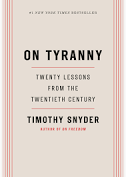
Take responsibility for the face of the world. The symbols of today enable the reality of tomorrow. Notice the swastikas and other symbols of hate. Do not look away, and do not get used to them. Remove them yourself and set an example for others to do so. (Timothy Snyder, On Tyranny, Chapter 4.)
The symbols of hate are around you because our students are as divided as we are. Do not look away.
I’m not going to define for you symbols of hate. You know what they are. But I will share a few memories from my teaching career that show division.
Black Lives Matter did not begin with the killing of George Floyd. The movement came into being after the killing of Trayvon Martin and the subsequent acquittal of George Zimmerman. Sometime afterward, the clapback began with Blue Lives Matter (police.)
This played out in one of my classes. One boy felt strongly about supporting the police, wore blue silicon bracelets, and other items that made his feelings clear. Other students took exception and muttered in the back of the classroom about how they were offended. It became one more problem for classroom management and keeping the peace.
We were supposed to be the safe school, the one where a large LGBTQ+ community existed and teens could find their people. Yet, there were students on the other side of that culture war. I was always on the lookout for brewing trouble.
Teenagers have a talent whereby they can say things to their peers just loud enough to be heard by their target, but not the teacher. They can act in passive-aggressive ways to stay out of trouble. There was an incident in another classroom where a LGBTQ student was getting more and more upset. The alert teacher realized she was being bullied by the student next to her and moved to intervene.
I have had a student complain about bits of pencil being thrown at him. The offenders were careful to do it in a way that I would not see. Being alerted, I then caught them at it.
The symbols of hate that show up in school are not always tangible. We, as educators, have to be on the alert and not look away. We cannot dismiss divisiveness in our classrooms as not belonging in our subject area, for example, math or science. We have to address it.
Sometimes, that means taking a student aside for a quiet conversation about what they are doing and that it won’t be tolerated. Sometimes, that means a conference to facilitate communication and provide a means for students to understand one another. Sometimes, that means consulting with the school counselors to get a bigger picture. If there’s one adult in the building who has knowledge about the undercurrents, it’s the counselor.
It can mean setting the tone for the classroom and making it a place of mutual respect. At the beginning of every school year, I worked to establish my mathematics classroom as a place where it was okay to make mistakes, even encouraging students to make mistakes because that is how humans learn: experimentation, failure, and reflection on better or different ways to approach a problem.
Students would put solutions to problems on the whiteboard. I never said right or wrong. I asked the class to give feedback. “Do we agree on this solution? Or does someone have an alternative to propose?” The best classes happened when students disagreed on the solution and through the back-and-forth came up with the correct answer.
Hate is best met with openness and discussion with others. This is the approach of restorative justice, a process that some unfamiliar adults condemn, because they do not understand it and what it can and cannot do. That makes it ripe for culture war issues.
The culture wars, a neat little euphemism we’ve used for decades to we can avoid the reality of the division and hatred inherent in the phrase, attitudes, and actions of those who engage.
“Take responsibility for the face of the world.” What we do today sets the stage for what people do tomorrow. If we are to put aside the divisiveness and hate, which is not to say that we cannot disagree on matters of little and great importance, we know what we need to do: tone down the rhetoric, stop trolling on social media, and talk reasonably with others, not hyperbolically.
School is a good place to start.
 Grumpy Old Teacher