Reflections on the short yet deep book of Timothy Snyder.
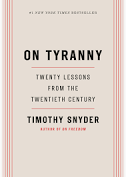
Defend Institutions. It is institutions that help us preserve decency. They need our help as well. Do not speak of “our institutions” unless you make them yours by acting on their behalf. Institutions do not protect themselves. They fall one after another unless each is defended from the beginning. So choose an institution you care about–a court, a newspaper, a law, a labor union–and take its side. (Timothy Snyder, On Tyranny, Chapter 2)
Snyder teaches us from history that authoritarian leaders who have come to power through institutions seldom eliminate them. They change them from within to support their program.
Isn’t that what’s happened to public education? Men like JEB! Bush, Ron DeSantis and Richard Corcoran (in your own state, you will find suitable names to substitute,) organizations like the Heritage Foundation, Fordham Institute, and other think tanks (too many to list them all,) did not set out to abolish public schools. They sought to change them into something different, something that would support their ideas about how education should be delivered.
First, they changed the environment in which public schools operated. They took a developing institution that was meant for experimentation to find better ideas for schools and turned it into a profit-churning machine. I’m speaking of charter schools.
They convinced the parents and society-at-large that public schools were failing and then, when charters performed and still perform worse, they shifted to convince everyone that parents should have a choice, but a choice funded by taxpayer dollars who then had no choice over how their money was spent.
It was not a pivot; it was a developing narrative to achieve change from within and to transform the institution of public education into supporting the greater aims of the reformers, which we are now only seeing in such efforts as Project 2025.
Once parents and others believed that they had the right to choose and the right to force taxpayers to fund their choice, they moved on to their next steps. You might think I’m talking about vouchers for private schools, but I’m not. That’s part of the plan, but they have something greater in mind.
They were coming for the schools; they were always coming for the schools. Schools are places of learning, where children learn their history, learn about others, and discover themselves. Schools instill values, it’s inherent in what they do, and across the many decades of existence, those have been the values of democracy.
If the authoritarians and throw-back-to-antebellum years thinkers were to be successful, they had to convert schools into teaching their values. So first, they came for the teachers.
They introduced VAM scoring, a complicated formula that no one understood and created a mess that brought lawsuits and suicides. Not that they were bothered by that.
They mandated that teacher performance would be determined by a flawed-at-best testing system dominated by corporations trying to turn a buck out of the demand for accountability.
They undermined the longstanding system of school accreditation, a system that might have needed reform but did not need annihilation.
After convincing too many people that teachers were lazy and greedy, they moved on to call them indoctrinators and groomers.
First they came for the teachers, because teachers were the first and most fervent defenders of the institution of public education. But individuals were well regarded by parents, so they turned their fire upon teacher unions, as if those unions were anything more than groups of individual teachers organized to look out for their interests.
As everyone does.
Next, they came for the curriculum. CRT, DEI, all red herrings to disguise the real purpose–that public schools, still the runaway choice of most parents–of determining what children will and will not be taught.
The institution of public education remains under attack, but not for demolition. They seek to convert it into a tool of their means.
Defend it as if the next generations depend upon it. They do.
NPE, the Network for Public Education, will gather in Columbus, Ohio next month. They are the greatest collection of the defenders of the institution. If all works out, I’ll be able to post in real-time what’s taking place.
 Grumpy Old Teacher