Reflections on the short yet deep book of Timothy Snyder.
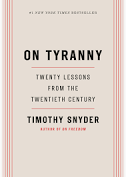
Do Not Obey In Advance. (Yes, unless you spend no time on the internet and social media, you are well aware of this sentence. But if you are not, then you can’t possibly be reading this.)
Most of the power of authoritarianism is freely given. In times like these, individuals think ahead about what a more repressive government will want, and then offer themselves without being asked. A citizen who adapts in this way is teaching power what it can do. (Emphasis mine.)
At the beginning of this series, we must go back to the beginning and that takes us back to the test. First, there were the standards and then there was the test. The standards were meant as a guide and tests to check how well the standards were working. But a chain by any other name is still a chain and that’s how that story turned out.
It wasn’t long until the tests became known as high-stakes, a term perhaps borrowed from a poker game, which would be appropriate as annual test results made or broke careers not only for teachers, but for administrators and superintendents as well. As time went on, because students showed little interest in these tests, they were made the basis for promotion and graduation.
Then, JEB! Bush (May his name live in infamy) used the tests to grade schools. Schools shifted their focus from student learning to student test results, a movement they disguised by calling it student achievement.
Some teachers resisted; others gave in. They didn’t have to, but there’s something about the prinicipal–when extension 103 comes up on the classroom phone and you know it’s a direct call–calling and we go back to our own school days when getting called to the office was the scariest thing ever.
It’s easy to collapse. What do ‘they’ want? I have to give it to them. They want high test scores? I’ll do what I need to without being asked. But a citizen teacher who adapts in this way is telling power what it can do.
I knew of a teacher once who came from a state far away from Florida. When she first arrived, her attitude was ‘what the hell is wrong with you people and your state and your obsession with testing?’ Yet a year later, that was her focus. If you walked through the hallway with her, she would comment on students, “He’s a 2. She’s a 4. There’s a 1.”
The students no longer had names. They had become numbers to her, numbers derived from test results.
When I arrived at the school a year earlier, the principal came for his post-observation conference. Every teacher new to a school, no matter how long their years of experience, must have an observation within 30 days. They were also enrolled in the new teacher mentorship, no matter how long they had worked in the district, until dismissed by power that they did not belong there.
I was not going to have any of this groveling before the Big P. I set the stage by welcoming his feedback but as an equal, a co-educator interested in true student learning. He did his part by explaining how I could achieve a highly effective rating in his school. As the conversation went on, he began to grasp that I did not give a damn about that rating, that my reflection on my teaching practices and my assessment of my performance was what mattered, but I also welcomed honest feedback from others that would help me be a better teacher.
Two years later, he told me in a conference that I was one of the few teachers in his building who truly cared about the craft of teaching.
This is not supposed to be a brag piece. It’s easy to game the system, show power what it can do, and produce phony-baloney numbers.
Math is vulnerable to this especially with multiple choice answers. Algebra 1 students excel at the beginning of the year before they have learned any algebra in getting test questions correct because they have learned the plug and chug: try out the answer choices and find the one that works. They have no idea how to solve an equation and in their view, they don’t have to. Plug and chug works just fine.
ELA, under the vaunted Common Core that lives on under various new brands, became as bad. Over the years, I observed students taking the state test not bother to read the passages or sources. They went right to the questions to see what they needed for a response, and then scanned through the material to find their response.
From a student viewpoint, why not? After all, when an end-of-course exam score of 28% is a pass, why bother doing the hard work?
When a student does no work in a class, learns nothing, and fails authentic assessments and the teacher thereby fails him/her for the class, but the student games their way to a pass on the state test so the district changes their course grade to a Z*, why resist?
*A Z means the F remains a part of the GPA calculation, but they have received the credit for the course they need to count to their graduation requirement.
A lot has gone wrong with education over the last 30 years, much or most of it began with the test. Teachers must recognize the test is meaningless. Oh, it’s easy when a teacher does well and wants to say, “The test is bad, but I played power’s game and I beat them using their own rules.”
But did they? Or are they validating power’s methodology? Power wins regardless.
I’m not advocating for teachers to ignore the chains of the educational reforms that have strangled the profession. We all have those moments of our lives where we are vulnerable to financial disaster if we lose our jobs.
But we can teach power, i.e. districts and state authorities, what it cannot do and that is that they can make us have a concern about test results, but they cannot make us engage in educational malpractice. We can teach authentically and enrich the lives of Marco, Shaniqua, Tho Bien, Jerry, and Sharon. Yes, they have names.
 Grumpy Old Teacher