The D.A. Scandal

A few months ago, this blog, other blogs, and numerous Jacksonville news sources reported or commented upon the cancellation of the play Indecent at the nationally-renowned high school for the arts, Douglas Anderson, informally called DA.

Something was INDECENT at the school and that’s an understatement! What began as just another story about a predatory teacher has ripped the cover off what is now described as a toxic culture going back decades. At this point, the accused teacher has been arrested, two others are being investigated (to be fair, we don’t know for what, but they have been removed from contact with students), and the school system is in full damage control.

Suffice it to say that the investigations are ongoing, but the district is bringing in outsiders. The school board does not want an internal investigation (cue the bomp bomp doom music.) They have asked for recommendations of independent attorney firms to hire from their first stop for legal advice, the Office of General Counsel, an agency of the city government. (It’s a feature of Jacksonville’s consolidated government and it is complicated.)

The Superintendent is busy trying to address the ongoing issues. She wants to bring in a South Florida consultant firm with expertise in establishing an appropriate culture at specialized arts schools like DA. She has communicated to families that changes are coming amidst internal investigations and encouraged anyone with information to come forward.

At last count, law enforcement agencies have identified 140 current and former students they would like to talk to.

Too late. People are already beginning to lawyer up and their attorneys are telling their clients not to talk to anyone who is not from a law enforcement agency.

This is huge. How long before this becomes national news? The revelations are only beginning and, of course, the state has started to poke their nose into the controversy.

Some observations:

  1. If you read all the reports carefully, the school board is staking out an independent position from the superintendent. They don’t want an internal investigation; they want to hire outside counsel. They don’t trust the superintendent or district staff to do the job.
  2. The superintendent cannot claim lack of knowledge. If she didn’t know, she should have known. In 2021, the district reported the arrested teacher to Florida’s Department of Children and Families (the agency charged with the responsibility of protecting children) and the Department of Education’s Professional Practices Office. It begs belief to think that even in the nation’s 20th largest school district that the superintendent would not have been informed of allegations of indecent conduct by an employee. It’s not that common.
  3. This has legs–as the expression goes. How much money will the district have to pay in compensation to the victims by the time all is known? Poor teachers, that property tax referendum for operational expenses, the one that was going mostly to raise your salaries, will now be needed to pay the many settlements that will come over the next few years.
  4. Truly, to use an expression from the late Queen of England, this has been Diana Greene’s annus horribilis*. She cannot run from this scandal like she did in 2018 when she left her subordinate, Cynthia Saunders, to deal with the allegations that they had pushed 12th grade students into home school or other options in their last semester to avoid taking a hit to their graduation rate. Both scandals started before her but continued under her leadership.
  5. But that’s what comes with a leader obsessed with data and test performance. Other things that ought not to be ignored go unnoticed.

———————————————————————————————————————————-

*Cancellation of the JASMYN contract, cancellation of the Indecent production, removal of books from libraries and classrooms, cancellation of the risky behavior survey, removal of Safe Space stickers, the choice office publishing the lottery results for magnet schools too early … the list goes on. The superintendent would do better to be the featured bovine in a game of cow pie bingo.

David and the Classical Education

By now, everyone who reads or follows the internet has learned of the Tallahassee principal who was dismissed from her position because the teacher of a 6th grade class showed the students a picture of Michelangelo’s David statue, a famous piece of Renaissance sculpture in Florence, Italy. Because early news reports got some of the details wrong, let’s review the essential facts.

The school in question is Tallahassee Classical School (TCS), a charter school that is a part of the Barney Charter School Initiative, which is a project of Hillsdale College (Michigan.) You can always spot one of these by the appearance of the word Classical in the school’s name. This particular school has existed since 2019.

The Board terminated the principal, but it was the governing board of the charter school, not the Leon County School Board as previously reported. The constitutional officers of the elected school board for the district have no power to intervene in charter school operations under Florida law. Barney Bishop III is the chair for the school’s governing body.

While the instigating event for the termination was the lesson that included the statue, it was the culminating event for the school as Bishop revealed that it was only one of several issues they had with the principal’s leadership. Although we may be inclined to disregard the whole matter as a tempest in a teapot, most likely, the issue revolved around parent complaints.

There are two issues at play: one, that parents were not informed about the controversial and perhaps disturbing (for the students) nature of the lesson; two, that the statue itself is pornographic. The number of parents making the complaint in this incident were two for the first issue and one for the second, not large numbers at all even for a school that has a low enrollment of 403 students in all its K-12 grades.

There’s not much more to say about this particular instance. A minority of parents do opt for charter school education, including the Classical model that is promoted by Hillsdale College. A minority of parents are angry, whether innately or stirred-up by others, about public school curriculum and teacher discretion over creating lessons. A Venn diagram would show that these two sets of parents overlap to some degree.

We could sum up by viewing this as an instance where the principal and teacher failed to understand the clientele or to use what is rapidly becoming a cliche, read the room. While the principal was dismissed, we have yet to learn what discipline was given to the 6th grade teacher.

TCS has a faculty and staff of 48 persons, of whom 15 are deemed in-field teachers (they hold valid certification in their subject areas from the Florida Department of Education), 1 is transferring credentials, and the rest are out-of-field for various reasons like their certification has expired or they need to add their current subject area to their certificate. It is a plus for them that they require state certification for their teachers, but a minus that the percentage deemed in-field is low, only 33%.

Most interestingly, no one on staff teaches science although the school lists it as part of its curriculum. That leads into what the Barney Initiative means by prescribing a Classical education for children ages 5 to 18. So as not to tax your patience reading the descriptions of Classical education on various websites, it may be understood as a learning curriculum structured by what used to be described as the learning of DWM (dead white men) or traditional curriculums in vogue during the early years of the Enlightenment in Western civilization.

Proponents of Classical education make sure to explain that the foundation of their model is Greco-Roman philosophical thought, such as that expressed by Plato, Aristotle, and other famous thinkers of the ancient world. For instance, “If a student were asked to read Plato, Virgil, Augustine, Aquinas or Locke because there will be a test on their content, the student would likely find them uninteresting. Our scholars read with a purpose. Like a treasure hunt, they are looking for the connections and development of ideas that span all great literature. When reason and belief are integrated, students are unlikely to be persuaded by college dogma.”

For what purpose would students be reading Plato? Like the Symposium, in which the men get drunk as they discuss the nature and pleasures of Eros, the god of love, and make reference to love between men. In these Don’t-Be-Gay days in Florida (remember to read the charter school room,) this cannot be in the curriculum. It must be a selective use of Plato in the curriculum.

Because, yes, Classical education comes with a purpose. It values everything that was valued in late medieval Europe (circa 17th and 18th centuries) “through a content-rich classical education in the liberal arts and sciences, with instruction in the principles of moral character and civic virtue.

It emphasizes the use of traditional texts (those DWMs again!) and the practice of logic, rhetoric, and debate. It seeks to produce an informed citizenry of the virtues (an old-fashioned word) of art, science, and literature. Students learn Latin and mathematics and receive intentional instruction in moral principles and encouragement to practice them.

The challenge, for them and for others, is that we don’t live in the 18th century and social media savvy is more important for today’s students than the careful construction of an hours-long argument complete with the rhetoric needed to sustain it.

It also leaves out an acknowledgment that we live in a very different world from that of George Washington, John Adams, and Thomas Jefferson. It glosses over the existence of LGBTQ people and that they too are endowed with unalienable rights. It ignores the experiences of Black people and others in the world who are not European in origin, and western European at that!

Does it even investigate the tensions in Renaissance art between those like Michelangelo, who painted male nudes on the ceiling of the Sistene Chapel and a subsequent pope who ordered that modesty drapes or fig leaves be painted over what the Brits would call the naughty bits?

It would seem, given the recent flare-up over the statue of David, that more critical thought may need to go into how the curriculum is developed and what resources are used, the kind of critical thought that Classical schools pride themselves on.

Perhaps Classical education advocates should even examine their belief in the superiority of Western civilization and American exceptionalism, both features of the learning these schools seek to impart to their students. While great advances have taken place under these auspices, there were also great evils of colonial exploitation and wealth extraction that continue to shape the world today.

Ah, poor David and his overly large-sized hands! What was the artist’s intent in fashioning his masterpiece so? It is a debate worthy of having, although many of us would agree that the typical 6th-grade student is too young for it. But it is not a debate the typical Classical education advocate is interested in having. It is a great piece of art, they acknowledge, admire it and move on.

And by no means ask why Michelangelo painted and sculpted the many nudes he and other Renaissance artists are famous for or why Leonardo da Vinci fled Florence.

Jubao

Transliterated from Chinese, the word is a verb and it is used for the moment when students report a teacher to authorities for inappropriate teaching that diverges in the slightest way from the government curriculum.

Jubao. Given all the parental rights bills that have been rushed into law and the many more now moving through Spring state legislative sessions, it is fair to ask the question about how many K-12 teachers will be jubaoed this year.

Grumpy Old Teacher (GOT) ran into this term over the summer of 2022 when reading an article in the New Yorker about an American teaching in China who was blindsided when a student reported him to authorities. In this case, the teacher had made some editing comments on a student paper, which made their way to Chinese social media but no one knows how. The comments were reported, the teacher investigated with the Communist Party interviewing students, the university withdrew its support of him and non-renewed his contract.

Jubao! His teaching career was over, a moment every teacher can relate to.

From Florida’s Don’t-Be-Gay bill, which muzzled teachers from kindergarten to third grade from mentioning sexual orientation or gender identity that is now being extended to grades 4 – 8 in proposed legislation, or through grade 12 according to a proposed rule by the State Board of Education, to Florida’s Stop WOKE act, which stifled honest discussions of race in all classrooms, anyone including students can now report a teacher for anything that was said in a classroom if it is thought to violate these strictures.

Other states are passing similar laws. Then there are the attempts at setting up parental hotlines, dedicated phone numbers or email addresses where any parent can report a teacher for saying something they don’t like.

We are crossing familiar ground here. Many excellent writers have covered these attempts to censor public education classrooms including the increasing effort to ban books in the classroom.

There are no protections for teachers. Depending upon the state and the strength of one’s particular union, if one is a member at all, there may be very little recourse once a teacher is jubaoed.

The motivation of those who would jubao a teacher are seldom discussed. Is it a sincere belief that the instruction was age-inappropriate? Is it the imposition of moral values upon others, including the cramped moral values of those who are threatened by people who are seen as other? Is it a desire for revenge because a teacher gave a low grade for work, intervened in an act of misbehavior, or attempted to keep a student’s attention upon the learning?

Perhaps a student will decide to jubao a teacher because they did not make the cheerleading squad or a sports team. Any reason will do in these days of cartoonish reasoning by legislators currying favor to advance their careers or garner campaign donations.

Maybe it would be innate racism, a distinctive feature of the American character. In an example filled with irony, Grumpy Old Teacher (GOT) knows of a school where there is a Chinese teacher who many of the students don’t like. Students have complained about her. The complaints have no validity. She demands that they work, she demands they achieve competency in mathematics, and she speaks with an accent, which is often the real reason students take a disliking. In other words, she is an excellent teacher, one who does not seek popularity but strives to impart learning every day in her classroom.

Would she be jubaoed? She already has been although the students complained to the wrong person, in this case, GOT who sees the complaints for what they are: immature griping by teenagers.

It is doubtful, though, in these days of hyper-charged partisan politics that the politicians would react the same way. Attacking teachers has become second nature in states like Florida, Texas, Oklahoma, Arizona, and Tennessee.

Teachers now live in fear of being reported for doing their job, that is, teaching. GOT hears the horror stories that are disseminated in political speeches and across social media about teachers not teaching their subject but indoctrinating students. However, he has yet to come across an actual example in any school in which he has taught, his many teacher acquaintances and colleagues, and even in teacher posts in social media and blog essays. The indoctrination claim is false.

Jubao! No individual can stop politicians from imitating China in their attempts to set up reporting networks and proscribe speech, especially those ideologically driven politicians who genuflect before their god of Christian nationalism.

But now, teachers, at least we have a word for it. Jubao!

May it never happen to you.

Cheating and ChatGPT (Denise Pope and Drew Schrader)

If you only read one piece this week about kids, schools, and education, this is it.

larrycuban's avatarLarry Cuban on School Reform and Classroom Practice

Denise Pope is co-founder of Challenge Success and senior lecturer, Stanford Graduate School of Education. Drew Schrader is a school design partner at Challenge Success.This article appeared in The Hechinger Report, February 14, 2023

Recently, there’s been a virtual tsunami of stories about artificial intelligence and its impact on education. A primary concern is how easy programs like ChatGPT make it for students to cheat. Educators are scrambling to rethink assignments, and families are struggling with another addition to the ever-growing list of online tools that cause concern.

Yet, the conversations we have heard so far are really missing the point. Instead of asking “How can we prevent students from cheating?,” we ought to ask whythey are cheating in the first place.

From our research on hundreds of thousands of middle and high school students over the past decade, we have learned that cheating is often a symptom of…

View original post 865 more words

Looney Tunes

Welcome to the eve of another Florida legislative session or, as we locals call it, Looney Tunes when Florida’s attention-seeking representatives compete to see who can introduce the most crazy, most stupid, most overreaching, most gonna-get-the-internet buzzing, most own-the-libs bill for consideration.

A word about the title: Grumpy Old Teacher (GOT) knows about the racism that infused the classic Warner Bros. cartoons. It’s not only the banned cartoons the link will inform you about; it’s also the way stereotypes infuse the classic Bugs Bunny, Daffy Duck, Foghorn Leghorn, Elmer Fudd, Yosemite Sam, and more cartoons. Some people object that Warner Bros. edited that out in the 1980s, but it’s too pervasive for editing to remove the underlying, offensive themes.

Given the current governor’s anti-woke campaign, which includes banning any teaching in public schools that might make anyone (white) feel uncomfortable about the past, bring up systemic racism, or imply that we have a responsibility to address past inequities, the title bears a painful irony even as GOT uses it in its general slang sense of ongoing mayhem.

“I’ve never owned a slave.” How often has GOT heard a white person say that as if the only issue in discussing reparations is the economic theft of labor before the 13th amendment passed. How about the massacres and violence directed against Black people whenever and wherever they built up wealth–places like Tulsa, OK, Wilmington, NC, and too many others to list them all that destroyed their property and took their lives.

“I didn’t do that.” How about the GI bill that benefitted returning white veterans of World War 2 but left out returning Black veterans?

“I wasn’t alive then.” How about the redlining that limited Black people to certain neighborhoods that then failed to appreciate in value the way that white neighborhoods did? The main way that white families built generational wealth was denied to Black families because of the racism codified into law and human behavior. What about that?

Ron DeSantis seeks to bring back those days, those Looney Tune days (feel the bitter irony?) with his anti-woke campaign. There is legislation to ban investments in businesses with environmental, social, or governmental policies that consider anything other than the rapacious pursuit of profit. There is HB 999 that would eliminate programs and centers that focus on diversity, equity, and inclusion (DEI) as well as majors and minors that could be considered CRT (critical race theory), gender theory, or intersectionality related.

Even now, the governor’s office is sending messages to colleges and universities demanding information about DEI programs.

But there’s more. SB 1320 would ban the use of preferred pronouns expressed by either a student or a teacher. It would extend the ban on classroom instruction about gender identity or sexual orientation through grade 8, the last middle school grade. (Because, as everyone knows, that’s all schools do. They’ve given up on teaching reading, math, science, and history because corrupting American youth is just so delicious and the mission is to reach them before they reach puberty around age 25 or so. Oops, sarcasm alert.)

HB 1069 would give authority over adopting sex education curriculum to the state Department of Education, which removes curriculum-deciding authority from local school boards. It would declare in statute that a person’s sex can only be binary, either male or female, as observed at birth from genitalia and that this is unchangeable, immutable, and forever.

Sponsor of SB 254, erstwhile Jacksonville Councilman, he has always looked like Richey Rich to GOT.

SB 254 would prohibit parents from seeking gender-affirming care for their children. Oh, those silly parents who think that Florida’s Republicans led by their Dear Leader really hold parents’ rights as a moral principle! If parents do that, Florida courts would be given the authority to remove custody of their children and place them into the state system.

Oh, and all health-care providers would have to swear that they are not providing gender-affirming care just in case parents escape notice.

Then there’s the bill that would require bloggers to register with the state if they derive income from what they publish online.

Let GOT declare now that no one pays him for what he writes in this little-noticed blog. Further, he has denied WordPress permission to show ads on the pages that would otherwise provide a small stream of income to offset the hosting and domain name fees.

GOT knows how the GOP sneers at him because he gives it away for free. But there are more important things to life than acquiring money.

But the silly season is not done yet. The last example is SB 1248, which would outlaw the Democrat Party without mentioning it by name. After enjoying his more than 15 minutes of Andy Warhol fame, the bill’s sponsor walked it back saying he was only trolling the opposition. But what’s really hilarious is that when GOT did a Google Search for a link, Google added ‘cartoon character’ to the description, which fits the Looney Tunes motif of this post, that nowhere appears in the actual article.

Let’s not overreact. Every Florida legislative session, as GOT suspects happens in many other states, features foolishness designed to gain attention. These bills are doomed to die in committee. Two months is not enough time for the hundreds of bills that are filed to even get a hearing, much less advance to the floor of either chamber.

However, we have also seen how one year’s crazy-pants bill laughed out of town becomes a common-sense-how-come-nobody-thought-of-this-before law two or three years later. The first year’s objective is merely to introduce the outrageous to the conversation.

Moreover, Florida is also prone to the strike-all-and-replace amendment that takes place the night before the last day of the session in the house speaker’s or senate president’s office. The first 59 days seldom matter. It’s what the strong-arm leaders will put on the floor on the last day with the threat to vote for it or else. Bills that die in committee have a strange way of resurrecting in the budget or other legislation at the end.

Constant vigilance is required. Keep an eye on the principal actors, especially the Top Gov, who’s off running for president in Iowa as GOT writes … oops, he hasn’t declared yet … off promoting his book in key early primary/caucus states.

AP The Never-Ending Story

Grumpy Old Teacher (GOT) supposes we’ll still be talking about the Ron DeSantis, Florida’s I-was-elected-by-a-margin-of-19-percent-so-shut-up governor, rejection of the new AP course, still being piloted, on African-American Studies in 2026 as he exits the executive mansion in Tallahassee.

Today let’s look at the alternatives to Advanced Placement courses and exams because Florida, under the prodding of its self-designated Top Gov (has he never seen the disastrous Dukakis tank ride from 1988? Grumpy Old Teacher (GOT) remembers the scorn as people laughed and said Dukakis looked like Mr. Magoo. Must not since he replicated the comical effort with a campaign ad that tried to remind us of his Navy days, not as an aviator, but a lawyer,) is feuding with the College Board and wants to ban them from Florida including AP courses and exams.

Executive summary: There is no alternative to AP. Forget those reports of replacing the SAT with the CLT; the people behind CLT have nothing in regard to offering courses or exams for college credit. AICE (the Cambridge program) and IB are diploma programs, not a la carte offerings.

Before entertaining proposed alternatives, let’s hear from AP themselves. GOT as the AP Coordinator for his high school often has behind-the-scenes access that the general public does not. Last October, he was able to listen to a recording of a presentation made by a College Board VP about research into AP courses and the benefit they provide.

The Veep revealed that AP research concluded that there is little benefit to high school students taking more than 5 classes and exams. Above that, their research showed that additional AP exams did not shorten the time students spent in college earning their bachelor degrees. He offered two takeaways: One, we could greatly reduce the stress and anxiety of teenagers by not pushing them into too many AP classes with the accompanying heavy courseload; Two, schools should grow their AP programs not by getting existing AP students to take more classes, but by getting additional students to take an AP class.

That’s a huge difference between AP and the proposed alternatives, IB and AICE (Cambridge.) The latter are diploma programmes (English spelling deliberate.) Students are able to receive college credit for earning their IB or AICE diploma, but it’s all or nothing. Upon entering the program, they will spend their junior and senior years of high school taking a prescribed curriculum that includes core subjects like English, Science, and Math, theory of knowledge courses in which they study how we learn, and an extended essay, a research project into a topic of their choosing.

None of that is optional. IB and AICE students have to do it all or get no benefit from their efforts.

There are AP magnet programs that set expectations that students will take 8 to 10 AP classes and exams in their four years. But that is not necessary. AP allows an a la carte approach. Students can take one or two classes for which they have a particular affinity and not bother with others.

The advantage to that approach is that students have the chance to be teenagers in all their passion, hobbies, sports, after-school clubs, and goofiness. They can make choices about how much acceleration they will endure and they can focus on their developmental agenda as they choose versus an academic one.

Please understand that GOT is not trying to defend or make a case for AP. He is merely pointing out the uniqueness of the offering.

GOT looked at the CLT or Classical Learning Test. It has nothing to do with offering college-level classes in high school and the chance to earn college credits through passing end-of-the-year exams.

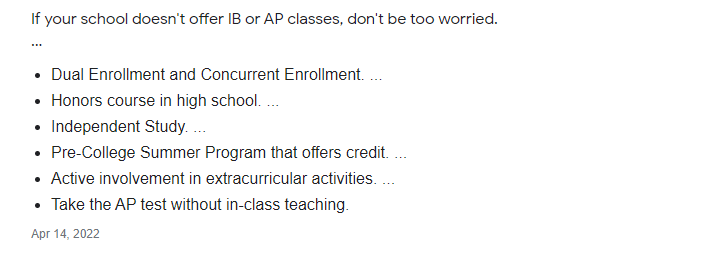
What are the alternatives to AP? Google to the rescue (?) in response to that question:

And just for giggles, you can check out this link. It says the same thing as above. No one gets college credit for extracurricular activities, not even the jocks who will get a full ride because of their talent on the gridiron, court, or diamond. Same for honors courses. Same for independent study.

Dual enrollment is an option, but again, it is an all-or-nothing approach. Students take classes under the auspices of a college or university that will gain them credits for high school graduation and a two-year college Associate Degree. That’s nothing to be sneezed at, but they don’t get the opportunity to limit themselves to one or two classes if they’re not up to the time and effort demanded.

There’s no alternative to AP. So if Ron DeSantis, in a typical pique because someone challenged him, forbids high schools from participating in the Advanced Placement program, he deprives them of this option with nothing to replace it.

Unless he orders Florida’s universities to remake their freshman survey courses into something high school students can do and to require them to grant credit. One never knows what Little Napoleon will do next.

But that would limit Florida students who gain those credits to Florida universities. They would find themselves at a severe competitive disadvantage if they want to go out of state to colleges like Harvard or Yale, you know–the ones DeSantis attended.

In the days ahead, we can count on Top Gov and his minions to employ sleight of hand to keep us diverted from this reality.

The Best Man

If things keep going the way they are going, LOL, the expression ‘Banned in Boston’ will be replaced by ‘Banned in the Bold New City of the South’, a/k/a Jacksonville, Florida.

While it’s debatable whether the picture books about Roberto Clemente and Hank Aaron were disallowed in DCPS libraries or under review (GOT seems to remember that they were disallowed until they weren’t,) what isn’t debatable is that this book is definitely banned.

What’s a Grumpy Old Teacher to do? Why, buy the book and read it for himself.

First, understand that the objection was the positive portrayal of gay marriage. The person doing the review believed that other marriages were disparaged in the book. More than that, the reviewer concluded that the book portrays sexual excitement and thus would damage students. Oh, and by the way, the reviewer found that the book contained scenes of bullying and that the scenes were ignored by school administration.

Let’s dispense with that sexual excitement claim. If the reviewer is getting off by reading this book, um, that’s a private matter between her and her therapist. Nobody else finds anything titillating in the book or appealing to a ‘prurient interest’ as defined in the classic SCOTUS case, Miller vs. California.

It was Justice Potter Stewart who gave us the best (pun intended) take on pornography:I shall not today attempt further to define the kinds of material I understand to be embraced within that shorthand description; and perhaps I could never succeed in intelligibly doing so. But I know it when I see it, and the motion picture involved in this case is not that.”

If you will allow GOT to apply that to the book in question: I know it when I don’t see it. This book ain’t it.

The book itself is book-ended by two weddings in each of which the protagonist participated. The book is written in first person and presents itself as a memoir from a boy recounting his years from kindergarten to early middle school.

The train wreck of the opening wedding does not disparage heterosexual marriage or as Christian Nationalists would sniff, “Between a man and a woman as defined by the body parts they were born with.” It was a brilliantly written episode in which a 5-year old resisted that which he was told he must do: be the ring bearer in a wedding that meant nothing to him and wear a too-tight outfit that brought on disaster.

This first chapter in the book brings together the protagonist and his best bud, who will accompany him along his journey through childhood and school. BTW, it’s really funny as well. If GOT as an adult can appreciate the humor, imagine how funny the book will be to children.

The text is brilliantly well-written. In the early chapters, the sentences are short and limited to basic vocabulary. As we move through the protagonist’s years, the sentences and words expand to match the growing development of the protagonist. While it is clear that the book’s major theme is the acceptance of gay men and gay marriage, it is slowly revealed through foreshadowing in the early chapters and the protagonist’s slower grasp of things everyone else already knows including his best bud.

The book contains scenes of everyday school life, the good and the bad. Some of that bad is bullying. In particular, there are two types. One is the ill-treatment of a student (5th grader) deemed gay. But the reaction of the adults is anything but negligent. In this, the reviewer errs, but perhaps because of her own prejudices, she skips over it.

The second is the middle school cafeteria, where the 7th graders do not allow the 6th graders to eat unless they pay protection money. The 6th graders are saved by a new student who comes with a bodyguard. It is a stretch to say that this plot twist makes the book unacceptable. It only means that the book falls within the prevailing ethos of this age literature in that the adults are incompetent but the kids save themselves.

Particularly hilarious are the off-hand comments about standardized testing when the kids use the ‘special pencils’ from the locked storeroom to bubble in the answer sheets. Bits like these make it clear that the author knew his subject and the kid-worldview of school well. One would almost be tempted to say the protagonist was the B.E.S.T. man, but that Florida joke would fall flat in the rest of the country.

This is a good book. Children will find it an enjoyable read. The only protest comes from those uncomfortable with a positive portrayal of two men in love who make a commitment of marriage and the matter-of-fact way others accept it. People like the protagonist’s parents, who think the matter of concern is that the gay uncle stop sabotaging relationships and have someone who will make him happy.

If you call that pornography, the rest of us can see why you would object to this book in school libraries. If you fight the culture wars, the rest of us can see why you would misinterpret this as propaganda in your self-declared war. But really, the book is nothing more than a fictional memoir of a boy growing up in today’s world who admires his uncle much as my nephew admired me when he grew up.

In closing, the book also depicts happy, loving marriages between cis-gendered, heterosexual couples, the protagonist’s grandparents and his parents. GOT can’t imagine how the reviewer overlooked that.

The CLT Exam

As we closed out one of the weirder weeks in Florida public education, where the governor did some backpedaling over the censorship his 2022 laws imposed upon public school libraries and classrooms, doubled down on his feud with the College Board, and readied legislation to take control of the nonprofit association that regulates high school sports, we got this, a report that education officials had spent the week hashing out their alternative to the SAT (Scholastic Aptitude Test or Scholastic Assessment Test, depending upon the era in which you encountered it.)

So THAT’S why the Florida Department of Education didn’t release December testing results to parents and schools until Friday even though they had sent the results to school districts last week.

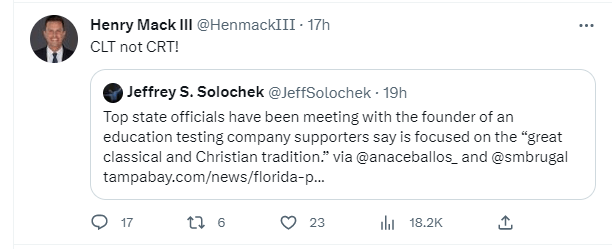
They were busy examining the CLT and creating witty tweets like these:

Senior Chancellor of Florida’s Department of Education https://www.fldoe.org/about-us/leadership-team.stml

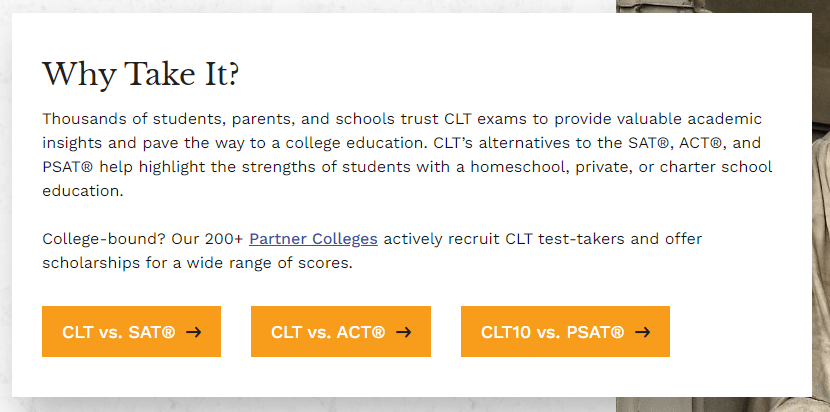
The CLT began as a pitch to parents that it would help their home school, private school, or charter school children highlight their strengths better than the established SAT, ACT, and PSAT.

Here’s their comparison of their test vs. the SAT:

There doesn’t seem to be much difference except perhaps the additional fees for score reports that College Board charges after the first four reports/score sends that the College Board includes in the exam cost.

Looking at the sample exam available on their website, it doesn’t appear to be different from the SAT except in its choice of excerpts in the reading test (Anna Bronte’s 1847 Anna Grey, Naureen Ghani’s 2017 blog post about octopi, John Paul II’s 1984 essay on Christian suffering, and Aristotle’s treatise on government vs. the College Board’s offerings, which can be seen through practice exams it makes available on its website, that might include excerpts from other places.)

It’s the same for the writing test. There is no difference in the math tests.

One difference is that someone working through a practice SAT can score their work at the end to see how they might do on an actual exam, but the CLT sample test does not offer an answer key for self-scoring.

Why would this be more advantageous for home-schooled, private (Christian) schooled or charter-schooled (as in Classical Academies pushed by Hillsdale College)? Could it be that the CLT chooses texts that those students would be more familiar with as they are not exposed to other writings from cultures other than Western ones, including the Greco-Roman writings that formed the foundation of European thought?

But the CLT puts students at a great disadvantage. For one thing, if Governor DeSantis ditches all College Board products, Florida’s 11th-grade students will no longer take the PSAT/NMSQT that is used to award scholarships to the highest-scoring students. For another thing, few colleges accept this alternative and among those that do, none are Florida public universities although that is subject to change if the Governor decides to force Florida’s university system to accept CLT scores and perhaps no others.

No major or minor university or college accepts the CLT except for these, mostly private and/or Christian schools. Find the list here.

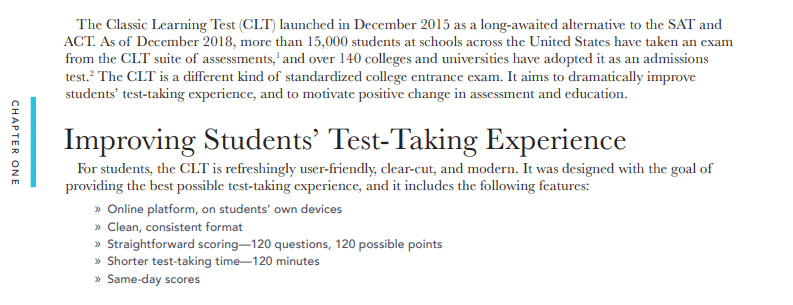
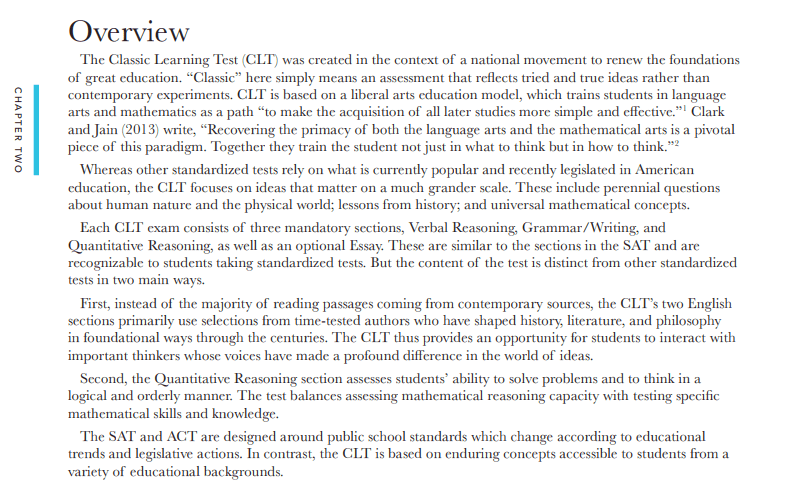
But the CLT comes with its own technical report as proof of its worthiness as an SAT or ACT alternative. It begins thusly:

That’s a marketing pitch, not a report on validity and reliability.

That’s a dated claim. The SAT is moving online next year with less time needed for the test and much faster reporting of scores.

Not defending the College Board, but providing evidence for SAT changes.

The technical report continues:

From the disguised shot at the Common Core standards, now anathema to all but its most dedicated proponents (yes, you’re thinking of David Coleman, CEO of the College Board,) to the dismissal of contemporary sources, this paragraph reads like something J.K. Rowling would put into the mouth of her character Dolores Umbridge.

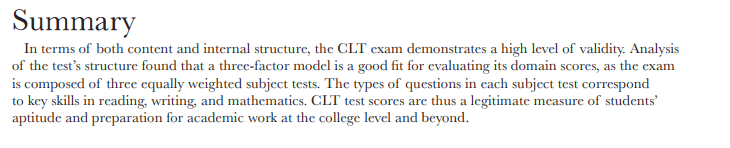
There’s a lot more in the report, graphs, explanations for those unused to test lingo from testing experts known as psychometricians, and yes, we could have a lot of fun with that word, but they are serious people who try to make sure that standardized tests are good ones. The entire purpose is to get here:

And that is more than enough for Ron DeSantis to hang his hat on.

AP Forest for the Trees

The tree is interesting, stately and grand, but what about the forest?

Last month, the Department of Education in the Not-So-Free State of Florida sent a letter to the College Board, purveyors of the Advanced Placement program, to inform them that it was rejecting the course African-American Studies and would not allow it to be taught in Florida. Grumpy Old Teacher (GOT) first wrote about it here and then followed up with a second piece here.

In the back-and-forth since then, the latest shot coming Saturday night from the College Board (think about that–the College Board, purveyor of AP courses and exams, must regard this as a crisis if they have discussed this on the weekend and issued a statement at 8 PM Saturday night), there has been much focus on who said what to whom and when.

What did the College Board know and when did they know it? It was reported that the College Board lied about its interactions with Florida officials. but the letter last night disputes that fact.

What was removed and why was it done? People are comparing the pilot framework with the official framework and speculating on the changes. This goes on and on. What logs were removed from the forest and why?

In an anti-Oprah moment, Florida tells its Black students that you don’t get to study reparations, you don’t get to study Black Lives Matter, you don’t get to study …

GOT, as the AP Coordinator for his high school, was able to sit in on a video conference that the College Board staged last Tuesday for its AP Community. (Their words, not mine.)

The presenters were at pains to make two points: (1) A course framework is not a curriculum. It merely lays out the topics teachers need to cover to prepare their students for the AP exam. Teachers create their own curriculum and have access, through AP Classroom, an online school if you will for authorized AP teachers, to create assignments for students by selecting from the numerous resources available.

(2) Nothing has been removed from the course. The suggested resources in the AP pilot framework are in the process of being put into the AP Classroom. The College Board needs permissions to do that and, as the permissions are granted from the persons who hold copyright over the source, the resources are added.

Further, those controversial topics are areas for students to explore. Rather than mandate them, AP has placed them as possible areas for research as it added a mandatory research project to the exam.

In response, Florida demanded access to AP Classroom (normally restricted to approved AP teachers) to see what resources the College Board is providing.

Florida claimed credit for making AP change the course, AP clapped back, and …

People, you’re reading about the trees. Let’s step back and look at the forest.

It’s as basic as this. Top Gov, a/k/a Ron DeSantis, says he has no problem with African-American HISTORY as long as it’s confined to a dry recitation of the facts.

But he has a huge problem with African-American STUDIES, which will affirm the value of Black people in our society, which will examine contemporary issues that affect them today and consider the multiple viewpoints that Black people have about those issues …

Hell, no <ahem> this time, Ron DeSantis has a huge problem with Black people, period. He’s not going to read this post, but GOT will tweak him anyway by ending with the anthem–

Whiplash, Part Two

We’re getting a deepening understanding about the events taking place regarding the Youth Risky Behavior Survey (YRBS) that culminated in the abrupt cancelation of plans to administer the survey in the next four weeks in Duval County. It is the abrupt reaction of the school district and the hastiness of its decisions that throw off long-set plans and NGO partnerships that is causing the whiplash.

One can only speculate about what might have happened behind the scenes from Tuesday’s School Board meeting in which our favorite ‘my way or the highway, no wait, forget the highway, my way, period’ group of malcontents complained about the survey and the questions that were asked to Friday’s receipt of a letter from Manny Diaz, Jr., the current Commissioner of Education.

Do people still overnight letters? Was this sent by certified mail? It would have been hilarious if this arrived by snail mail and the district pretended they never received it.

The letter is a classic example of bureaucratic dictatorship in which, without ever saying it directly, the bureaucrat makes clear the decision that will be made and leaves the impression that there will be consequences if the desired decision is not forthcoming. It also contains opinions stated as facts, another rhetorical flourish of someone who will brook no discussion of the issue. (Paragraph 1: “such an inflammatory and sexualized survey …” Grumpy Old Teacher (GOT) wonders if the Commissioner has even seen the questions.)

But the letter overreaches and betrays the Commissioner as an ignorant man when it comes to education, child/adolescent development, youth culture, and youth behavior when he asserts that if a child even sees the questions, that will induce them to engage in behaviors they would not otherwise have imagined.

That won’t stop him, though, from lecturing Dr. Greene, who has earned post-secondary degrees in K-12 Curriculum and Instruction (Ph.D) and Educational Leadership (MS). Clearly, the man who carried the water for his charter school employer in the Florida Senate knows more than she does about what is helpful, educational, and developmentally-appropriate for youth. (“The primary focus of your district should be …” and “you should refocus your efforts on teaching and learning …”, also “my first priority has and will always be …”)

On top of that, the district received this letter from the Florida Department of Health (FLDOH):

A 30-day notice of cancelation effective immediately..

It is the FLDOH that gathers the surveys, analyzes the responses, and reports on the results. Without notice, it informed the Superintendent that it refuses to honor its contract even though a 30-day notice of cancelation is required by contract. The Superintendent was put into an untenable situation and was forced to abort the plans for the 2023 survey for which the school district was under contract with the Center for Disease Control to administer.

What a mess! Dr. Greene made this statement (reported in the story from News4Jax, a local TV station):

“Since 2009, the YRBS has been used to provide the district and health partners with extensive data about the experiences of our students and the services they need,” said Dr. Diana Greene, superintendent. “We know we are serving multiple students as young as middle school who are already moms and dads. Even though this survey is going away, we will do our best to remain attentive to the experiences and behaviors of our students and continue to work with other community partners to address their needs.”

How Duval County Public Schools will do that in the future is uncertain. We will have to await further whiplash … er, developments as this controverse du jour continues.

The original post, Whiplash, may be found here.