Since the book-banning began in earnest, Grumpy Old Teacher (GOT) has been buying some of the targeted titles on his limited budget and reading them to see if the text supports the objections of those who would see them burned a la Fahrenheit 451. Warning: what you are about to read are GOT’s thoughts and they are not likely to please anybody on any side of this controversy.
There is a theme to the book-banning going on in Florida, actually two themes, the books either involve Black history or the LGBTQ experience. Recently, GOT saw a video clip on social media in which Florida’s Top Gov singled out Gender Queer as being particularly problematical.
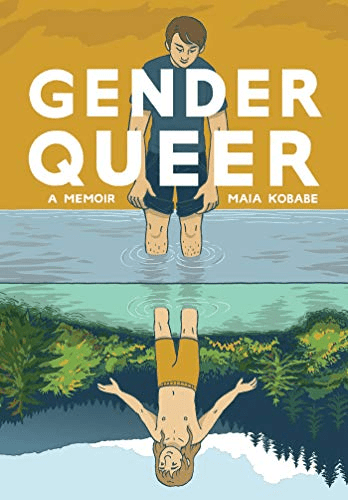
That piqued GOT’s curiosity to find out what exactly is in the book.
The first thing to notice is that it is a memoir. The author, Maia Kobabe, is first and foremost going to tell us about her life from childhood into adulthood and her struggles with locating who E is (Sorry, Top Gov, if that upsets you, but I read the book and I know the pronouns E wants us to use.)
This book is not a manifesto. That is one of its strengths.
It’s someone telling a story about eir life, a life from toddlerhood through postgraduate years where the author can’t figure out where E fits in.
Not everyone needs to read this book, but there are those who do. Those who, like the author, struggle to understand themselves and why they don’t fit easily into traditional categories of gender and sex. That’s why people like Kobabe share their stories–to help someone else going through the same struggle.
In eir story, Kobabe recalls how the library was a refuge during the difficult years of adolescence and growing up. How E found the books that helped, how E spent hours and days and months in libraries reading about others who also didn’t quite fit into traditional gender roles.
Books are important.
That brings up the second book, All Boys Aren’t Blue, another memoir that is being banned in Florida’s schools. GOT read this one, too.

This one’s a bit different, but of the same vein. The author recounts how he knew he was different from a young age, but he didn’t spend a lot of time worrying about how he was different and where he fit. His gender identity was firmly male and he found himself with a same-sex orientation.
Like Kobabe, his family realized who he was and accepted it. He wasn’t the first and they took it in stride. Even on a family trip, when all the other children were getting stylish sneakers, but Matthew (that’s the author, you’ve got to read the book) insisted upon cowboy boots, his grandmother took everyone to a Western store so he could get his boots.
So what’s going on here?
Book banners delight in pushing buttons. Those who show compassion, tolerance, and empathy toward those who don’t fit traditional gender roles, those who simply listen to children talk about their developmental path toward discovering who they are, those who show basic respect for the human dignity of children by calling them they want are called groomers and indoctrinators, not for the purpose of bringing attention to caring adults, but to obscure the true picture by provoking an emotional response from the public at large.
Thus it is that they are calling these books pornography. Any book they don’t like that involves a theme of LGBTQ is pornography even though they don’t fit the definition, which basically is a work in pictures or writing intended to cause sexual excitement.
Both books are stories recounted by their authors of their awkward, difficult journey toward adulthood, including coming to an understanding of their sexuality. As they tell their life histories from the vantage point of young adulthood, they touch upon some sensitive subjects that are an essential part of their story.
Each has a chapter or two that discusses a sexual experience. This alone does not make either book pornographic. Neither does it mean that the books should be freely available in a school. GOT in particular would not ban these books from a school library, but on on the other hand, he would admit that those who have reservations have a legitimate point of view.
This is why I said at the beginning that this piece would not make anyone happy. I truly believe that those who object to some parts of some books have a valid opinion.
It’s not that I agree with it; it’s that I can recognize that others have a different viewpoint and that there is room for legitimate disagreement that we need to work through. That happens not by name-calling on social media or screaming at school board meetings. It takes place through the quiet discussions that we have in our lives, whether in our churches or civic organizations or shopping or visits to the park.
To return to the books, both authors have an intended audience. They write for others who did not have or could not find a book like this to help them through their difficult years of finding and accepting their identity. They did not write for a general audience.
So–don’t ban these books. Stop the assault on any book that dares to mention or include characters who are other than cisgendered and heterosexual. Let these books find their audience for whom they are intended.
Each may be vital to some youth, some struggling adolescent, for whom the book will make all the difference in the world.
In GOT’s experience, they will find the book and the book will find them. All others won’t even notice. Sometimes, we adults make more of things than we ought. The kids are okay; it’s our issues that cause the problems.
Should these books sit on a school library shelf for anyone to find and peruse? Perhaps not. Maybe what we need are wise librarians, media specialists, who know their clientele and can make appropriate recommendations either toward or away from a particular book.
Oh wait, we decided years ago that schools didn’t need responsible, mature adults with professional expertise and experience to help children find books to read.
Oops!
 Grumpy Old Teacher